
What Is the TSCA Inventory?
Summary
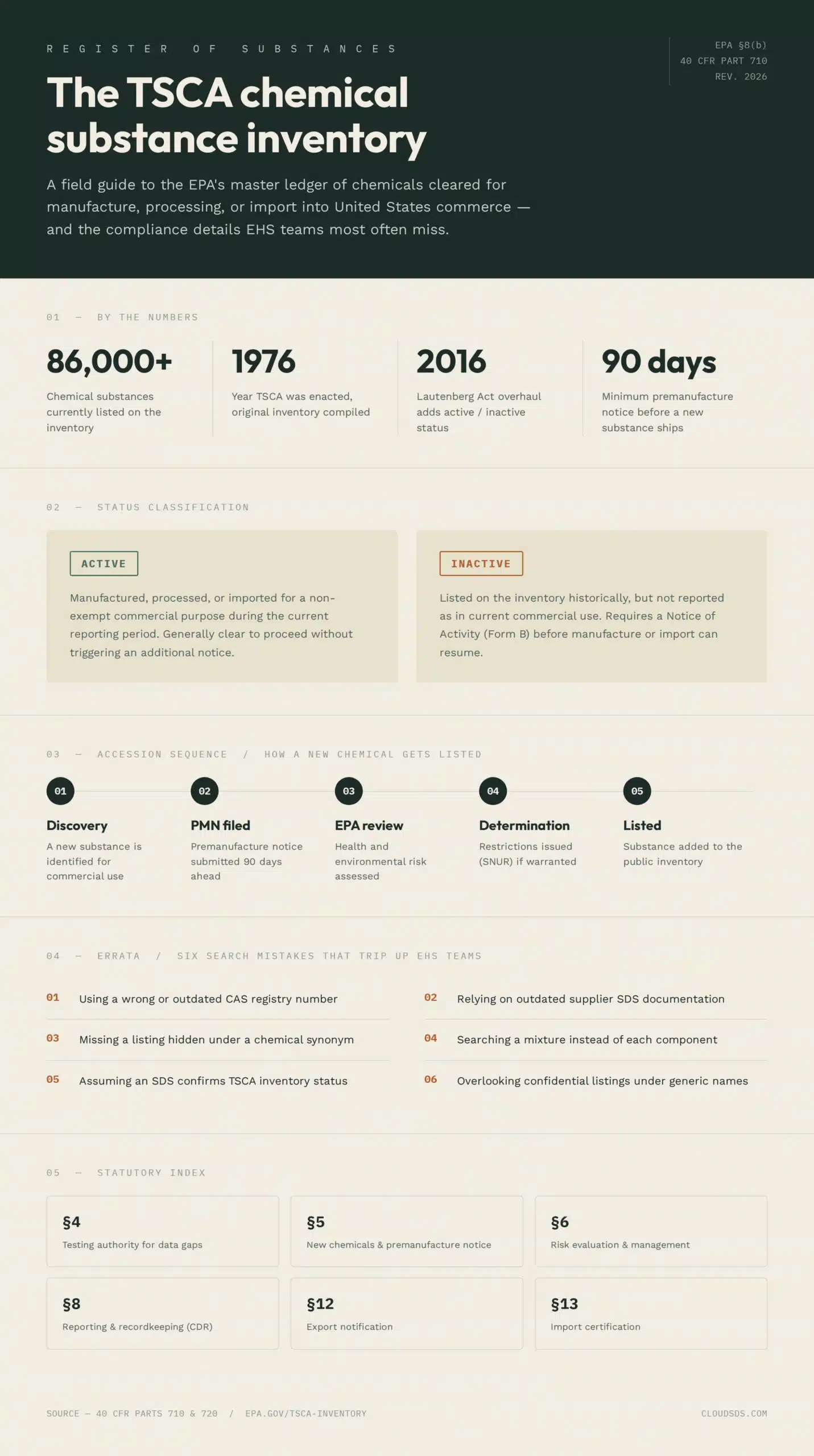
The TSCA Inventory is the EPA’s master list of chemical substances cleared for manufacture, processing, or import into U.S. commerce, currently more than 86,000 substances strong. This guide breaks down what the inventory actually covers, the difference between “active” and “inactive” listings, how new chemicals get added, and the compliance mistakes that most often trip up EHS and supply chain teams. Whether you’re importing a raw material for the first time or auditing your chemical inventory for the tenth time, this article is the practical reference to keep close.
Key takeaways
- Not a safety list: the TSCA Inventory lists substances cleared for non-exempt commercial manufacture, processing, or import in the U.S.; it does not certify that a chemical is safe.
- Active vs. Inactive matters: only substances marked Active can generally be manufactured or imported without triggering additional notice requirements.
- Absence isn’t automatic prohibition: a chemical missing from the inventory usually means a Premanufacture Notice (PMN) or an applicable exemption is required, not that the substance is banned outright.
- An SDS is not a TSCA check: confirming a chemical’s hazard classification on a Safety Data Sheet is a separate compliance task from confirming its TSCA Inventory status. EHS teams often conflate the two.
- Software reduces audit risk: centralizing chemical data, automating supplier verification, and flagging regulatory changes materially outperforms spreadsheet-based tracking.
Why was the TSCA inventory created?
Before 1976, the U.S. had no comprehensive federal system for tracking which chemical substances were already in commercial use or for screening new ones before they entered the marketplace. The EPA had limited visibility into what was being manufactured, imported, and processed across industries, which made it difficult to manage chemical risk, protect public health, or safeguard the environment in any systematic way.
TSCA was designed to close that gap, creating oversight without freezing innovation. The law aimed to balance two goals that are often in tension:
- Giving industry room to develop and commercialize new chemistry
- Giving regulators the tools to catch substances that pose an unreasonable risk before they become widespread
- Protecting public health and the environment through systematic chemical risk management
Key milestones in TSCA history:
- 1976: TSCA enacted; the original inventory is compiled from substances already in commerce at the time.
- 1986: Refinements to reporting and recordkeeping requirements as the chemical industry expands.
- 2016: The Frank R. Lautenberg Chemical Safety for the 21st Century Act overhauls TSCA, introducing mandatory risk evaluations and the active/inactive status system.
- Post 2016: The EPA continues to update the Inventory as new PMNs clear review and as Section 8 reporting reshapes which substances are marked active.
TSCA vs. OSHA vs. GHS vs. REACH: What’s the difference?
EHS teams juggle multiple, overlapping chemical frameworks, and it’s easy to conflate them. Here’s how the four most common ones differ and where they intersect.
| Framework | Governing Body | Primary Focus | Key Questions It Answers |
|---|---|---|---|
| TSCA | U.S. EPA | Chemical entry into U.S. commerce | Can this substance legally be manufactured or imported? |
| OSHA HazCom | U.S. OSHA | Workplace hazard communication | Do workers know what they're handling and how to stay safe? |
| GHS | United Nations | Global classification & labeling system | How should hazards be classified and labeled consistently? |
| REACH | EU ECHA | EU chemical registration & authorization | Can this substance be manufactured or sold in the EU? |
What is included in the TSCA inventory?
The inventory covers a broad range of chemical substance types, including:
- Chemical substances generally, whether organic or inorganic compounds
- Polymers
- UVCBs, substances of unknown or variable composition, complex reaction products, or biological materials
- Naturally occurring substances, when they meet the applicable criteria
- Certain microorganisms, in specific regulated cases
What is not included in the TSCA inventory?
Just as important as knowing what’s on the Inventory is knowing what’s categorically excluded. TSCA explicitly carves out several categories, most of which are regulated under other federal statutes:
-
Articles:
Manufactured items with a specific shape or design that don’t release the chemical substance during normal use are generally excluded.
-
Finished products:
End-use products themselves are not separately listed, even though their component chemicals may be.
-
Mixtures:
The mixture as a whole isn’t listed, though its individual chemical components may be.
-
Foods:
These are regulated under the Federal Food, Drug, and Cosmetic Act, not TSCA.
-
Drugs:
These are regulated by the FDA.
-
Cosmetics:
Certain cosmetic ingredients are excluded, subject to FDA oversight.
-
Pesticides:
The pesticides are regulated separately under FIFRA.
-
Nuclear materials:
Regulated by the Nuclear Regulatory Commission and Atomic Energy Act.
How many chemicals are on the TSCA inventory?
The TSCA Inventory currently contains more than 86,000 chemical substances, though that number is a moving target; it shifts as new substances clear PMN review and as existing substances are reclassified through Section 8 reporting cycles.
It's important to distinguish between three related but different concepts:
-
Listed:
The substance appears on the Inventory in some form, active or inactive.
-
Active:
The substance was manufactured, processed, or imported for a non-exempt commercial purpose during the relevant reporting look-back period.
-
Inactive:
The substance is listed historically but wasn't reported as being in current commercial use during that period.
The inventory's total size grows as new chemistry clears review, but the active/inactive split changes more frequently as companies file the notices of activity that keep the designation current.
Active vs. inactive TSCA chemicals: what’s the difference?
1. What does “active” and “inactive” mean?
An active chemical manufactured, imported, or processed in the United States for non-exempt commercial uses during the reporting period recognized by the EPA. An inactive chemical product is present on the TSCA inventory. However, this product is not being used at present commercially.
2. Is it possible to produce or import a chemical that is inactive?
Not immediately. A company must file a Notice of Activity (NOA) Form B to the EPA before it can manufacture or import an inactive chemical for a non-exempt commercial purpose to revive a substance. Failure to do so may result in TSCA breaches.
3. What is the significance of the active or inactive status?
TSCA status is a key consideration in regulatory compliance, product planning, and supply chain operations for a chemical. The knowledge of the active or inactive status of a chemical can be very beneficial for companies. It helps them avoid delays and enforcement proceedings. Organizations can also ignore unexpected compliance concerns by knowing if a chemical is active or inactive before they source or manufacture it.
TSCA chemical status explained: new, existing and confidential substances
Beyond active and inactive, the inventory distinguishes chemicals along a few other dimensions worth knowing:
1. Existing vs. new chemicals:
Existing chemicals were already in commerce when the relevant inventory snapshot was taken; new chemicals must clear PMN review before entering commerce for the first time.
2. Confidential vs. public listings:
Some substances are listed under a generic name to protect confidential business information (CBI), rather than under their specific chemical identity.
3. Generic names:
Used as a placeholder identity for substances with an approved CBI claim, preserving competitive information while still satisfying public disclosure requirements.
4. Accession numbers:
Unique identifiers assigned to confidential substances, used in place of a CAS number for tracking and search purposes.
How are new chemicals added to the TSCA inventory?
| Stage | What Happens |
|---|---|
| 1. Discovery | A company identifies a new chemical substance it intends to manufacture or import for a non-exempt commercial purpose. |
| 2. PMN Submission | The company files a Premanufacture Notice (PMN) with the EPA at least 90 days before manufacture or import begins. |
| 3. EPA Review | EPA reviews the PMN for potential health and environmental risks and may request additional data. |
| 4. Risk Evaluation | EPA evaluates exposure and hazard information to determine whether the substance presents an unreasonable risk. |
| 5. Restrictions (If Applicable) | EPA may issue a Significant New Use Rule (SNUR) or other restrictions before allowing commercial use. |
| 6. Listed on Inventory | Once cleared, the substance is added to the TSCA Inventory and becomes available for broader commercial use. |
The entire process, from PMN submission to Inventory listing, commonly takes several months, and EPA has statutory authority to extend its review period if it needs additional data, which is why companies introducing genuinely new chemistry need to build TSCA review time into their product timelines, not treat it as a rubber stamp.
What happens if a chemical isn't on the TSCA inventory?
If a substance isn't listed or is listed but inactive, a company generally cannot simply manufacture or import it commercially without addressing that status first. The practical consequences typically include:
- Inability to manufacture the substance for commercial purposes until status is resolved
- Inability to import the substance commercially without triggering a compliance action
- A PMN may be required before the substance can be introduced (for genuinely new chemistry)
- A Notice of Activity may be required to reactivate an inactive substance
- Possible exemptions may apply, narrowing or eliminating the notice requirement
- Civil penalties for manufacturing or importing without resolving status
How to search for the TSCA inventory?
1. EPA TSCA inventory
Click on the EPA’s TSCA Chemical Substance Inventory search page. Always check the current version of the inventory for the most accurate information. The search tool is open to the public, and registration is not required.
2. Search by chemical identifier
Type the chemical name, CAS Registry Number (CAS RN), or any other identifier you have into the search box. Generally, the CAS RN gives the most accurate result. So, before searching to avoid false hits, make sure to verify the identifier.
3. Check your search results
To begin, first open the inventory record. It helps you to check the information about the chemical product. The purpose is to decide if the chemical is listed as active or inactive on the TSCA inventory. Also check any relevant notes or regulatory flags linked with the substance.
4. Review regulatory requirements
It’s also necessary to determine whether the substance is subject to any TSCA limits or reporting requirements. If the chemical is classified as inactive,
5. Log and monitor the information
Your team should also need to store compliance records. So, document the inventory status and related regulatory information for your compliance records. Recheck the TSCA Inventory periodically, as chemical status and regulatory requirements can change over time. Keeping records updated ensures continual regulatory compliance and audit readiness.
CAS numbers and TSCA: why accurate chemical ID matters
The CAS Registry Number, assigned by the Chemical Abstracts Service, is the closest thing the chemical industry has to a universal identifier. Because a single chemical substance can carry multiple trade names, common names, and regional naming conventions, relying on chemical names alone to verify TSCA status is risky; two suppliers can use different names for the same CAS number or, worse, the same name for chemically distinct substances.
Confidential listings add another layer of complexity: a substance protected by a CBI claim won’t show up under its specific CAS number in public search results at all, appearing instead under a generic name and accession number. This is one more reason relying purely on name-based searches leaves gaps in verification.
What are the common TSCA inventory search mistakes organizations must avoid?
1. Using the wrong CAS registry number
A transposed digit or old CAS Registry Number can result in incorrect or no search results. This could result in your team determining that a drug is not in the TSCA inventory when it actually is. Always verify the CAS number using reliable sources before searching.
2. Dependence on legacy supplier data
Supplier documentation may not always reflect the most updated EPA revisions or changes to a chemical’s TSCA status. Relying on old SDSs or product specifications alone can create compliance gaps. Check chemicals against the most current TSCA inventory, as kept by EPA, at all times.
3. Getting tripped up by chemical synonyms
Many compounds have different names, trade names, or common synonyms. If you search by a single name, the inventory listing may not be the right one if it is listed under another identification. Try to search using the CAS Registry Number for best results if possible.
4. Confusing mixtures with pure substances
The TSCA inventory is a catalog of discrete chemical compounds, not finished products or mixes. If you search for a commercial mixture, rather than the individual ingredients, you will typically find no relevant results. Check the content of the product. Search each reportable substance individually.
5. Assuming an SDS is TSCA compliant
An SDS gives information on the hazards of a chemical, how to handle it safely, and emergency procedures. It does not confirm the active or inactive status of the drug on the TSCA inventory and whether any other TSCA regulations apply. Always do a separate TSCA inventory search to confirm compliance.
6. Omitting confidential inventory listings
Some compounds are listed in the confidential component of the TSCA inventory and may be listed with generic chemical names. This can make it hard to find a perfect match with a regular search. If confidentiality is an issue, consult with your supplier or regulatory specialists to determine the TSCA status of the substance.
TSCA export requirements: section 12(b) notification explained
Exporting can trigger its own notice of obligations under TSCA Section 12(b). If a company exports a chemical substance that is subject to certain EPA actions, such as a rule, order, or ongoing risk evaluation, it generally must notify the EPA before the export occurs.
Notification applies even to substances that are freely manufactured domestically, since the trigger is the substance’s regulatory status, not whether it’s restricted for U.S. use
Exporters should maintain documentation showing which substances required notification
Records should confirm that the required notice was actually filed with the EPA
Exporters carry an ongoing obligation to monitor for new Section 12(b)-triggering actions, since the list of regulated chemicals changes over time
Understanding major TSCA sections: 4, 5, 6, 8, 12 & 13
1. Section 4: testing
Gives EPA authority to require testing of chemical substances to fill data gaps on potential health and environmental effects.
2. Section 5: new chemicals (PMN)
Establishes the Premanufacture Notice process that new chemical substances must clear before entering commerce.
3. Section 6: risk evaluation and risk management
Authorizes EPA to evaluate existing chemicals for unreasonable risk and to impose risk management requirements, up to and including restrictions or bans, where warranted.
4. Section 8: reporting and recordkeeping
Requires companies to report chemical manufacturing and processing data, including through the Chemical Data Reporting (CDR) rule and, more recently, mandatory PFAS reporting.
5. Section 12: exports
Governs export notification requirements for substances subject to specific EPA actions.
6. Section 13: imports
Establishes import certification requirements enforced jointly by EPA and U.S. Customs and Border Protection.
Common TSCA exemptions: LVE, LoREX, TME, and more
-
Low Volume Exemption (LVE):
Available for substances manufactured or imported below defined annual volume thresholds.
-
Low Release and Low Exposure (LoREX):
for substances where manufacturing, processing, and use result in minimal release or exposure.
-
Test Marketing Exemption (TME):
Allows limited-scale marketing of a new substance before full PMN review, under EPA-approved conditions.
-
Research and development:
Covers substances used strictly for R&D purposes under supervised, non-commercial conditions.
-
Polymer exemption:
Certain polymers meeting specific molecular weight and reactivity criteria qualify for streamlined treatment.
-
Naturally occurring substances:
Certain unprocessed natural substances fall outside standard PMN requirements.
-
Impurities and byproducts:
Substances that result incidentally from a reaction, rather than being the intended product, may be exempt.
TSCA penalties for non-compliance: what's at stake
The implications of non-compliance with TSCA are far more than just a fine. Depending on the nature and severity of the breach, companies face the following:
- EPA civil penalties
- Import delays when status concerns are being worked out
- Refusals of shipments outright at the border
- EPA's Formal Enforcement Actions
- Damage to reputation with customers and partners
- Business interruption from stopped manufacturing or banned imports
- Legal implications based on the nature of the infringement as a whole
The best way to avoid these consequences isn't to react faster when a problem arises but to embed verification into procurement and supplier management, catching status concerns before a shipment ever leaves the port.
Conclusion
The TSCA Inventory is more than a searchable list; it’s the foundation of chemical compliance in the United States. A chemical presence on the Inventory does not automatically mean it’s unrestricted or “safe,” and its absence doesn’t always prohibit commercial activity, since exemptions may apply. What matters is that EHS teams have robust processes for verifying inventory status, managing supplier documentation, monitoring regulatory changes, and maintaining accurate records.
Combining strong internal governance with digital tools purpose-built SDS and chemical inventory management software reduces compliance risk and keeps your organization audit-ready, whatever the EPA’s next update to the inventory brings.
References:
- EPA – TSCA Chemical Substance Inventory (overview page): https://www.epa.gov/tsca-inventory
- EPA – About the TSCA Chemical Substance Inventory (history, size, active/inactive framework, Section 8(b) authority): https://www.epa.gov/tsca-inventory/about-tsca-chemical-substance-inventory
- EPA – How to Access the TSCA Inventory (search methods, CSV/Access downloads, SRS tool): https://www.epa.gov/tsca-inventory/how-access-tsca-inventory
- EPA – Filing a Pre-manufacture Notice with EPA (PMN process, 90-day requirement, e-PMN/CDX submission): https://www.epa.gov/reviewing-new-chemicals-under-toxic-substances-control-act-tsca/filing-pre-manufacture-notice-epa
- EPA – Status of Pre-Manufacture Notices reviewed under Section 5 of TSCA (review timelines, “not likely to present an unreasonable risk” determinations): https://www.epa.gov/reviewing-new-chemicals-under-toxic-substances-control-act-tsca/status-pre-manufacture-notices
- EPA – Premanufacture Notices (PMNs) and Significant New Use Notices (SNUNs) Table: https://www.epa.gov/reviewing-new-chemicals-under-toxic-substances-control-act-tsca/filing-pre-manufacture-notice-epa-and
FAQs
1. What is the TSCA inventory?
It’s the EPA’s list of chemical substances cleared for non-exempt manufacture, processing, or import into U.S. commerce under the Toxic Substances Control Act. It helps organizations determine whether a chemical is already recognized under TSCA or may require additional regulatory review.
2. Who must comply with TSCA?
Any company that manufactures, processes, or imports chemical substances for commercial purposes in the U.S. generally falls under TSCA’s requirements. This includes domestic manufacturers, importers, and certain processors handling regulated chemical substances.
3. Is every chemical on the TSCA Inventory approved as safe?
No. Inventory listing reflects commercial status, not a safety determination; some listed substances are still subject to restrictions or ongoing risk evaluation. Companies should always review any applicable EPA requirements before manufacturing, importing, or using a listed substance.
4. What does active mean?
The substance was reported as manufactured, processed, or imported for a non-exempt commercial purpose during the relevant reporting period. Active status indicates that the chemical is currently in commercial circulation under TSCA reporting requirements.
5. What does inactive mean?
The substance is listed but wasn’t reported as being in current commercial use; it generally needs a notice of activity before it can be reactivated. Manufacturers and importers should verify the status before beginning commercial activities involving the substance.
6. How do I know if a chemical is on the TSCA inventory?
Search the EPA’s CompTox Chemicals Dashboard using the CAS number, chemical name, or accession number. Using the correct CAS Registry Number is the most reliable way to identify the appropriate inventory listing.

Simplify Your SDS Management
CloudSDS gives your team instant access to 23M+ safety data sheets with AI-powered search, automated updates, and full OSHA/GHS compliance — all from one platform.
Leave A Comment