
Premanufacture Notice (PMN): Complete Guide
Summary
A Premanufacture Notice (PMN) is a mandatory pre-market notification required under TSCA Section 5 before manufacturing or importing most new chemical substances for commercial use in the United States. Before submitting a PMN, companies must first determine whether the substance is already listed on the TSCA Chemical Substance Inventory or qualifies for an applicable exemption, such as the Low Volume Exemption (LVE), Polymer Exemption, or Research and Development (R&D) Exemption.
A complete PMN includes information on chemical identity, manufacturing processes, intended uses, exposure scenarios, and available hazard data. EPA generally reviews complete submissions within 90 days, assessing potential risks to human health and the environment before the substance enters commerce. Once commercial manufacture or import begins, companies must submit a Notice of Commencement (NOC) within 30 days to have the substance added to the TSCA Inventory. Early planning, accurate chemical data management, and cross-functional coordination are essential for achieving timely regulatory compliance and avoiding costly delays.
Key Takeaways
1. What is a Premanufacture Notice (PMN)?
A PMN is a mandatory notification required under TSCA Section 5 before manufacturing or importing most new chemical substances in the United States.
2. When is a PMN required?
A PMN is generally required if a chemical is not listed on the TSCA Chemical Substance Inventory and no applicable exemption applies.
3. What does a PMN submission include?
A complete PMN contains chemical identity, manufacturing details, intended uses, exposure information, environmental release estimates, and available hazard data.
4. How long does EPA review a PMN?
EPA generally reviews a complete PMN within 90 days, although the review period may be extended if additional information is needed.
5. What happens after EPA completes the review?
Once manufacturing or import begins, companies must submit a Notice of Commencement (NOC) within 30 days to add the substance to the TSCA inventory.
6. What are the keys to successful PMN compliance?
Verify TSCA Inventory status early, evaluate exemptions, maintain accurate chemical data, and coordinate across regulatory affairs, EHS, R&D, manufacturing, and legal teams.
What Is a Premanufacture Notice (PMN)?
A Premanufacture Notice (PMN) is a formal pre-market notification that must be submitted to the U.S. Environmental Protection Agency (EPA) before a firm can manufacture or import a new chemical substance for commercial purposes in the United States.
The PMN requirement is authorized under TSCA Section 5. Section 5 requires any person intending to manufacture or import a novel chemical substance to inform EPA at least 90 days before initiating such activity. EPA employs the PMN review process to assess the possible risks to human health and the environment before new chemicals are introduced into commerce in the U.S.
It is crucial to note that a PMN is not a product of approval, a safety certification, or a regulatory endorsement. It is a pre-manufacture notice procedure that allows EPA to assess the information available and, if appropriate, take steps to control hazards before a chemical is introduced into the market. The EPA does not approve or certify compounds as safe through the PMN procedure.
What is considered a 'new chemical' under TSCA?
TSCA defines a 'new' chemical substance as a chemical compound that is not listed on the TSCA Chemical Substance Inventory (commonly known as the TSCA inventory). The inventory is the official list of chemical substances manufactured, imported, or in U.S. commerce.
An existing chemical is one that is already in the TSCA inventory and is normally exempt from PMN requirements.
The first and most important stage in compliance is to determine if a chemical is new or existing. This conclusion is dependent upon correct chemical identity, including molecular structure, content, and, where appropriate, CAS Registry Numbers. Some substances are on the list under confidential identities, meaning they are listed by generic names. Chemical Identity CBI The companies claiming CBI must meet certain conditions.
Chemical identity consistency is important throughout the full compliance procedure. Substantial regulatory complications could occur if the substance stated in a PMN is not the same as the substance manufactured or imported.
Do you need a PMN?
Not all new chemical substances require complete PMN submission. Several exclusions may be relevant, depending on the material, its intended use, and the levels involved. The following framework can assist in determining the proper course.
Here is a decision framework for when a PMN is required:
Step 1: Is the chemical already on the TSCA?
If the response is affirmative, often there is no need for a PMN. Just confirm the active/inactive status and any related SNURs or reporting responsibilities. If the answer is no, go to step 2.
Step 2: Is there any exemption?
Your organization must meet the requirements of all the applicable exemptions. For instance, low volume exemption, polymer exemption, and R&D exemption. All exception notices must be submitted on time. If no, proceed to step 3.
Step 3: Submit a PMN
You must submit a complete PMN to the EPA before commencing the manufacture or import of the new chemical substance.
Who must submit a PMN?
TSCA Section 5 requires that the manufacturer or importer of a new chemical substance submit the PMN. In practice, this means:
- Chemical manufacturers who produce a new substance in the United States
- Importers who bring a new chemical substance into the United States for commercial purposes
- Joint submitters, where two or more companies share responsibilities for a PMN submission
- U.S. importers acting on behalf of foreign manufacturers who do not have a U.S. presence
- Contract manufacturers, depending on the specific contractual and regulatory arrangements
What is the information required for a PMN submission?
1. Identity of the substance
- Material composition and molecular structure
- CAS registry number (if applicable)
- Claims for chemical identity, if applicable, Confidential Business Information (CBI)
- Other systematic (IUPAC) name
2. Process of manufacturing
- Description of methods of manufacture
- Estimated annual production/import volume
- Byproducts produced in the manufacturing process
3. Objectives
- Industrial applications (e.g., chemical intermediate, process additive)
- Commercial usage (e.g., formulation ingredient, specialized chemical)
- Consumer usage (when appropriate)
5. Exposure data for workers
- Estimated number of workers potentially exposed
- Exposure scenarios and duration
- PPE assumptions
6. Environmental release information
- Emissions to air from manufacture and processing
- Water discharges and effluent streams
- Estimated release by use case
If no test data exists, that fact must be disclosed.
How to conduct the PMN review process step by step?
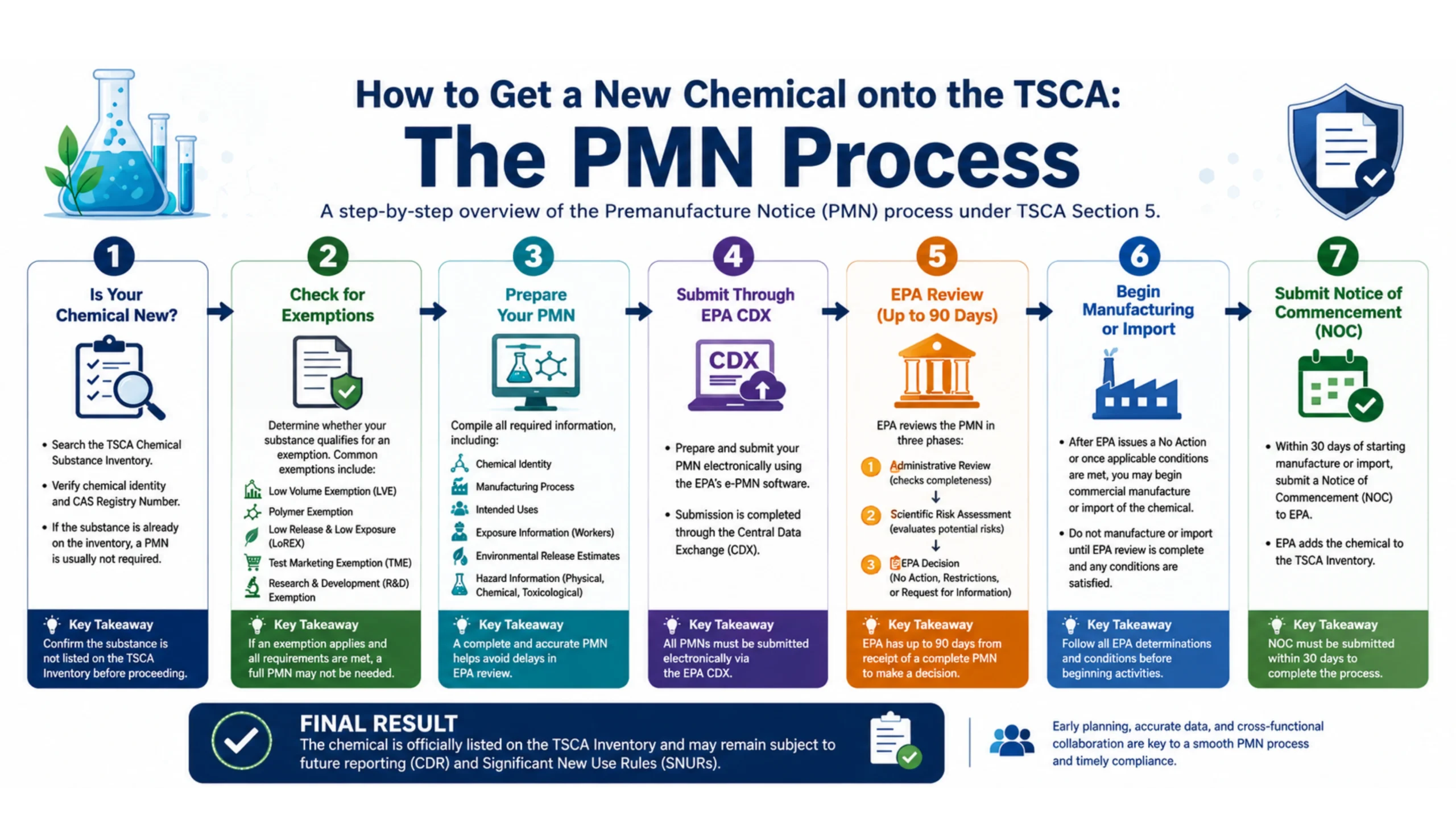
The following steps outline the complete PMN process from initial determination to TSCA listing.
Step 1: determine status
Before any other action, verify whether the substance is already listed on the TSCA inventory. This determination should be made during product development, not after production has begun. Use EPA's chemical substance database and consult qualified regulatory counsel where chemical identity questions are complex.
Step 2: PMN package preparation
Collect all the information you need in the areas above. Review test findings Exposure estimates: Details about the manufacturing process. Work with R&D, manufacturing, and EHS departments to gather the correct information. Note any charges of CBI. Before going to the trouble and expense of a full PMN file, check to see if any exemptions may be available.
Step 3: Submit electronically using EPA's Central Data Exchange (CDX)
PMNs must be submitted electronically to EPA using the e-PMN software accessible on EPA's Central Data Exchange (CDX) portal. No submission of papers will be accepted. Submitters must register with CDX and have the appropriate system of access before submitting.
Step 4: Check for completeness of administration
Upon receipt of the PMN package, EPA conducts an administrative review to determine the adequacy of the package. The agency may contact the submitter for further information or clarification. The statutory 90-day review clock generally begins when a complete submission is received.
Step 5. risk assessment
The EPA's New Chemicals Program conducts a scientific risk evaluation of the chemical using the information in the PMN and other available data. The assessment includes consideration of:
- Toxicological hazards based on test results or SAR analysis
- Human health implications
- Persistence and potential for bioaccumulation, including environmental exposure
Where specific testing is not available, the EPA may depend on computational models and data on chemicals of similar character. The agency uses the hazard and exposure information together to judge the potential for, and severity of, unreasonable risk.
Step 6: commencing manufacture or import
Unless restricted by a consent order or other regulatory action, the submitter may begin the manufacture or import of the novel chemical substance when the review period has passed and any applicable requirements have been satisfied.
Step 7: notice of commencement (NOC)
After commencing commercial manufacture or import, the submitter must file a Notice of Commencement (NOC) with EPA within 30 days. The NOC triggers the official listing of the substance on the TSCA, making it an 'existing chemical' for future regulatory purposes. Failure to file an NOC is a compliance violation.
EPA review timeline
| Phase | Duration | Main activities |
| Pre-submission preparation | 4–12+ weeks | check, data gathering, exemption analysis, internal review |
| EPA administrative review | 1–2 weeks | Completeness check: clock begins upon complete submission |
| EPA scientific risk assessment | Weeks 2–10 | Hazard, exposure, and risk evaluation |
| EPA decision / negotiation | Weeks 8–90+ | No action, consent order negotiation, or SNUR rulemaking |
| Commencement of manufacture | After review completes | Begin commercial production or import |
| Notice of commencement filing | Within 30 days of commencement | Triggers TSCA listing |
What happens after EPA completes the review?
Once the PMN review process is complete and the submitter has addressed any applicable conditions, the company may begin commercial manufacture or import. The following post-review steps are critical to maintaining compliance and ensuring the substance is properly listed on the TSCA.
1. Filing the notice of commencement (NOC)
The NOC must be submitted within 30 days of the date commercial manufacture or import begins. The NOC triggers EPA's action to list the substance on the TSCA. Submitters should verify the accuracy of all information in the NOC, particularly chemical identity information, to ensure the listing is correct.
2. TSCA listing and active status
Following receipt of the NOC, EPA lists the substance on the TSCA. The substance is listed as 'active' for the submitter that filed with the NOC. Under TSCA's notification rules, other manufacturers and importers who subsequently wish to use the substance for commercial purposes may need to review whether they are required to notify EPA of their activity status.
3. Ongoing reporting obligations
Once a substance is on the TSCA, ongoing obligations may apply, including Chemical Data Reporting (CDR) under TSCA Section 8(a) for manufacturers and importers above specified volume thresholds and compliance with any applicable consent order conditions or SNURs.
Why does PMN face delays?
EPA's ability to complete a timely PMN review depends heavily on the quality and completeness of the initial submission. The following issues frequently result in delays:
- Incomplete submissions that are missing required information across one or more required categories
- Inaccurate or poorly documented exposure estimates that EPA must question or independently develop
- Confidential business information (CBI) claims that are not adequately substantiated or that create inconsistencies in the public version of the submission
- Missing or inadequate toxicological data that forces EPA to rely entirely on computational modeling
- Inconsistent chemical identity across different sections of the submission
- Manufacturing process changes discovered after submission that require amendment
- Failure to respond promptly and completely to EPA's requests for additional information
- Failure to coordinate across R&D, manufacturing, regulatory, and legal functions during submission preparation
The best way to avoid delays is to invest in thorough pre-submission preparation, involve experienced regulatory counsel, and establish clear internal communication protocols before beginning the submission process.
What are some common business scenarios?
1. Launching a new chemical product
A specialty chemical company has synthesized a novel performance additive not listed on the TSCA. Before the product can be sold or distributed in the United States, the company must complete a PMN review. Product development timelines, commercial launch dates, and customer commitments should be structured around the PMN process, not the other way around.
2. Importing an innovative ingredient
A U.S. company plans to import a chemical ingredient manufactured by a foreign supplier. If the ingredient is not on the TSCA, the U.S. importer bears the legal responsibility for submitting a PMN before the first commercial shipment arrives. This responsibility should be identified during supplier qualification and import planning.
3. Commercializing university research
A startup is licensing a novel chemical process developed at a university. The R&D exemption may have covered activities at the university, but it does not extend to commercial manufacturing. The company must complete PMN requirements before scaling to commercial production.
4. Scaling from R&D toproduction
An internal R&D program has produced a promising new compound. As the company prepares to transition from laboratory-scale R&D to pilot or commercial production, it must evaluate whether PMN obligations are triggered. The transition from R&D to commercial scale is a critical compliance checkpoint.
5. Acquiring intellectual property
A company acquires the rights to manufacture a chemical substance developed by another party. If the substance is not on the TSCA or if the acquiring company is not the entity that originally submitted to the PMN, it must evaluate its TSCA compliance obligations before commencing manufacture or import.
What is the role of SDS and chemical data during the PMN process?
Accurate chemical data management is a foundational element of PMN compliance. Safety Data Sheets (SDS) and related technical documentation play an important supporting role throughout the process.
1. Maintain chemical identity consistency
Chemical identity information must be consistent across the PMN submission, internal documentation, SDS, and supplier communications. Discrepancies between how a substance is identified in the PMN and how it is described in an SDS or product specification can raise questions during EPA's review or a subsequent inspection.
2. Unified hazard data
Hazard communication documentation, including GHS classification and SDS information, should draw on the same underlying toxicological and physical-chemical data that supports the PMN submission. Where hazard data is limited, this limitation should be transparently reflected in both the PMN and the SDS.
3. Effective record retention
Technical documentation supporting the PMN, including test data reports, exposure assessments, and process descriptions, should be retained in a manner that is readily accessible for regulatory review. Record retention periods for TSCA compliance documentation should be clearly defined in internal procedures.
4. Supplier data coordination
Supplier collaboration is also important. If a company is importing a substance, the foreign manufacturer may hold relevant test data and safety information. Coordinating with the supplier to obtain complete and accurate information before submission preparation begins can prevent delays.
Common mistakes companies make
Understanding common compliance errors can help organizations avoid them:
- PMN does not require generating new test data in every case; available information must be disclosed, but existing data gaps do not necessarily prevent submission.
- Treating a PMN as equivalent to an EPA product approval or safety certification. EPA reviews risk; it does not certify chemicals as safe.
- Beginning manufacture or import before the PMN process is complete, which constitutes a TSCA violation regardless of the submitter's intent.
- Misidentifying TSCA status due to insufficient or inaccurate chemical identity analysis.
- Underestimating the time required for PMN preparation, submission review, and post-review compliance, leading to commercial launch delays.
- Failing to coordinate across R&D, regulatory, legal, manufacturing, and procurement functions, resulting in incomplete or internally inconsistent submissions.
- Missing the NOC filing deadline after commencing commercial manufacture or import.
- Relying on exemptions without conducting a complete analysis of eligibility requirements and limitations.
Conclusion
The Premanufacture Notice process is a cornerstone of TSCA's new chemical program and a foundational compliance obligation for any company developing, manufacturing, or importing new chemical substances for commercial use in the United States. Getting the process right requires early action, accurate chemical identity analysis, thorough data compilation, and realistic planning for EPA to review timelines.
Companies that treat the PMN process as an afterthought, rather than integrating it into product development planning from the outset, are at the greatest risk of commercial delays, enforcement actions, and supply chain disruptions. Conversely, organizations that build TSCA compliance into their product lifecycle processes, invest in cross-functional coordination between R&D, regulatory affairs, EHS, manufacturing, and legal teams, and maintain accurate chemical data and documentation are better positioned to bring new substances to market efficiently and with confidence.
If your organization is evaluating the PMN requirements for a new substance, the time to act is early in the product development process, not after production has begun.
References
- U.S. Environmental Protection Agency (EPA). New Chemicals Program under TSCA Section 5. https://www.epa.gov/reviewing-new-chemicals-under-toxic-substances-control-act-tsca
- U.S. Environmental Protection Agency (EPA). Premanufacture Notices (PMNs). https://www.epa.gov/reviewing-new-chemicals-under-toxic-substances-control-act-tsca/filing-pre-manufacture-notice-epa
- U.S. Environmental Protection Agency (EPA). TSCA Chemical Substance Inventory. https://www.epa.gov/tsca-inventory
- U.S. Environmental Protection Agency (EPA). Electronic PMN (e-PMN) Software and Central Data Exchange (CDX). https://www.epa.gov/reviewing-new-chemicals-under-toxic-substances-control-act-tsca/guidance-documents-and-sample-forms
- Electronic Code of Federal Regulations (eCFR). 40 CFR Part 720 – Premanufacture Notification. https://www.ecfr.gov/current/title-40/chapter-I/subchapter-R/part-720
- Electronic Code of Federal Regulations (eCFR). 40 CFR Part 723 – Premanufacture Notification Exemptions. https://www.ecfr.gov/current/title-40/chapter-I/subchapter-R/part-723
- United States Congress. Toxic Substances Control Act (15 U.S.C. Chapter 53). https://uscode.house.gov/view.xhtml?path=/prelim@title15/chapter53&edition=prelim
- U.S. Environmental Protection Agency (EPA). Notice of Commencement (NOC). https://www.epa.gov/reviewing-new-chemicals-under-toxic-substances-control-act-tsca
- U.S. Environmental Protection Agency (EPA). Significant New Use Rules (SNURs). https://www.epa.gov/reviewing-new-chemicals-under-toxic-substances-control-act-tsca
- U.S. Environmental Protection Agency (EPA). Chemical Data Reporting (CDR). https://www.epa.gov/chemical-data-reporting
- CAS (Chemical Abstracts Service). CAS Registry. https://www.cas.org/cas-data/cas-registry
- U.S. Environmental Protection Agency (EPA). Confidential Business Information (CBI) under TSCA. https://www.epa.gov/tsca-cbi
FAQs
1. What is a premanufacture notice (PMN)?
A PMN is a formal pre-market notification required under TSCA Section 5 before a company manufactures or imports a new chemical substance for commercial purposes in the United States. It provides EPA with information to assess potential risks before the substance enters commerce.
2. When is a PMN required?
A PMN is required when a company intends to manufacture or import a chemical substance that is not currently listed on the TSCA and no applicable exemption applies.
3. How do I know if my chemical is new under TSCA?
A chemical is 'new' if it does not appear on the TSCA Chemical Substance List. Determining status requires a careful analysis of chemical identity, including molecular structure and composition, and a search of the TSCA database. Qualified regulatory counsel should assist with complex identity determinations.
4. How long does EPA take to review a PMN?
EPA generally has 90 days to review a PMN from the date it receives a complete submission. The agency may extend this period by an additional 90 days for good cause. In practice, the process may take longer depending on complexity, information gaps, and EPA workload.
5. What happens after EPA completes its review?
After the review period, the submitter may commence manufacture or import, subject to any conditions imposed by EPA. Within 30 days of commencing commercial activity, the submitter must file a Notice of Commencement (NOC), which triggers the substance's listing on the TSCA.
6. What is a Notice of Commencement?
A Notice of Commencement (NOC) is a notification submitted to EPA within 30 days of the date a company first manufactures or imports a new chemical substance for commercial purposes following a completed PMN review. Filing the NOC is what causes the substance to be listed on the TSCA.
7. Does every new chemical require a PMN?
No. Several exemptions may apply, including the Low Volume Exemption, LoREX Exemption, Test Marketing Exemption, Polymer Exemption, and R&D Exemption. Each has specific eligibility criteria that must be carefully evaluated.
Simplify Your SDS Management
CloudSDS gives your team instant access to 23M+ safety data sheets with AI-powered search, automated updates, and full OSHA/GHS compliance — all from one platform.
Leave A Comment