

Last Updated on August 4, 2026
Boron Trichloride: Properties, Hazards, Uses, and Safety Guide
Summary
Boron trichloride (BCl₃) is a very toxic and corrosive colorless gas that finds its major application in the production of semiconductors, plasma etching, and chemical synthesis. Boron trichloride reacts explosively with water and releases hydrochloric acid.
Introduction
Boron trichloride (BCl₃) is a versatile and valuable substance that is absolutely necessary in many sophisticated industrial processes. Due to specific characteristics of this chemical, BCl3 is used in the etching of semiconductors, synthesis of boron-containing compounds, and as an efficient Lewis acid catalyst for organic syntheses. On the other hand, high versatility and efficiency are accompanied by danger – BCl3 is a corrosive, toxic gas which interacts violently with water, so there is a threat of harm both to people and equipment. That is why knowledge about its interaction properties, possible consequences for the human body and safety instructions are a must for everybody dealing with this substance. The following guide is designed to help you learn about diverse aspects of boron trichloride, including its application and dangers.
The basics of boron trichloride
Boron trichloride is a toxic, corrosive substance that reacts vigorously with water and forms hydrogen chloride. The compound requires special precautions during storage, handling, use of personal protective equipment (PPE), ventilation, and emergencies due to its high reactivity with moisture.
What is boron trichloride?
Boron trichloride is an inorganic boron halide with the chemical formula BCl₃. It is commonly encountered as a colorless gas or fuming liquid with a pungent odor, and it is used as a reactive industrial gas and chemical reagent.
| Property | Value |
| Chemical formula | BCl₃ |
| CAS number | 10294-34-5 |
| UN number | UN 1741 |
| Molecular weight | 117.17 g/mol |
| Appearance | Colorless gas or colorless fuming liquid |
| Odor | Pungent, suffocating odor |
| Physical state | Gas at room temperature may be compressed or liquefied |
| Common names | Boron trichloride, boron chloride, trichloroborane |
| GHS classification | Toxic gas, corrosive, compressed gas; also classified in SDSs as acute toxic by inhalation and skin/eye corrosive |
Chemical properties
| Property | Value |
| Molecular formula | BCl₃ |
| Density | About 1.35 g/cm³ as a liquid; gas density 4.03 relative to air |
| Boiling point | 12.5–12.6 °C |
| Melting point | About -107 °C |
| Vapor density | 4.03 relative to air |
| Vapor pressure | About 150 kPa at 20 °C |
| Solubility | Reacts with water; decomposes/hydrolyzes rather than simply dissolving |
| Reactivity | Violently reacts with moisture, alcohols, aniline, phosphine, oxygen, and organic matter; produces HCl and boric acid |
| Flash point | Not applicable; nonflammable |
| Autoignition | Not generally applicable as a nonflammable gas; heat can decompose it into toxic gases |
| Stability | Stable when dry and properly contained; moisture-sensitive and highly reactive |
Why it is dangerous
Boron trichloride is dangerous mainly because it is a corrosive, toxic gas that reacts violently with moisture. When it contacts water or humid air, it generates hydrogen chloride, which is highly irritating and corrosive to the respiratory tract, eyes, skin, and mucous membranes. This means a leak is not just a release event; it can quickly become a chemical burn and inhalation emergency. Inhalation can cause severe airway irritation, lung injury, and delayed pulmonary edema, which may worsen after the initial exposure.
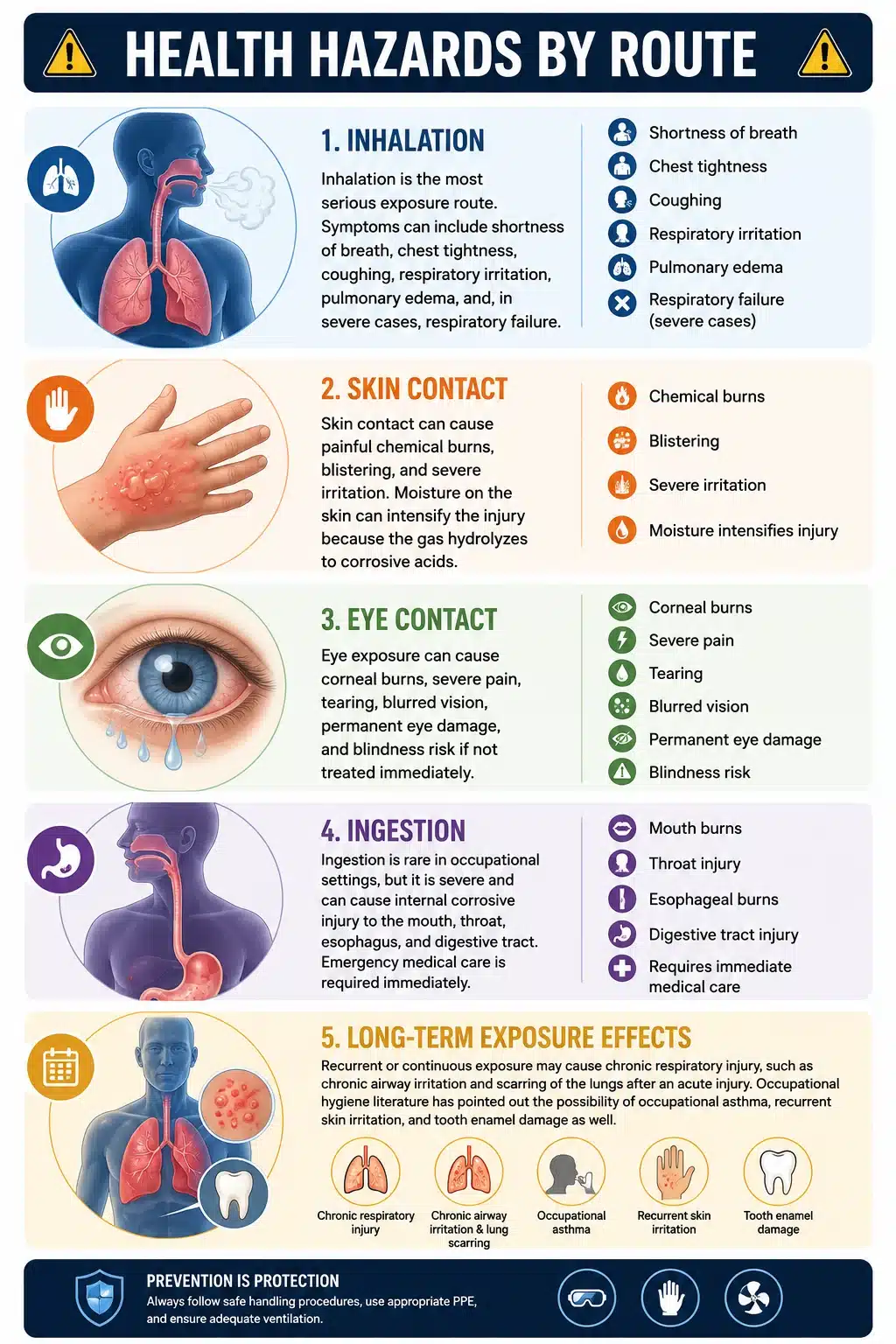
Health hazards by route
-
Inhalation
Inhalation is the most serious exposure route. Symptoms can include shortness of breath, chest tightness, coughing, respiratory irritation, pulmonary edema, and, in severe cases, respiratory failure.
-
Skin contact
Skin contact can cause painful chemical burns, blistering, and severe irritation. Moisture on the skin can intensify the injury because the gas hydrolyzes to corrosive acids.
-
Eye contact
Eye exposure can cause corneal burns, severe pain, tearing, blurred vision, permanent eye damage, and blindness risk if not treated immediately.
-
Ingestion
Ingestion is rare in occupational settings, but it is severe and can cause internal corrosive injury to the mouth, throat, esophagus, and digestive tract. Emergency medical care is required immediately.
-
Long-term exposure effects
Recurrent or continuous exposure may cause chronic respiratory injury, such as chronic airway irritation and scarring of the lungs after an acute injury. Occupational hygiene literature has pointed out the possibility of occupational asthma, recurrent skin irritation, and tooth enamel damage as well.
Industrial applications
Boron trichloride is extensively used as a powerful Lewis acid and reactive process gas. The primary uses include semiconductor fabrication, chemical reactions, fiber optics fabrication, organic chemistry catalysis, metal refinement, and boron compound fabrication. Some of the common applications include:
- Semiconductor fabrication
- Fiber optics fabrication
- Pharmaceutical intermediates
- Organic synthesis catalysts
- Metal refinement
- Fabrication of boron compounds
- Petrochemical process
In semiconductor manufacturing
Boron trichloride is an important process of gas in semiconductor fabrication because it supports plasma etching, wafer processing, microelectronics manufacturing, chip production, and thin film-related steps. It is also used as a doping-related reagent in certain controlled processes involving boron introduction into silicon-based materials. In practice, its value comes from its high reactivity and ability to help shape or modify surfaces at very small scales. That same reactivity is why gas cabinets, exhaust, leak detection, and scrubber systems are critical in cleanroom environments.
Industries that use it
| Industry | Purpose |
| Electronics | Etching |
| Chemical manufacturing | Catalyst |
| Research labs | Reagent |
| Petrochemical | Catalyst |
| Pharmaceutical | Intermediate |
| Metallurgy | Purification |
Exposure limits
Published occupational exposure guidance is limited and often inconsistent across sources. OSHA does not appear to list a specific PEL for boron trichloride, while some SDSs note no established occupational exposure limit and refer to hydrogen chloride guidance instead.
| Limit type | Value |
| OSHA PEL | Not established in the sources reviewed |
| NIOSH REL | No specific REL found in the reviewed sources |
| IDLH | No specific current IDLH value found in the reviewed sources; NIOSH IDLH resources should be checked directly |
| ACGIH TLV | No established TLV identified in the reviewed sources; some sources note nonavailable |
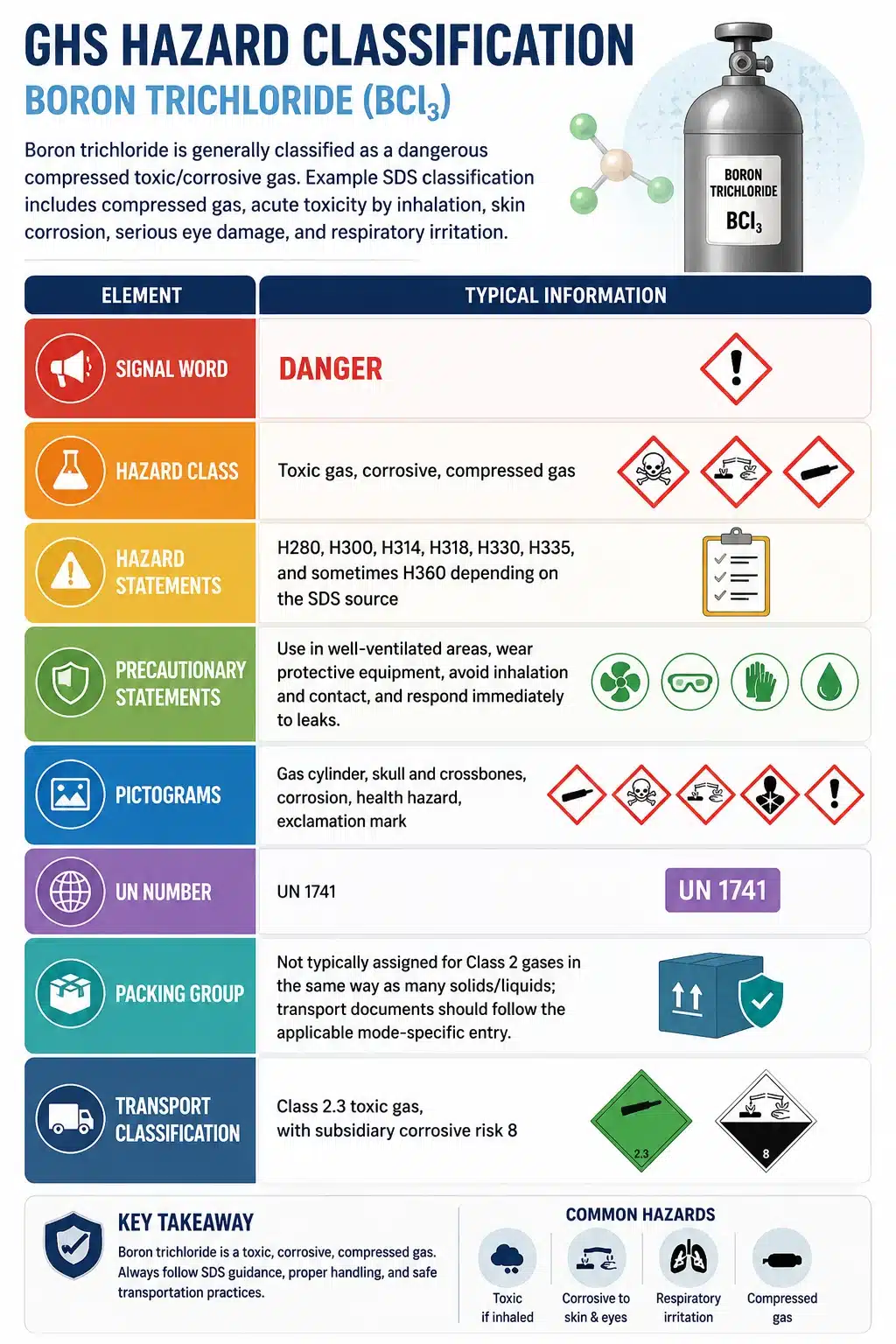
GHS hazard classification
Boron trichloride is generally classified as a dangerous compressed toxic/corrosive gas. Example SDS classification includes compressed gas, acute toxicity by inhalation, skin corrosion, serious eye damage, and respiratory irritation.
| Element | Typical information |
| Signal word | Danger |
| Hazard class | Toxic gas, corrosive, compressed gas |
| Hazard statements | H280, H300, H314, H318, H330, H335, and sometimes H360 depending on the SDS source |
| Precautionary statements | Use in well-ventilated areas, wear protective equipment, avoid inhalation and contact, and respond immediately to leaks. |
| Pictograms | Gas cylinder, skull and crossbones, corrosion, health hazard, exclamation mark |
| UN number | UN 1741 |
| Packing group | Not typically assigned for Class 2 gases in the same way as many solids/liquids; transport documents should follow the applicable mode-specific entry. |
| Transport classification | Class 2.3 toxic gas, with subsidiary corrosive risk 8 |
Label requirements
Boron trichloride containers should carry compliant GHS labels with product identifier, signal word, hazard statements, pictograms, supplier identification, and precautionary statements. Secondary containers, pipeline labels, and shipping labels must also identify the gas clearly and warn users of toxic and corrosive hazards. In the case of the workplace, labels on supplier containers should not be tampered, and the labels on secondary containers should be identical to the original hazard communication information. In case of transportation, shipping papers and markings should conform to UN 1741.
Required PPE
| Task | Required PPE |
| Cylinder handling | Chemical gloves, eye protection, protective clothing |
| Maintenance | SCBA, chemical-resistant suit, face shield |
| Transfer | Face shield, chemical gloves, protective clothing |
| Emergency | Level A suit and SCBA for unknown or high-concentration releases |
| Inspection | Chemical goggles, gloves, and protective clothing |
For emergency response, authoritative guidance recommends gas-tight chemical protection with self-contained breathing apparatus when exposure potential is severe.
Safe handling procedures
Proper operating procedures would include cylinder handling, inspection, leakage detection, cylinder movement, connection of regulators, disconnection, shutdown, and isolation in case of emergencies.
- Cylinders should be received only from authorized sources, and they must have intact labels and proper documentation.
- Inspection of the cylinder must be done to verify for signs of damage, corrosion, defective valves, and improper seals.
- Confirmation that the gas cabinets, exhaust, and emergency shutoff systems are functional.
- Perform the leak test using an approved method before starting the cylinder.
- Cylinders should be moved using an appropriate cart, caps, and restraints and not dragged or rolled inappropriately.
- The connection of the regulator must be made using compatible regulators, fittings, and construction materials.
- The valves must be opened slowly while monitoring them continually for leaks and pressure changes.
- Cylinders must be disconnected, purged, and capped only when the line is safe and isolated.
- In case of any abnormal situation, shut down and isolate the source and evacuate when necessary.
Storage requirements
Store boron trichloride in a cool, dry, well-ventilated, fire-protected area away from moisture and incompatible chemicals. Cylinders should be restrained upright, segregated from food and feed, and protected by gas cabinets or equivalent engineered controls where required.
Because it reacts violently with water and moist air, humidity control matters as much as temperature control. Automatic shutoff valves, secondary containment where applicable, and clear segregation from reactive materials are strongly recommended.
Engineering controls
Effective engineering controls include gas cabinets, local exhaust ventilation, scrubbers, leak detectors, continuous monitoring, emergency shutdown systems, interlocks, and negative-pressure process rooms. These controls reduce the chance that a small leak becomes an area-wide toxic exposure. For semiconductor and high-hazard gas applications, interlocked ventilation and automatic gas shutdown are especially important because of the rapid corrosive impact of moisture-reactive gases.
Spill response
A boron trichloride leak should be treated as a toxic gas emergency. The first priority is evacuation, isolation, and use of trained responders with appropriate respiratory protection. Here's the response sequence:
- Detect the leak using fixed or portable detection systems.
- Evacuate the area as soon as possible.
- Isolate the source if it can be done safely.
- Call trained emergency responders or HazMat.
- Wear SCBA and chemical-protective clothing before re-entry.
- Use scrubber systems or controlled neutralization only by qualified personnel.
- Collect and dispose of contaminated materials as hazardous waste.
Firefighting measures
Boron trichloride is inherently non-flammable; however, heat may decompose the substance and lead to the production of harmful fumes like hydrogen chloride. Firefighters are required to wear full protective clothing and breathing apparatus during firefighting operations. Cylinders should be cooled from a distance when involved in fire. Fire extinguishing agents are dependent on the fire around, not the boron trichloride.
First aid measures
| Exposure | Immediate action |
| Inhalation | Move to fresh air, call emergency medical services, monitor breathing |
| Eyes | Flush with water for at least 15 minutes, remove contacts if easy, and get urgent medical care. |
| Skin | Remove contaminated clothing and wash thoroughly with water. |
| Ingestion | Seek immediate medical care; do not delay |
Emergency response checklist
| Emergency | Response |
| Gas leak | Evacuate |
| Cylinder rupture | Call HazMat. |
| Skin exposure | Flush immediately. |
| Eye exposure | Emergency wash |
| Fire nearby | Cool cylinders from a safe distance |
Environmental hazards
Water pollution due to boron trichloride could happen since it is capable of undergoing hydrolysis to produce acidic compounds. It also causes pollution of the local atmosphere and corrosion of equipment, concrete, and metals. Wastewater concerns are significant if contaminated water is allowed to enter drains without treatment.
Disposal considerations
Disposal should follow EPA for hazardous waste practices, company procedures, and the supplier's return program where available. Empty or unused cylinders should not be vented casually; they should be handled by licensed disposal or cylinder-return services, and any contaminated residues should be neutralized only by qualified personnel.
Transportation regulations
Boron trichloride is transported as UN 1741, Class 2.3 toxic gas, with a corrosive subsidiary risk. Transport entries in ADR, IMDG, IATA, and similar systems consistently identify it as poisonous/corrosive compressed gas.
Boron trichloride vs. boron tribromide
| Property | BCl₃ | BBr₃ |
| Reactivity | Very high, moisture-sensitive | Also highly reactive, generally less volatile |
| Applications | Semiconductor etching, synthesis, refining | Organic synthesis, demethylation, reagent chemistry |
| Cost | Often lower and more widely used industrially | Often higher and more specialty-oriented |
| Corrosiveness | Severe, especially with moisture | Severe, often more handled as a specialty reagent |
| Handling | Gas-cylinder and gas-cabinet systems | Typically tighter reagent handling controls |
Boron trichloride vs. chlorine gas
Boron trichloride and chlorine gas are both toxic and corrosive inhalation hazards, but they are used differently. While chlorine is widely known for being a component in disinfection and oxidization, boron trichloride is a reactive gas and Lewis's acid involved in the production of semiconductors and chemicals. Boron trichloride is even more dangerous, as it forms hydrochloric acid when exposed to moisture, which happens immediately upon the leak. Chlorine is hazardous too; however, there are differences in its chemistry and handling that make safety measures specific.
Common accidents at the workplace
Examples of typical accidents are cylinder leaks, the presence of moisture, valve failure, improper choice of regulators, transport damage, and maintenance mistakes. These events often happen during cylinder changeout, line purging, or poor compatibility control. Most accidents are preventable with the basics: the right materials of construction, trained operators, leak checks, and strict control of moisture.
SDS requirements
Boron trichloride should appear in a standard 16-section Safety Data Sheet with identification, hazards, composition, first aid, firefighting, accidental release, handling, exposure controls, physical properties, stability, toxicology, ecology, disposal, transport, regulatory, and other information. Employees must have ready access to the SDS, and manufacturers or importers must update it when hazard information changes.
Chemical inventory management
In the case of EHS programs that involve multiple locations, the boron trichloride cylinders are to be monitored according to the following parameters: location, number of cylinders, expiry date or date of inspection, and ownership of the cylinders. Barcodes or QR codes will help to enhance visibility and prevent overdue cylinders. This is when chemical inventory software comes in handy.
Training requirements
Employees dealing with boron trichloride must be instructed in HazCom, cylinder handling, PPE selection, emergency response planning, respirators where necessary, and SOPs particular to their site. Refresher training shall be offered following an accident or a change in procedures. Training must be position-related; operators require training handling and dealing with leaks, while maintenance and emergency staff require more advanced training.
Conclusion
This highly reactive, toxic, and hygroscopic gas needs to be handled with extreme care throughout the process chain. The importance of its use in semiconductor fabrication, synthesis of chemicals, and metal purification industries is well-known; however, it is accompanied by severe hazards like inhalation damage, corrosive burns, and respiratory ailments in the long run. Proper engineering controls, appropriate personal protective equipment, correct storage, emergency procedures, and training of employees are essential for the safe handling of this compound. Organizations dealing with boron trichloride should consider it a high-risk substance and keep themselves prepared for any eventualities.
References:
- Boron Trichloride | BCl3 | CID 25135 – PubChem – https://pubchem.ncbi.nlm.nih.gov/compound/Boron-Trichloride
- ICSC 0616: Boron trichloride – https://www.ilo.org/dyn/icsc/showcard.display?p_lang=en&p_card_id=0616
- Boron trichloride – NIST WebBook – https://webbook.nist.gov/cgi/cbook.cgi?ID=C10294345
- Boron trichloride – Wikipedia – https://en.wikipedia.org/wiki/Boron_trichloride
- Boron trichloride – ChemicalBook Safety Data Sheet – https://www.chemicalbook.com/MSDS/Boron-trichloride.htm
- Boron Trichloride – ACGIH Data – https://www.acgih.org/
- Boron trichloride – Knowledge and References – Taylor & Francis – https://www.tandfonline.com/
FAQs
-
Is boron trichloride flammable?
No. It is generally considered nonflammable, but it can decompose in fire and release toxic, corrosive gases.
-
Is boron trichloride toxic?
Yes. It is a highly toxic inhalation hazard and a corrosive gas.
-
What happens when boron trichloride contacts water?
It hydrolyzes violently and forms hydrogen chloride and boric acid.
-
What PPE is required?
At minimum, chemical-resistant gloves, eye protection, and protective clothing are needed for controlled work; emergency response may require SCBA and gas-tight chemical protection.
-
What industries use boron trichloride?
Electronics, chemical manufacturing, research labs, petrochemical processing, pharmaceuticals, and metallurgy all use it in different ways.
-
Is boron trichloride an oxidizer?
It is not typically treated as a classic oxidizer; its primary hazard is toxicity, corrosivity, and moisture reactivity.
-
Can boron trichloride cause permanent lung damage?
Yes. Severe inhalation exposure can damage the lungs and may lead to long-term respiratory effects.
Simplify Your SDS Management
CloudSDS gives your team instant access to 23M+ safety data sheets with AI-powered search, automated updates, and full OSHA/GHS compliance — all from one platform.
Leave A Comment