
Last Updated on September 4, 2026
Airborne vs. Droplet Transmission: Key Differences and Safety Measures
Summary
WHO's 2024 terminology update replaced the strict droplet-vs-aerosol binary with a "transmission through the air" continuum. This article explains what changed, why the traditional droplet/airborne categories still matter for choosing workplace controls, and how EHS teams can apply the same hierarchy of controls, respiratory protection, and ventilation principles used for chemical exposures to biological hazards. It also corrects common myths, including the misuse of hospital-grade ventilation specs as general workplace requirements.
Introduction
For decades, infection control in the workplace rested on a simple binary: pathogens spread either as "droplets" that fall quickly to the ground within a few feet or as "aerosols" that float and travel farther on air currents. In April 2024, the World Health Organization, working with the U.S. CDC and three other public health agencies, published a global technical consultation report that formally moved away from that binary. The new framework describes transmission "through the air" as a continuum rather than a hard cutoff between two particle categories.
For environmental health and safety (EHS) professionals, this isn't just a semantic update. The old droplet/airborne split has shaped respirator selection, ventilation specifications, and exposure-control plans for years. A shift in the underlying science means it's worth revisiting how those decisions get made—and where the traditional categories are still operationally useful, even if they're no longer treated as scientifically absolute. This article walks through what changed, why it matters for EHS and chemical safety teams specifically, and how to apply practical control measures using both the updated terminology and the language most safety programs already use.
What has changed? WHO's 2024 "Through the Air" Framework
The old model
For much of the modern era of infection control, respiratory particles were divided using a single size cutoff—typically somewhere between 5 and 10 microns. Particles above that threshold were called "droplets": relatively large, falling out of the air within a short distance of the source, and associated with short-range exposure to the eyes, nose, or mouth. Particles below the cutoff were called "aerosols" and treated as capable of staying suspended in air currents and traveling farther, including beyond the immediate vicinity of an infected person.
This binary was operationally convenient. It mapped cleanly onto two different control strategies: distancing and surface hygiene for droplet-type threats, and respirators plus enhanced ventilation for airborne-type threats. Guidance documents, PPE standards, and building codes were built around it.
The updated approach
The 2024 WHO report, developed with the Africa CDC, China CDC, the European Centre for Disease Prevention and Control, and the U.S. CDC, introduces new common descriptors. Under the new terminology, infected individuals generate what the report calls infectious respiratory particles (IRPs) through breathing, talking, singing, coughing, or sneezing. Critically, the report frames IRPs as existing on a continuous spectrum of sizes rather than splitting cleanly at a fixed threshold. As one epidemiologist not involved in drafting the report has explained it, the field had relied for decades on a cutoff of roughly 5 to 10 microns to separate "aerosol" from "droplet"—even though real-world particle sizes don't actually respect that line.
In place of "droplet vs. airborne," the report introduces "transmission through the air" as the umbrella term, with two subcategories underneath it: "airborne transmission," which describes infectious respiratory particles that enter the air and are then inhaled into another person's respiratory tract, and "direct deposition," which describes particles that enter the air and land directly on another person's mouth, nose, or eyes without first being inhaled.
To be clear, this update doesn't mean droplets "no longer exist" or that everything is now airborne in the traditional sense. It means the strict scientific binary that used to separate droplets from aerosols by particle size is now considered outdated. The practical categories built on top of that binary—shorter-range, larger-particle exposure versus longer-range, smaller-particle exposure—remain useful for choosing controls, even as the underlying science moves toward a continuum model. That's the approach this article takes: using WHO's updated terminology where precision matters, while retaining the traditional "droplet" and "airborne" language where it helps with practical control selection.
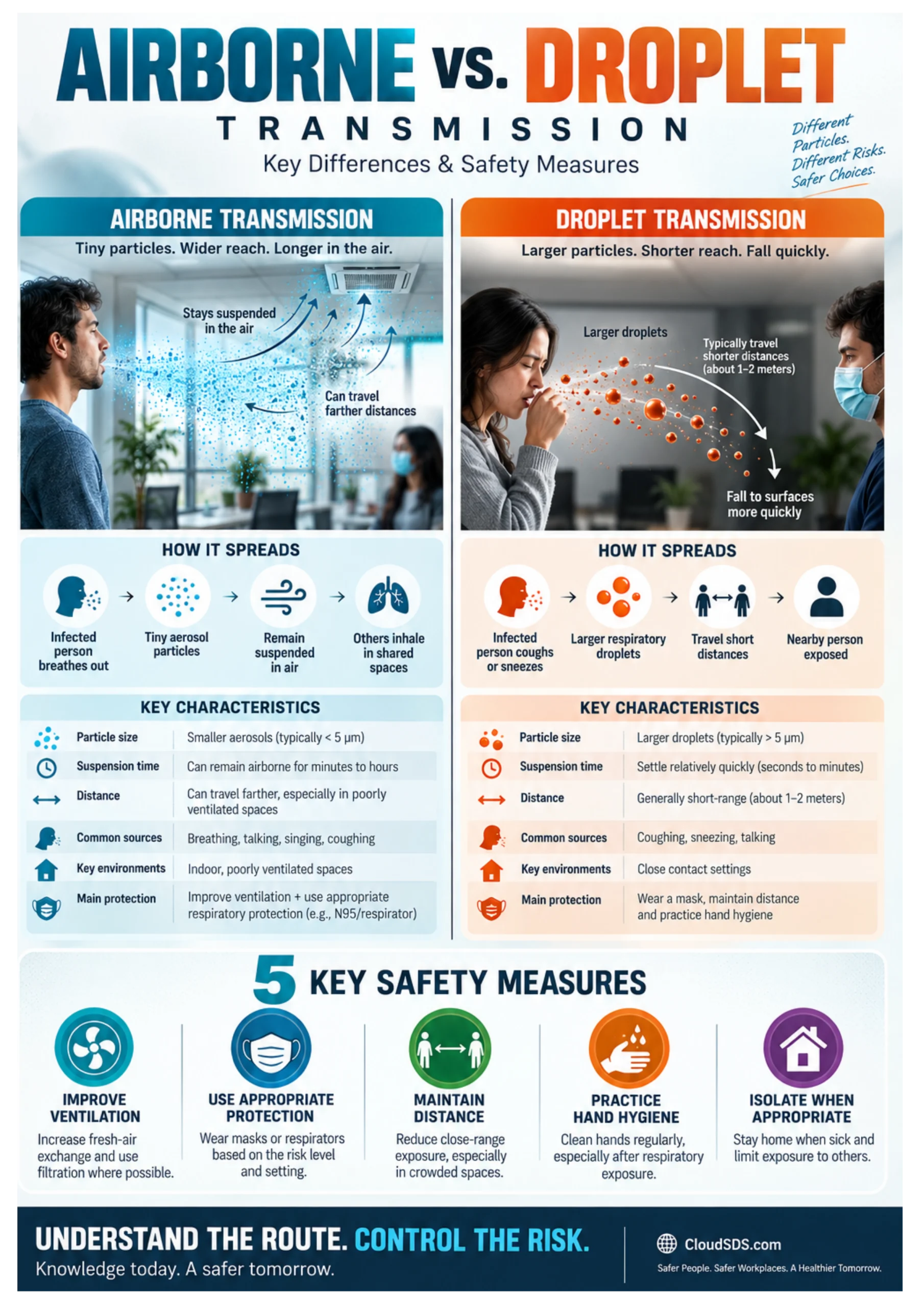
Airborne vs. droplet transmission: Practical categories for workplace safety
Traditional droplet-type transmission
In the traditional model, droplet-type transmission involves larger respiratory particles that are expelled with enough mass to fall out of the air relatively quickly. Exposure is generally short-range—the classic picture is one person's respiratory particles landing directly in another person's eyes, nose, or mouth during close, face-to-face contact. Because these particles fall out of suspension faster, distance and time near the source are the dominant factors: the farther apart two people are and the less time they spend in close contact, the lower the exposure risk from this route. Air movement, humidity, and temperature all influence exactly how far a given particle travels before settling, which is part of why a single fixed distance (like "6 feet") was always an approximation rather than a hard boundary.
Traditional airborne-type transmission
Airborne-type transmission, in the traditional sense, involves smaller particles capable of remaining suspended in air for longer periods and being carried on air currents well beyond the immediate area around the source. Because these particles can be inhaled deep into the respiratory tract, ventilation, airflow patterns, and room conditions play a much larger role in exposure than they do for droplet-type transmission. Exposure isn't limited to people in close proximity—someone across a room, or in some cases in a connected space served by the same air handling system, can potentially be exposed.
Key differences: practical categories for control selection
It’s worth framing this comparison as a set of practical categories for choosing controls, rather than as two scientifically absolute buckets a given pathogen must fall into.
| Factor | Droplet-type (short-range) | Airborne-type (longer-range) |
| Typical particle behavior | Falls out of the air relatively quickly | Can remain suspended longer |
| Typical exposure range | Proximity, direct contact with mucous membranes | Beyond immediate proximity in some conditions |
| Primary influencing factors | Distance, duration of close contact | Ventilation, airflow, room air changes |
| Representative controls | Distancing, source control, hygiene | Respiratory protection, ventilation, isolation |
| Control domain | Chemical exposure control | Biological/respiratory exposure control |
| Engineering | Local exhaust ventilation | General/dilution ventilation, filtration |
| Source management | Substitution, enclosure | Source isolation, source control (masking) |
| Air treatment | Filtration where applicable | Filtration, air cleaning (HEPA, GUV) |
| Assessment | Exposure assessment | Exposure/risk assessment |
| PPE | Respiratory protection | Respiratory protection |
How respiratory particles are generated
Every one of these exposure pathways starts the same way: with a person generating particles through ordinary respiratory activity. Breathing, talking, and singing all generate particles continuously, with volume and particle output generally increasing with vocal effort—singing and loud talking are associated with more particle generation than quiet breathing. Coughing and sneezing are higher-intensity events that generate more particles at higher velocity.
Exactly how far those particles can travel has been studied directly. In a widely cited 2020 JAMA analysis, MIT fluid dynamics researcher Lydia Bourouiba described coughs and sneezes not as simple ballistic sprays of individual droplets, but as turbulent, multiphase gas clouds that carry a range of particle sizes together. Studies building on that work have estimated that the smaller droplets emitted during a sneeze can, under some conditions, travel on the order of several meters—considerably farther than the "large droplet falls within a couple of feet" model would predict. It's worth being cautious about treating any single distance figure as a universal constant; how far particles travel depends heavily on the specific respiratory event, environmental conditions, and how the study measured it. The broader significance of this line of research is less about a single number and more about the recognition that expiratory events behave as turbulent gas clouds rather than isolated projectiles—a finding that helped drive the broader move away from a strict size-based cutoff for classifying transmission risk.
Why this matters for EHS and chemical safety teams
1. Biological and chemical exposure share a control philosophy.
This is where the topic earns its place on an EHS and chemical safety platform. Biological respiratory hazards and airborne chemical hazards are different in origin, but they share the same fundamental exposure model: a source generates a hazardous agent, that agent moves through air (or is deposited via direct contact), and a person is exposed via inhalation, ingestion, or contact with mucous membranes or skin. Because the exposure routes are structurally similar, the control toolkit is largely the same one EHS teams already use for chemical exposures—engineering controls, administrative controls, and PPE, applied in that order of preference.
2. Respiratory protection
For chemical hazards, respirator selection is already governed by a well-established regulatory framework: OSHA’s Respiratory Protection Standard, 29 CFR 1910.134, which requires a written respiratory protection program, medical evaluation, fit testing, and selection of an appropriate respirator and cartridge or filter based on the specific hazard and exposure level. That same framework extends directly to biological aerosol hazards. An N95 or higher-rated filtering facepiece respirator selected and fit-tested under a 1910.134-compliant program provides protection against infectious respiratory particles using the same fit-testing and cartridge/filter-selection logic used for particulate chemical hazards. Teams that already run a mature respiratory protection program for chemical exposures have most of the infrastructure—medical evaluation records, fit-test schedules, cartridge selection logic—needed to extend that program to biological hazards during periods of elevated respiratory illness risk.
3. Engineering controls
The overlap continues at the engineering-controls level. Local exhaust ventilation, used to capture chemical contaminants at the source, has a direct biological analog in source-capture and isolation strategies for infectious or symptomatic individuals. General or dilution ventilation, already a familiar concept for controlling ambient chemical vapor concentrations, plays the same role for airborne biological particles—increasing outdoor air delivery and air changes to dilute and remove contaminants. Isolation of a hazard source and air cleaning (filtration, and in some cases germicidal UV treatment) rounds out a control set that will look familiar to any EHS professional who has designed a chemical exposure control plan.
The core message for this section: an EHS team that already manages airborne chemical exposure has most of the same control principles—and often much of the same physical infrastructure—needed to address biological airborne hazards. The gap is usually less about missing tools and more about applying the existing toolkit to a new category of source.
Safety measures for droplet-type transmission
1. Source control
The most direct way to reduce droplet-type exposure is to reduce what’s generated at the source. This includes masking or other source control measures where appropriate for the hazard and setting, covering coughs and sneezes, and staying home when ill where organizational policy allows it.
2. Reduce close-range exposure.
Physical distancing, where appropriate for the setting and hazard, reduces the likelihood of direct exposure to larger respiratory particles. Avoiding prolonged, close, face-to-face interaction — particularly with someone who is symptomatic — reduces cumulative exposure time at close range, which is the dominant risk factor for this transmission pathway.
3. Hygiene
Hand hygiene remains a relevant control, since respiratory particles that land on surfaces or hands can be transferred to the eyes, nose, or mouth. Surface cleaning in high-touch areas is relevant where contact transmission is a plausible pathway. These measures are best understood as controls for short-range, larger-particle exposure specifically—not as a universal solution that applies equally to every pathogen or transmission scenario.
Safety measures for droplet-type transmission
-
Source control
The most direct way to reduce droplet-type exposure is to reduce what's generated at the source. This includes masking or other source control measures where appropriate for the hazard and setting, covering coughs and sneezes, and staying home when ill where organizational policy allows it.
-
Reduce close-range exposure
Physical distancing, where appropriate for the setting and hazard, reduces the likelihood of direct exposure to larger respiratory particles. Avoiding prolonged, close, face-to-face interaction — particularly with someone who is symptomatic — reduces cumulative exposure time at close range, which is the dominant risk factor for this transmission pathway.
-
Hygiene
Hand hygiene remains a relevant control, since respiratory particles that land on surfaces or hands can be transferred to the eyes, nose, or mouth. Surface cleaning in high-touch areas is relevant where contact transmission is a plausible pathway. These measures are best understood as controls for short-range, larger-particle exposure specifically—not as a universal solution that applies equally to every pathogen or transmission scenario.
Safety measures for airborne-type transmission
1. Respiratory protection
Where a hazard assessment indicates a meaningful risk of inhalation exposure, appropriate respiratory protection—selected and fit-tested consistent with 29 CFR 1910.134—is the relevant PPE-level control. The right respirator and cartridge or filter combination depends on the specific hazard, much as it would for a chemical inhalation hazard.
2. Engineering controls
Ventilation, isolation, and air filtration or cleaning are the primary engineering controls for airborne-type exposure. Appropriate HVAC operation—including adequate outdoor air delivery, filtration, and air movement that avoids stagnant zones—is central to reducing the concentration of infectious particles in an occupied space.
3. Administrative controls
Exposure policies, training, occupancy management, and scheduling adjustments round out the administrative layer. These controls don't eliminate the hazard, but they reduce the number of people exposed, the duration of exposure, or the concentration of hazard in a space at any given time.
4. An important ventilation correction
It's common to see specific ventilation numbers—commonly cited figures include roughly 12 or more air changes per hour and negative pressure differentials around 2.5 pascals—presented as general workplace targets. Those numbers are not universal requirements for ordinary workplaces. They come from CDC and ASHRAE guidance for healthcare Airborne Infection Isolation Rooms (AIIRs), where the CDC and Healthcare Infection Control Practices Advisory Committee recommend pressure differentials greater than 2.5 pascals negative relative to the corridor, along with roughly 12 air changes per hour for new construction (a figure sometimes relaxed for existing rooms that predate current construction standards). Those specifications are designed for a very specific use case: containing a known infectious patient in a healthcare setting.
For general workplaces, CDC's current guidance takes a different, less prescriptive approach. Rather than mandating a specific ACH figure for every building type, the guidance emphasizes improving clean-air delivery, dilution, and filtration relative to a building's existing baseline, with a general aim of five or more air changes per hour of clean air where practical—achieved through any combination of central ventilation, natural ventilation, or supplemental devices that provide an equivalent air-change rate. That's a substantially different—and more broadly achievable—target than the AIIR specifications, and it reflects the fact that ordinary offices, manufacturing floors, and classrooms have different risk profiles, occupancy patterns, and HVAC capabilities than a hospital isolation room.
Ventilation's Role—And its overlap with chemical exposure controls
How ventilation reduces airborne exposure
Ventilation reduces exposure to airborne biological hazards through several overlapping mechanisms: diluting contaminant concentration with outdoor air, promoting air movement that avoids stagnant pockets where particles can accumulate, filtering recirculated air, and in some cases actively treating air (for example, with germicidal UV) to inactivate pathogens. CDC guidance is direct about the underlying mechanism: improving ventilation reduces the number of particles in indoor air and lowers occupants' risk of exposure to airborne hazards, and protective ventilation practices reduce both the concentration of airborne viral particles and the overall exposure occupants experience.
Ventilation for chemical vs. biological hazards
The parallel to chemical exposure control is close enough to be a useful mental model for EHS teams:
| Chemical exposure control | Biological exposure control |
| Local exhaust ventilation | Ventilation/dilution |
| Source isolation | Source isolation |
| Filtration where applicable | Filtration/air cleaning |
| Exposure assessment | Exposure/risk assessment |
| Respiratory protection | Respiratory protection |
Avoid one-size-fits-all ventilation requirements
Ventilation requirements should be set based on facility type, occupancy density, the specific hazard being controlled, the capability of the existing HVAC system, and applicable codes and standards — not by importing a single number from an unrelated context. A healthcare setting managing a known airborne pathogen has different requirements than a general office, and both differ from a manufacturing floor with its own chemical exposure controls already in place. Treating any single ventilation specification as a universal requirement risks both over-engineering low-risk spaces and under-protecting higher-risk ones.
Workplace and public-space implications
The right mix of controls depends heavily on the specific environment:
- Offices typically have lower occupant density and shorter-duration close contact, making ventilation improvements and basic source control proportionate to first steps.
- Manufacturing facilities often already have engineering controls in place for chemical or particulate hazards; extending that same infrastructure to biological hazard assessment is usually a matter of expanding the scope of an existing program rather than building a new one.
- Laboratories may have specific biosafety requirements layered on top of general workplace controls, depending on the materials handled.
- Healthcare facilities face the highest-acuity scenarios and are where AIIR-level specifications are appropriate.
- Schools combine high occupant density with population groups that may have less consistent sources of control (masking, staying home when ill), making ventilation and administrative controls particularly relevant.
- Public indoor spaces vary widely but generally benefit from the same core principles: adequate outdoor air delivery, filtration, and avoiding overcrowding in poorly ventilated areas.
In every case, the right control set follows a hazard and exposure assessment specific to that space—not from applying one setting of requirements to another. It's also worth noting that ventilation improvements matter most indoors specifically, since particle concentrations generally build more readily in enclosed spaces than outdoors, where air movement and dilution happen naturally.
Common myths and misconceptions
Myth 1: "Every infection is either airborne or droplet transmitted." Reality: WHO's updated framework describes transmission through the air as a continuum of particle sizes and behaviors rather than a strict either/or binary. The traditional categories remain useful for control selection, but they were never a complete scientific description of how a given pathogen moves.
Myth 2: "COVID-19 primarily spreads through droplets." This was a common early framing, but the evidence base shifted substantially over the course of the pandemic. SARS-CoV-2 transmission includes a meaningful airborne/aerosol inhalation component, not just short-range droplet exposure—and the recognition that existing terminology didn't adequately capture that reality was one of the issues underlying WHO's 2024 terminology update in the first place.
Myth 3: "Airborne hazards always require hospital-grade ventilation." As covered above, AIIR-level specifications (roughly 12 ACH, negative pressure around 2.5 Pa) are designed for healthcare isolation rooms managing known infectious patients. They are not a general workplace requirement.
Myth 4: "Vaccination means transmission is impossible." Vaccination can meaningfully reduce transmission risk and disease severity for many respiratory pathogens. It does not eliminate exposure risk or transmission risk entirely, which is why layered controls—not vaccination alone—remain the standard approach in occupational hazard control.
Myth 5: "Ventilation eliminates infection risk." Ventilation reduces exposure risk; it doesn't eliminate it. CDC guidance is explicit that even substantially improved ventilation will not guarantee totally safe air in any space—it reduces the risk of exposure to viral particles and other harmful air contaminants, but it doesn't remove that risk entirely. Ventilation is one layer in a broader control strategy, not a standalone solution.
How health authorities classify transmission risk
The terminology used to describe transmission through the air has evolved considerably, and it’s worth going to the source documents directly rather than relying on secondhand summaries. WHO’s April 2024 report, developed in consultation with the Africa CDC, China CDC, the European CDC, and the U.S. CDC, is available in full: Leading health agencies outline updated terminology for pathogens that transmit through the air (WHO). For current U.S. workplace ventilation guidance specifically, CDC/NIOSH maintains a dedicated resource: Ventilation and Respiratory Viruses (CDC/NIOSH). Both are useful primary references for EHS teams updating internal exposure-control documentation.
Preparedness & prevention strategy: Applying the hierarchy of controls
The OSHA/NIOSH hierarchy of controls, already a familiar framework for chemical hazard management, applies just as directly to biological respiratory hazard planning.
- Elimination: Where feasible, remove the source of biological exposure entirely: for example, excluding a known-infectious individual from a shared workspace.
- Substitution: Where a higher-risk process, activity, or material can be replaced with a lower-risk alternative (for example, shifting a high-contact task to a remote or asynchronous format during a period of elevated respiratory illness risk), substitution reduces exposure at the source.
- Engineering controls: Ventilation, isolation, local exhaust or capture systems, physical barriers, and air cleaning all reduce exposure without depending on individual behavior.
- Administrative controls: Training, scheduling adjustments, occupancy management, exposure policies, and clear communication shape how people interact with a hazard that hasn't been fully engineered out.
- PPE: Respirators, masks, eye protection, and other task-specific protective equipment form the last line of defense, used to address residual risk after higher-level controls have been applied.
The important connection here is a conceptual one: the same hierarchy EHS professionals already use to structure chemical exposure prevention can organize biological hazard prevention as well. It's not a parallel framework that needs to be learned from scratch—it's the same framework, applied to a different category of source.
Conclusion
The traditional droplet/airborne distinction remains a useful practical planning tool for selecting workplace controls, but it shouldn't be treated as an absolute scientific binary — WHO's 2024 terminology update makes clear that transmission through the air happens across a continuum of particle sizes and behaviors, not a strict either/or split. For EHS teams, the more important takeaway may be the one that doesn't depend on terminology at all: the same hierarchy-of-controls approach already used for chemical hazard prevention applies directly to biological exposure planning, using much of the same engineering infrastructure, respiratory protection programs, and exposure-assessment processes already in place. Keeping safety data sheets, exposure-control plans, and respiratory protection documentation current — the kind of recordkeeping CloudSDS supports — is part of maintaining that same EHS program as it's extended to cover both chemical and biological respiratory hazards.
References

Simplify Your SDS Management
CloudSDS gives your team instant access to 23M+ safety data sheets with AI-powered search, automated updates, and full OSHA/GHS compliance — all from one platform.
Leave A Comment