

- Summary
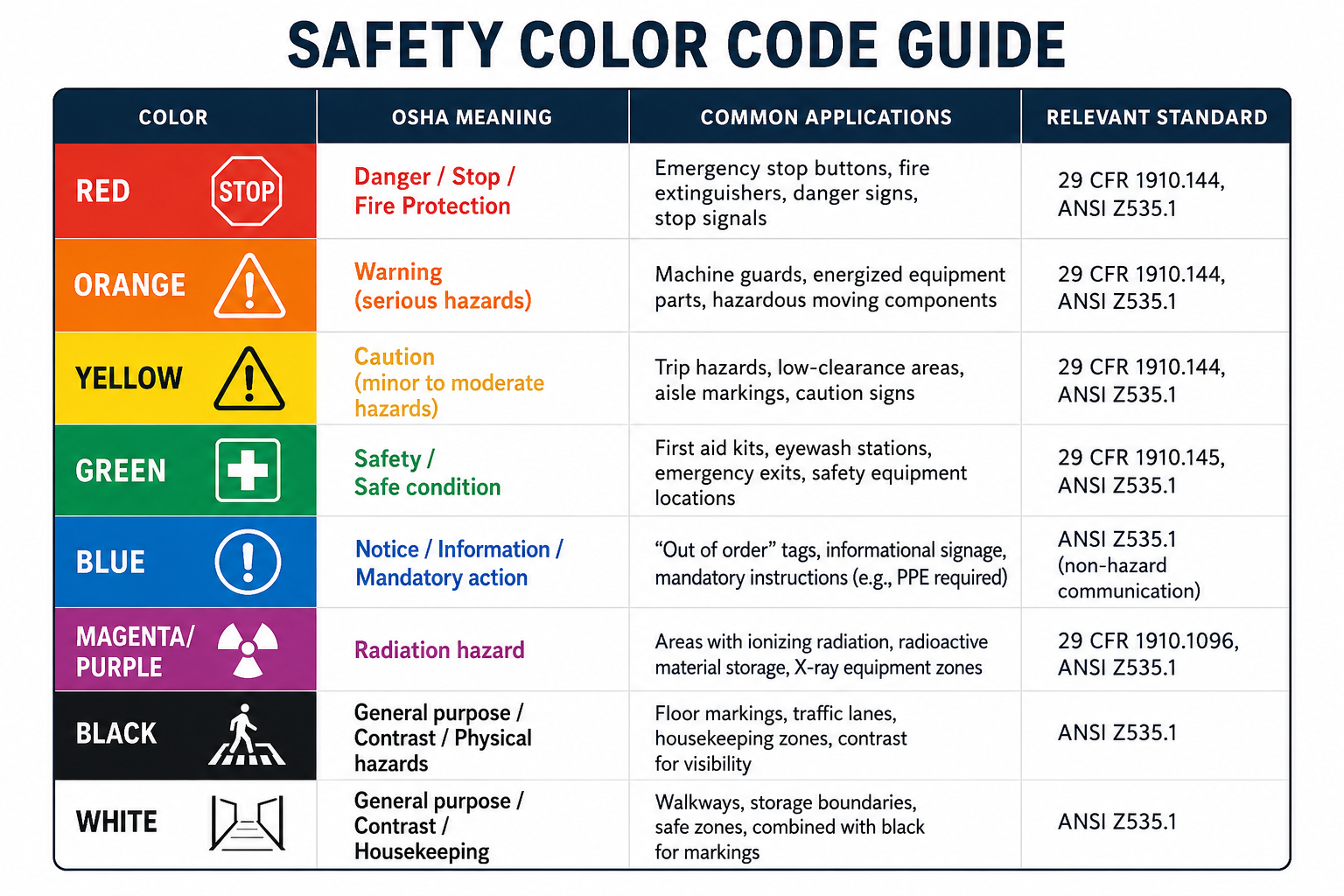
- Quick Reference Color Table
- LOTO (Lockout/Tagout) Color Codes Explained
- Who Can Apply or Remove LOTO Tags?
- OSHA Floor Marking Color Codes (29 CFR 1910.176)
- GHS / HazCom Label Colors for Chemical Containers
- NFPA 704 vs. OSHA HazCom Colors
- Why is Color Coding Important?
- OSHA-Recommended Color Coding and Their Meanings
- How Can Companies Follow or Utilize Color Codes?
- Common OSHA Safety Color Coding Mistakes (and How to Avoid Them)
- Frequently Asked Questions About OSHA Safety Colors
- Conclusion:
Summary
Colors do more than just look good; they also quickly convey important safety information, especially in high-risk situations where quick decisions are important. OSHA set up standard color guidelines for workplace safety under 29 CFR 1910.144 (safety color coding for indicating physical hazards) and 29 CFR 1910.145 (specifications for accident prevention signs and tags). These rules make it easier for workers to quickly see hazards, warnings, emergency equipment, and safe circumstances.
But a lot of workplaces mix up OSHA rules with ANSI Z535.1 regulations. ANSI gives advice on how to make current safety signs, symbols, and colors consistent, but OSHA rules are legally binding. ANSI Z535 standards are updated every so often to meet the needs of modern workplace safety communication. OSHA’s guidelines were first put in place decades ago.
Quick Reference Color Table
LOTO (Lockout/Tagout) Color Codes Explained
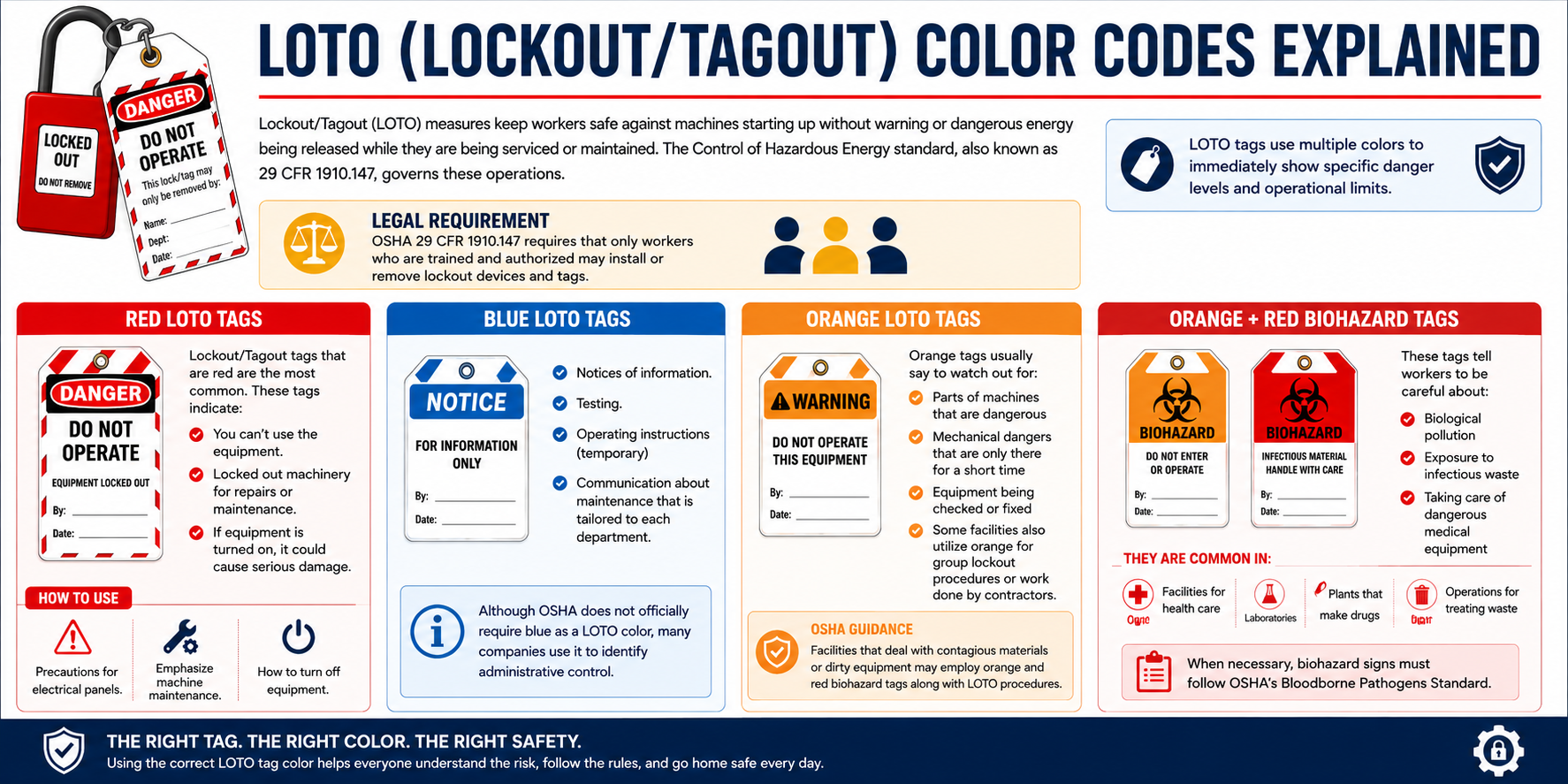
Lockout/Tagout (LOTO) measures keep workers safe against machines starting up without warning or dangerous energy being released while they are being serviced or maintained. The Control of Hazardous Energy standard, also known as 29 CFR 1910.147, governs these operations.
LOTO tags use multiple colors to immediately show specific danger levels and operational limits.
Tags with Red LOTO
Lockout/Tagout tags that are red are the most common. These tags indicate:
- You can’t use the equipment.
- Locked out machinery for repairs or maintenance
- If equipment is turned on, it could cause serious damage.
Legal Requirement
OSHA 29 CFR 1910.147 requires that only workers who are trained and authorized may install or remove lockout devices and tags.
How to Use
- Precautions for electrical panels.
- Emphasize machine maintenance.
- How to turn off equipment.
Blue LOTO Tags
- Notices of information.
- Testing.
- Operating instructions (temporary)
- Communication about maintenance that is tailored to each department.
Although OSHA does not officially require blue as a LOTO color, many companies use it to identify administrative control.
Orange LOTO Tags
Orange tags usually say to watch out for:
- Parts of machines that are dangerous
- Mechanical dangers that are only there for a short time
- Equipment being checked or fixed
Some facilities also utilize orange for group lockout procedures or work done by contractors.
OSHA Guidance
Facilities that deal with contagious materials or dirty equipment may employ orange and red biohazard tags along with LOTO procedures.
Orange + Red Biohazard Tags
Facilities that deal with contagious materials or dirty equipment may employ orange and red biohazard tags along with LOTO procedures.
These tags tell workers to be careful about:
- Biological pollution
- Exposure to infectious waste
- Taking care of dangerous medical equipment
They are common in:
- Facilities for health care
- Laboratories
- Plants that make drugs
- Operations for treating waste
When necessary, biohazard signs must follow OSHA’s Bloodborne Pathogens Standard.
Who Can Apply or Remove LOTO Tags?
According to 29 CFR 1910.147:
- Only personnel who have been given permission can put on or take off lockout/tagout devices.
- A tag should generally be removed only by the employee who applied it.
- Employees must receive documented LOTO training.
- Employers must establish written energy control procedures.
Affected employees and other workers must also understand the meaning of LOTO devices and restrictions.
1. Lack of Adequate Training for Employees
Workers may not know the techniques for isolating energy or the importance of tags.
2. Missing Written Procedures
OSHA often fines employers who don't have LOTO procedures for certain machines.
3. Using Tags Without Locks
Tagout-only systems are only okay when lockout methods can't be used and the same level of protection is offered.
4. Failure to Verify Energy Isolation
Sometimes machines stay powered on because they skip steps to check.
5. Unauthorized Tag Removal
It is a serious OSHA violation to take off another employee's lock or tag without following the right steps.
6. Damaged Tags
Citations can result from poorly maintained, illegible, or missing tags that undermine the effectiveness of hazard communication.
OSHA Floor Marking Color Codes (29 CFR 1910.176)
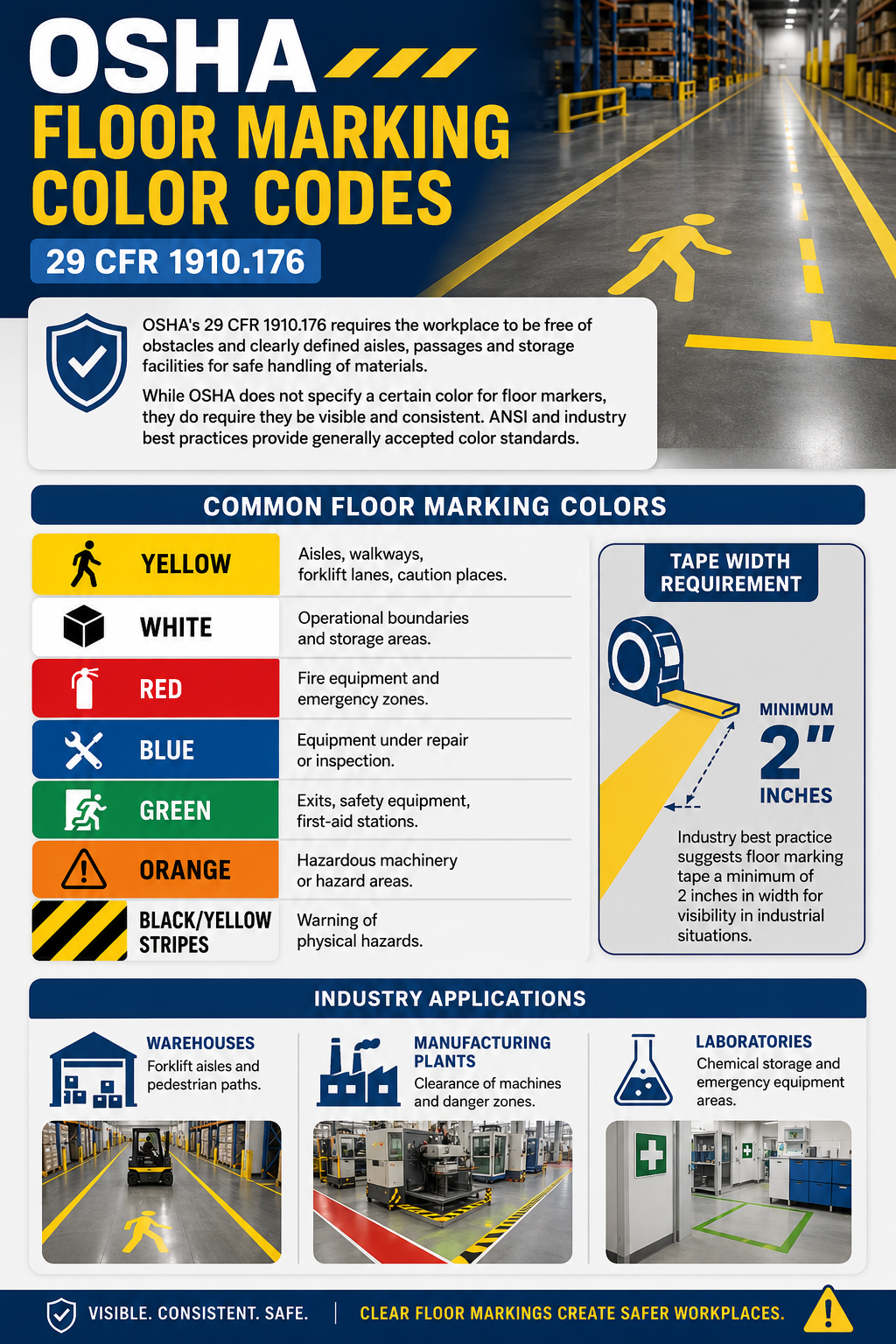
OSHA's 29 CFR 1910.176 requires the workplace to be free of obstacles and clearly defined aisles, passages, and storage facilities for safe handling of materials. While OSHA does not specify a certain color for floor markers, they do require they be visible and consistent. ANSI and industry best practices provide generally accepted color standards.
Common Floor Marking Colors
- Yellow – Aisles, walkways, forklift lanes, caution places.
- White—Operational boundaries and storage areas.
- Red – Fire equipment and emergency zones
- Blue – Equipment under repair or inspection
- Green – Exits, safety equipment, first-aid stations
- Orange – Hazardous machinery or hazard areas
- Black/Yellow Stripes – Warning of physical hazards
Tape Width Requirement
Industry best practice suggests floor marking tape a minimum of 2 inches in width for visibility in industrial situations.
Industry Applications
- Warehouses – Forklift aisles and pedestrian paths.
- Manufacturing Plants – Clearance of machines and danger zones.
- Laboratories – Chemical storage and emergency equipment areas
GHS / HazCom Label Colors for Chemical Containers
Chemical labels under OSHA HazCom and GHS standards utilize defined colors and symbols to quickly convey dangers.
GHS Pictogram Border Colors
GHS pictograms use:
- Red diamond border – Internationally standardized danger warning.
- Black symbol – Type of hazards.
- White background – Better visibility.
OSHA HazCom standards mandate a red diamond border on shipping hazardous chemical containers.
Secondary Container Labeling
OSHA does not specify colors for secondary containers in the workplace; however, labels must clearly identify:
- Chemical identification
- Hazard warnings
- Applicable hazard information
Several organizations also color code deliberately to speed hazard recognition.
NFPA 704 vs. OSHA HazCom Colors
NFPA 704 vs. OSHA HazCom Colors
| System | Purpose | Color Meaning |
|---|---|---|
| GHS/OSHA HazCom | Worker hazard communication | Red-bordered pictograms |
| NFPA 704 | Emergency response | Blue, red, yellow, and white hazard settings |
Why is Color Coding Important?
Color coding is important for several reasons:
1. Quick Recognition
In an emergency, every moment counts. Danger and safety equipment are easily seen by workers with the use of color-coded signs and labels. Such codes cut down on the need to read long instructions. A red sign, for instance, quickly alerts a person that there is a risk or fire hazard in that area. This fast recognition can save lives.
2. Universal Understanding
People from various cultural backgrounds may speak different languages. But almost everyone understands colors. For example, a yellow sign usually means “be careful.” Everyone can understand these signs easily, no matter what language people speak or where they come from. It’s a better workplace for everyone, especially in teams with different types of workers.
3. Improved Compliance
OSHA and other safety groups must monitor the color codes. If a corporation is using these codes properly, it’s a sign they’re following safety rules. This helps them avoid legal problems or fines when inspections are carried out.
4. Reduces Chances of Accidents
Clear, color-coded signage assists alert personnel before entering a dangerous location or coming into touch with hazardous chemicals. This reduces the danger of damage. For example, a bright orange or yellow sign can alert a physical hazard. If you stop accidents, you have smoother work and no damage to equipment.
OSHA-Recommended Color Coding and Their Meanings
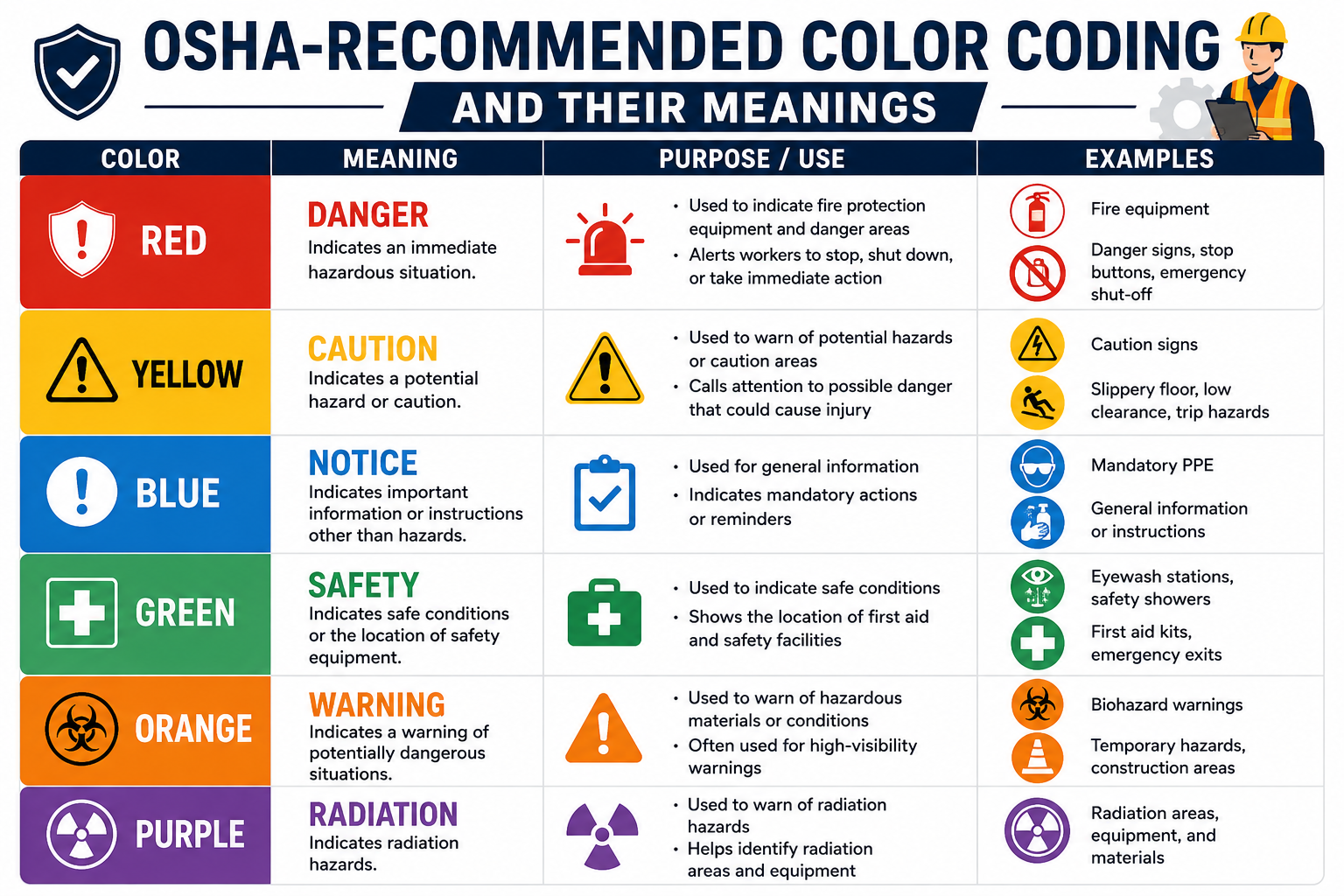
OSHA has specified color codes, as per ANSI (American National Standards Institute) guidelines, to be used in various workplace environments:
1) Red:
Red indicates danger. Organizations also use this color to mark fire apparatus or to highlight emergency stop buttons so that these can be easily identified in an emergency.
Where It's Used:
- Fire Protection Equipment:
Fire extinguishers and fire alarm boxes and other firefighting items are painted red so that they can be easily found in a crisis.
- Flammable Liquids:
This color is used on safety cans or containers of flammable liquids with a flash point at or below 80°F shall be red.
- Danger Signs:
Any warning sign or label indicating an urgent risk (for example, "DANGER – HIGH VOLTAGE") shall be red in color to attract quick attention.
- Emergency Stop Devices:
Stop buttons or switches and emergency stop bars on dangerous machinery must be red. These are needed for the rapid isolation of equipment in an emergency.
Why It Matters:
- Quick Threat Detection:
Red is an international color of stopping or danger. That way, workers can respond to dangerous situations.
- Fire Safety Preparedness:
The bright red signs are easy to find for people, and they can find fire extinguishers and alarms quickly, especially in stressful situations.
2) Orange
Orange is a warning color for parts of machinery or equipment that are dangerous. These are places that can shock, crush, or cut a person.”
Where It is Used:
Machine Guarding Areas:
Machine Guarding Areas: Machines with dangerous moving parts may be painted or designated orange. Like cutting blades, gears, or revolving shafts that are dangerous when exposed.
Electrical Panels and Equipment:
Orange is used on panels or switchgear that could be live. This alerts workers to possible electric shock and reminds them to be careful.
Why This Matters:
- Prevents Life-Threatening Injuries:
Navigation is required in the areas where machinery can cut, crush, or electrocute to reduce the risk of accidental contact with hazardous equipment.
- Supports Safe Maintenance Practices:
This color promotes safe maintenance procedures. Visual indicators advise technicians and engineers on parts of the equipment requiring special attention during repair operations.
3) Yellow
Yellow is a warning color that is used to identify physical risks such as an area where a person could slip, trip, or fall or get trapped between items.
Where It Is Used:
-
Floor Markings:
Yellow lines or tape on floors used to direct foot traffic and designate paths and equipment areas. This practice keeps employees out of the line of moving gear or forklifts.
-
Moving Equipment Zones:
It is used in the vicinity of moving equipment or in the vicinity of personnel who may touch with moving equipment such as conveyor belts.
Why It Matters:
- Prevents Accidents:
Yellow lines and signs draw attention and say, "be careful," prompting employees to slow down and be more aware of places where accidents can happen.
- Encourages Safe Movement:
When workers know where to walk, where not to stand, and where to avoid, the risk of tripping, slipping, or collision injuries is reduced.
4) Fluorescent Orange/Orange-Red
This bright color is meant for biological reasons. This includes exposure to infectious material or biohazardous waste.
Where It's Used:
Usually, it is used on infectious waste containers and biohazard signs. Even this color is used in laboratories (medical), hospital disposal, bags, and sharps containers.
Why It Matters:
This prevents personnel from being exposed to harmful germs and makes sure that they handle these substances with the utmost care.
How Can Companies Follow or Utilize Color Codes?
Here are some simple steps for companies to use OSHA's color coding correctly:
1. Audit Your Workplace
It is necessary to take a look and see where color coding is needed. You need to begin the audit in the vicinity of machines, storage areas, emergency exits, or hazardous zones.
2. Label and Mark Clearly
When you know where to use color codes with readily apparent materials.
- Colored floor tape or clear signage. High-visibility paint.
- Avoid faded or confusing colors.
3. Train Your Employees
It is important to train workers on the meanings of color and why they matter. Posters and quick reference charts should be used to help your employees understand what the meaning of each color is and what they should do when they see it.
4. Daily Review
Supervisors need to verify that color-coded areas are still visible and appropriate. Based on the requirement, survey areas need to repaint or change signs and tapes (in case of these are faded or worn out)
5. Use Digital Tools
Some tools offer digital mapping, labeling templates, and checklists to assist in monitoring safety zones. These systems also help you plan and keep your facility in compliance with OSHA regulations.
Common OSHA Safety Color Coding Mistakes (and How to Avoid Them)
Using Orange Instead of Red
A common mistake is using oranges where red is required.
- Red = Immediate danger, fire equipment, emergency stops
- Orange = Hazardous machine parts and warning areas
Avoid it: Create clear internal color rules and train employees on danger vs. warning colors.
Inconsistent Colors Across Departments
Different facilities sometimes use different meanings for the same color markings. This creates confusion and safety risks.
Avoid it: Standardize color coding across all departments and locations.
Faded or Damaged Markings
Worn-out floor tape, signs, and painted markings reduce hazard visibility and may lead to OSHA compliance issues.
Avoid it: Inspect markings regularly and replace faded labels or tapes immediately.
No Multilingual Training
Colors alone may not fully communicate hazards in multilingual workplaces.
Avoid it: Combine color codes with symbols, labels, and multilingual safety training.
Frequently Asked Questions About OSHA Safety Colors
What color does OSHA require for danger signs?
OSHA says Red signifies a hazard that is likely to cause death or serious injury if not avoided. OSHA standards widely use it on danger signs, emergency stop buttons, and fire protection equipment.
Is OSHA color coding legally required or just recommended?
OSHA safety color coding requirements are sometimes required by law (for example, 29 CFR 1910.144 and 29 CFR 1910.145). OSHA has defined some colors for hazard communication, but many organizations also adopt ANSI color standards to help bring consistency and clarity to the workplace.
What color is used for radiation hazard signs?
Magenta or purple on a yellow background (OSHA and ANSI standards) shows radiation hazards. These signs denote the presence of places, equipment, or material containing ionizing radiation.
Conclusion:
It might seem like a simple idea, but color coding is an important part of keeping workplaces safe. OSHA color standards assist workers in instantly identifying hazards, avoiding accidents, and responding promptly in case of an emergency. By using these colors properly and consistently, companies create a safer space for all. OSHA’s color-coding system is a simple and effective way to improve safety and ensure compliance in any industry.

Simplify Your SDS Management
CloudSDS gives your team instant access to 23M+ safety data sheets with AI-powered search, automated updates, and full OSHA/GHS compliance — all from one platform.
Leave A Comment