
- Understanding the Regulatory Landscape for SDS in 2026
- Planning Your Internal SDS Audit
- Executing the SDS Audit: Step-by-Step
- Analyzing Findings and Reporting
- Implementing Corrective Actions and Follow-Up
- Leveraging Technology for SDS Management and Auditing
- Conclusion
- FAQs: Internal SDS Audits & OSHA Compliance
As highlighted by the Bureau of Labor Statistics, exposure to chemicals is responsible for many cases of workplace injury annually. It is critical to emphasize that Safety Data Sheets (SDS) are the main source of accident prevention. According to the Globally Harmonized System (GHS), these sheets contain valuable information on chemical hazards and ways to deal with emergencies. Thus, having reliable and updated SDSs is essential not only legally but ethically.
Failure to maintain an organized and current collection of SDS is highly risky because it is illegal and can lead to substantial penalties and damage to the lives of people employed in the company. An internal audit helps identify all the potential risks and correct them before it becomes necessary. Moreover, it contributes to creating a safety culture and being ready for any external audits at any moment. The guide below discusses the procedure of performing an internal SDS audit in 2026.
Understanding the Regulatory Landscape for SDS in 2026
1. Key GHS Updates and Their Impact
To begin with, the basic concepts of the GHS remain the same; however, standards change. For instance, by 2026, there will be no tolerance for following rules of hazard classifications and labeling of products. It is vital to stay informed about any new information regarding chemical hazard classifications and labeling.
Pay attention to new hazard categories or revised pictogram standards from OSHA or your local agencies. If you export/import your goods, make sure that your safety data sheets comply with the new edition of the GHS purple book. Minor differences in product hazard classifications can affect its safety data sheets as well.
2. Employer Responsibilities Under SDS Regulations
Employers have clear duties under hazard communication standards. You must ensure that every hazardous chemical in the workplace has a current SDS. These documents must be easy to find. You cannot lock them away or make employees jump through hoops to read them.
Training is also part of your duty. You must train employees to read, interpret, and act on the information found in the 16 sections of an SDS. If a worker cannot find or understand the sheet for the chemical they are using, you are not meeting your legal responsibilities.
3. Common SDS Compliance Pitfalls
Most organizations fail their audits due to simple oversights. Common errors include:
- Inadequate SDS: Though the company has upgraded its product, the old SDS still persists in your binder.
- Incomplete information: Incomplete information with the absence of any of the 16 required items on an SDS.
- Unavailability: Electronic documents that do not open or binders kept in rooms locked during some shifts.
- Unfiled SDSs: There is an SDS available for a chemical, but it has never been filed.
- No proper training: There is no understanding of the meanings behind the hazard statements.
Planning Your Internal SDS Audit
Defining the Audit Scope and Objectives
At the outset, determine what is to be audited. Would you audit the single department, the single warehouse, or the entire organization? Make SMART goals so that everyone stays on target. An example of the goal can be "Audit whether all chemicals present on the current inventory list have their SDS copy that is less than 3 years old." Align these objectives with your current safety goals and areas where you have had past compliance issues.
Assembling Your Audit Team
A successful audit requires different perspectives. Do not try to do this alone. Your team should include:
- EHS Manager: To provide regulatory guidance.
- Safety Officer: For verification that it's physically accessible.
- Department Supervisors: For accuracy in regard to the inventory specific to their departments.
- Procurement: To assist in locating new SDS should there be changes.
Assign specific tasks to everyone involved. The EHS manager is responsible for regulation compliance, while the department supervisor makes sure that the SDS binders are physically present in the work area.
Developing Your Audit Checklist
A good checklist turns a chaotic process into a simple task. Include these elements:
- Does the chemical appear on the master inventory?
- Is the current SDS version present?
- Is the document accessible during all shifts?
- Are emergency contact numbers current?
- Did the employee working with this chemical receive training?
Use a digital checklist instead of paper. Digital tools allow you to sync data immediately, track progress, and create reports faster.
Executing the SDS Audit: Step-by-Step
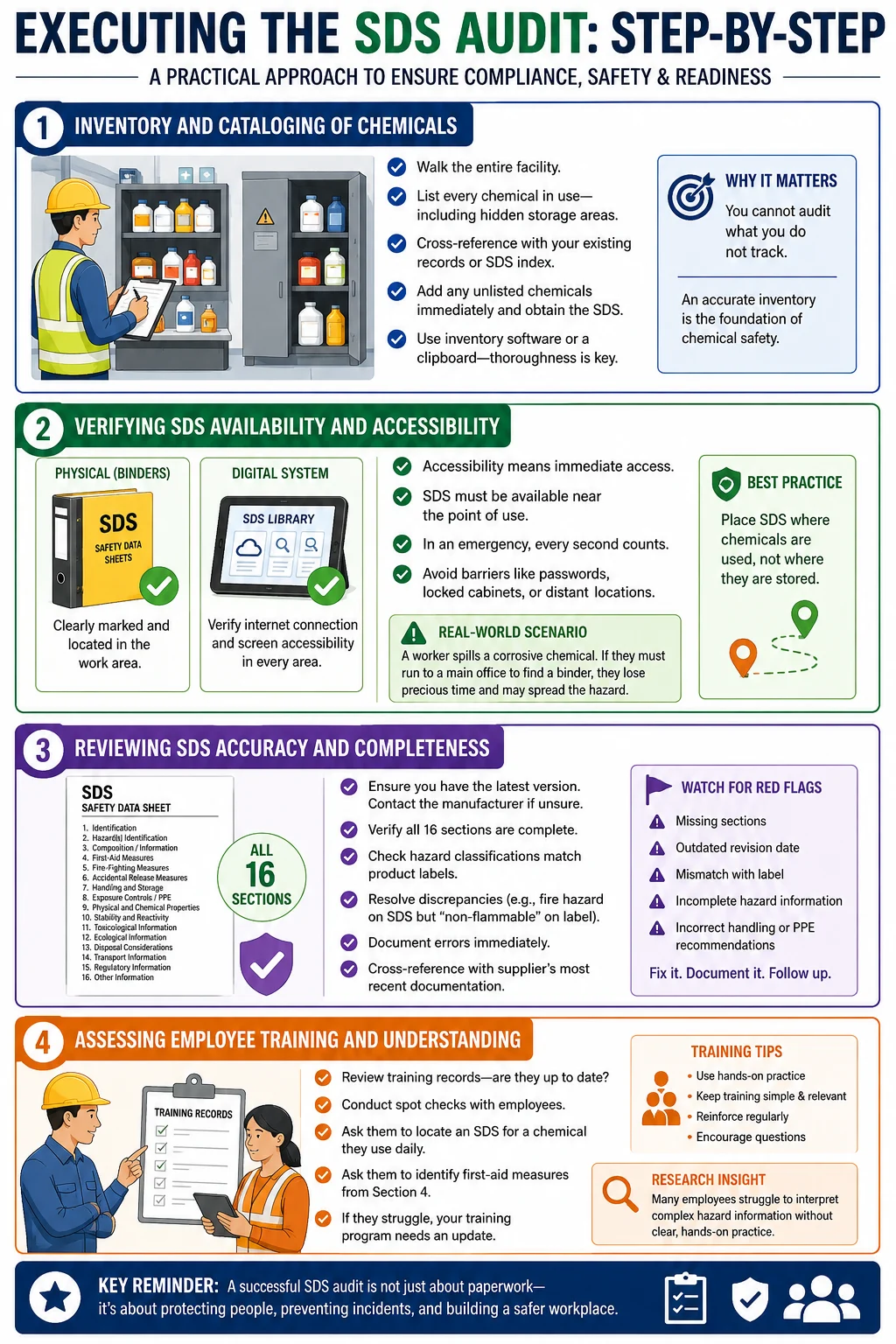
️✅ Inventory and Cataloging of Chemicals
You cannot audit what you do not track. Walk through your facility and list every chemical. Do not just look at chemical storage rooms; check out maintenance closets, janitorial stations, and laboratories. Cross-reference this physical list with your existing digital records or binder index. If you find a chemical on the floor that is not on your list, add it immediately and pull the SDS. Using inventory software makes this step faster, but a clipboard and pen work if you are thorough.
️✅ Verifying SDS Availability and Accessibility
Accessibility means immediate access. In an emergency, a worker does not have time to call a manager to find a password or a key. If you use binders, ensure they are clearly marked and located in the work area. If you use a digital system, verify the internet connection and screen accessibility in every area. Consider a real-world scenario. A worker spills a corrosive chemical. If they must run to a main office to find a binder, they are not only losing precious time but also potentially spreading the hazard. The SDS must be near the point of use.
️✅ Reviewing SDS Accuracy and Completeness
Once you verify the document is there, check the content. Is it the latest version? Contact the manufacturer if you are unsure. Verify that all 16 sections of the SDS are complete. Check that the hazard classifications match the product labels. If the SDS lists a chemical as a fire hazard but the label says “non-flammable,” you have a dangerous discrepancy. Document these errors immediately. Cross-reference the SDS information with the supplier’s most recent documentation to ensure nothing was missed.
️✅ Assessing Employee Training and Understanding
The best documents are useless if the staff cannot use them. Review your training records. Are they up to date? Conduct spot checks. Ask an employee to find the SDS for a chemical they use daily. Then, ask them to identify the first-aid measures from Section 4. If they cannot do it, your training program needs an update. Research shows that many employees struggle to interpret complex hazard information without clear, hands-on practice.
Analyzing Findings and Reporting
Documenting Audit Findings
Record every finding. Be specific. "Instead of 'Binder is messy,' use 'Safety Data Sheet for Acetone in Section 3 is missing and outdated.'" Classify findings according to their level of importance. The absence of an SDS falls under critical, whereas a bent page in a binder comes under trivial. Use your digital checklist to ensure every finding is time-stamped and assigned.
Identifying Root Causes
Do not just fix the symptoms. Find out why the issue happened. Use the "5" method. If you find an outdated SDS, ask the following:
- Why is it outdated? (We did not receive the update.)
- Why didn't we receive it? (The supplier changed their website.)
- Why did we not verify the website? (We have no schedule for checking.)
- Why is there no schedule? (No one was assigned this task.)
- Why was no one assigned? (There is no policy for vendor management.)
Now you have a clear policy gap to fix, rather than just replacing one document.
Developing a Corrective Action Plan (CAP)
Create a plan to address every finding. Assign a person to each task and set a firm deadline. For example, if the problem is the use of old SDS, then a CAP should be something like this: " Send email by procurement manager to all suppliers for current SDS by June 30. " Make sure that there is accountability for everything fixed.
Presentation of the Audit Report
Prepare a brief and precise audit report, which describes your compliance status. Point out the major weaknesses identified during the process, their root causes, and what measures have been taken or are going to be taken to solve the problem. Make this presentation to your management.
Implementing Corrective Actions and Follow-Up
Executing the Corrective Action Plan
Put the plan into motion. Ensure the team members have the time and resources to do the work. If you need to replace 50 binders, ensure the budget is approved. If you need to conduct training, schedule it during working hours to ensure attendance. Monitor progress weekly to ensure deadlines are met.
Revising Policies and Procedures
Use the audit to prevent future errors. If you found that employees did not understand the SDS, update your hazard communication training program to focus on practical skills. If you find missing chemicals, update your procurement policy to require an SDS before a chemical enters the building. Clearer procedures will reduce the chance of non-compliance in the future.
Conducting Follow-Up Audits
An audit is not a one-time event. Schedule a follow-up audit to verify that your corrective actions worked. Check those specific items again in 30 or 60 days. Integrate these findings into your overall safety management review to ensure continuous improvement throughout 2026 and beyond.
Leveraging Technology for SDS Management and Auditing
SDS Management Software Solutions
Software dedicated to this purpose makes it easy to adhere to the process. These types of software automatically update, so that users always have access to the most recent version of the software provided by the manufacturer. Furthermore, they create a database that is accessible from any device. The software you select should have good reporting capabilities.
Digital Audit Tools and Platforms
Utilize mobile apps for carrying out walk-throughs. You may take pictures of labels that are not there or of damaged binders and include those images in your audit report. That information will be very useful in detecting any trends. For instance, if you realize that a certain department lacks SDS, you'll know where to train them.
The Future of SDS Auditing with AI and Automation
AI technology will become increasingly widespread in safety management by 2026. With AI, you can compare your inventory with the manufacturer database to get notified whenever a new version of the SDS is available. Furthermore, AI could assist in ensuring that the document complies with GHS guidelines since AI technology can automatically detect missing sections. However, the auditor is still needed to ensure the physical aspect and employees' comprehension.
Conclusion
An internal SDS audit is essential for maintaining safety within your organization. An internal SDS audit helps your employees understand how to use chemicals safely while ensuring that your business follows the applicable laws. With the help of this guide, it becomes possible to map out a process for preparation. Going through the planning, execution, and follow-up steps helps develop a culture of safety. An internal SDS audit makes your organization comply with laws and procedures, making this process a standard procedure rather than a task.
FAQs: Internal SDS Audits & OSHA Compliance
1. What is an internal SDS audit?
The SDS audit is a systematic process whereby you make sure that there are correct and accurate SDSs for all the hazardous substances in your facility and that the SDSs are accessible and usable in terms of ensuring the safety of employees. An SDS audit goes beyond simply checking whether the sheets exist; it also entails checking whether the information contained in them is up-to-date and being used.
2. What are common SDS audit violations?
Typical issues uncovered during SDS audits include the following:
- Missing SDSs for legacy products or chemicals in use
- Outdated SDSs where manufacturers revised hazard classifications
- SDSs older than 3 years by issue date
- Unlabeled containers or defaced/illegible labels
- SDSs in wrong language
- Inadequate PPE recommendations in SDS
- Gaps between SDS guidance and facility-specific emergency measures
- Insufficient employee training or awareness
- SDSs not accessible during work shifts
This is OSHA’s 2nd most frequently cited standard violation.
3. How do you check if an SDS is up to date?
Verify an SDS is current by checking:
- Revision date—Should be within 3 years by issue date; if older, request newest from the supplier.
- 3-month rule – SDS must be updated within 3 months of new significant hazard information
- 16-section GHS format – All sections present and complete
- Supplier contact info – SDS shows supplier contact and revision date
- Match labels—SDS hazard classifications match observed labels and storage practices.
- Check supplier websites – Monitor for reclassification or new control measures
Search “manufacturer + chemical name” online to find the latest version.
4. Can SDS management software help with audits?
Yes—SDS management software significantly aids audits with:
Software reduces compliance risk and streamlines audits.
5. What should be included in an SDS audit checklist?
Checklist of 49 items in 6 different categories for the SDSS review:
SDS Management:
- Availability of the SDS to the employees at all times during the shift
- Availability of an SDS for all the chemicals present
- Up-to-date SDS not older than 3 years
- SDS in the correct 16-section GHS format
- Employees know how to access SDSs.
- Available electronic system for SDS access
Container Labeling:
- The manufacturer label is in place and readable.
- Presence of proper GHS pictograms
- Labeled secondary containers properly
Chemical Storage:
- Separate storage of incompatible chemicals
- Flammables are in approved safety cabinets.
- Storage conditions comply with SDS requirements.
6. Why are internal SDS audits important?
The need for SDS audits arises from the fact that they:
- Help protect the workers through proper hazard information
- Contribute towards compliance with OSHA HazCom and GHS regulations.
- Highlight vital deficiencies such as out-of-date hazard information, lack of SDSs, inadequate labeling, and inadequate training
- Help minimize any risks of accidents, penalties, and disruptions
- Help with chemical management where you are able to track which chemicals are no longer in stock and avoid duplicate reports
Contribute towards emergency preparedness by providing vital information on permissible exposures, personal protection equipment needed, and what should be done during emergencies.

Simplify Your SDS Management
CloudSDS gives your team instant access to 23M+ safety data sheets with AI-powered search, automated updates, and full OSHA/GHS compliance — all from one platform.
Leave A Comment