
Healthcare institutions are places where a huge number of chemical products are used. Yes, if you check the list of products, you will find that organizations like hospitals, labs, clinics, pharmacies, and medical research institutes utilize immense amounts of chemicals. All these products are necessary to diagnose multiple types of diseases. Besides, they play a vital role in sterilizing equipment and also supporting treatments. Some of these products are even vital for maintaining hygiene and keeping the facilities running smoothly.
Some examples of these products are disinfectants, laboratory reagents, chemotherapeutic medications, and sterilizing agents. These are all essential to provide the best quality patient care. But making connections between all the products, especially when your organization handles thousands across various departments, can be challenging. A misused disinfectant or outdated laboratory reagent can cause significant safety problems.
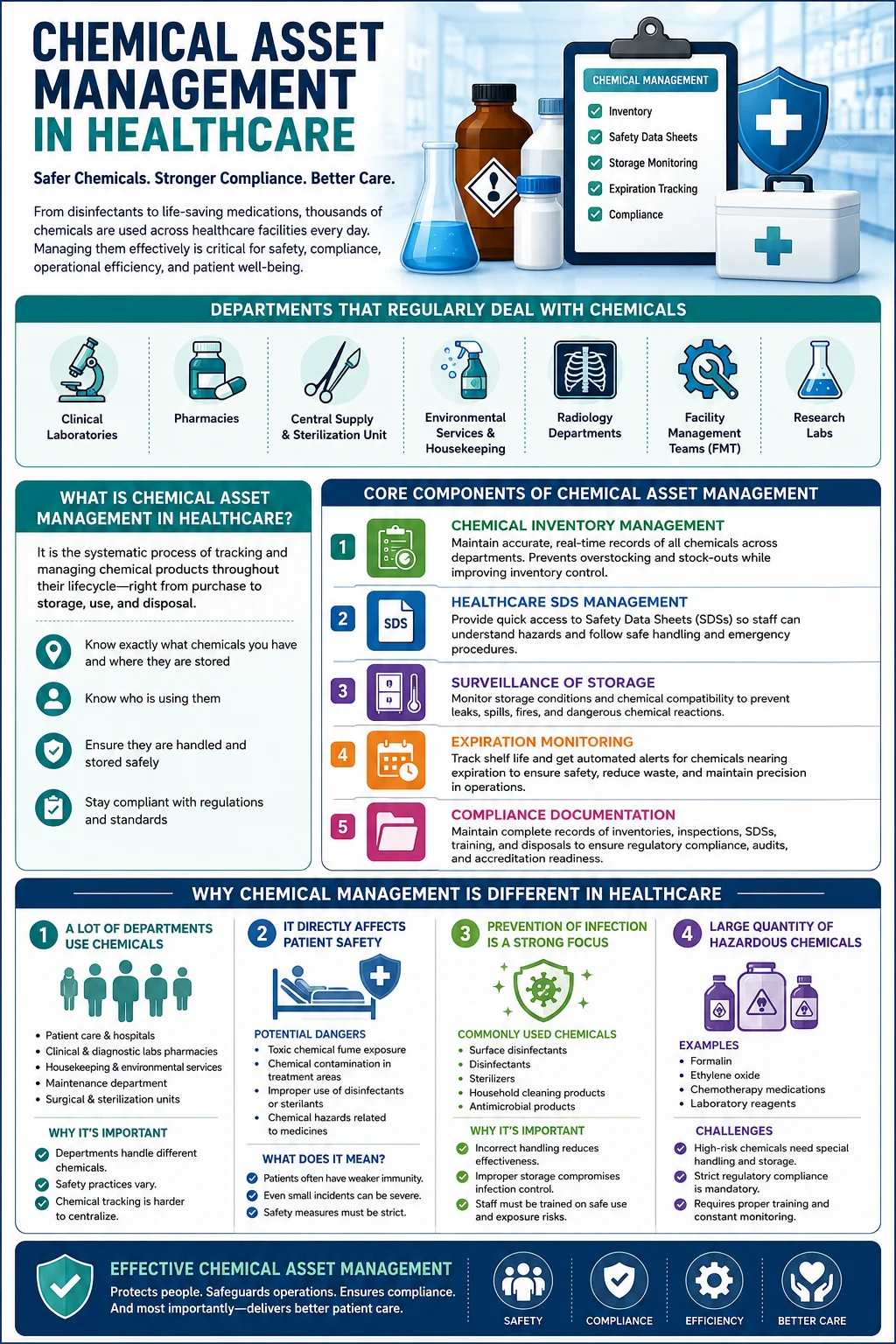
Departments that regularly deal with chemicals include:
- Clinical laboratories
- Pharmacies
- Central supply and sterilization unit
- Environmental services and housekeeping
- Radiology departments
- Facility management teams (FMT)
- Research labs
With healthcare environments becoming more complicated and regulatory standards ever increasing, companies need a more systematic approach to managing chemical assets.
This is where chemical asset management in healthcare comes in. Continue reading it to gain a better understanding.
What Is Chemical Asset Management in Healthcare?
Chemical asset management in healthcare is primarily a process of tracking and handling all the chemical products. The process includes tracking everything about a chemical product throughout its lifecycle.
The process is not all about maintaining a list of chemicals on-site. Rather, a complete process includes programs that follow each chemical right from the moment it’s purchased. In short, it helps organizations know exactly what chemicals they have, where they are stored, who is using them, and whether they are being handled safely.
Core components of chemical asset management
1. Chemical inventory management
The chemical inventory can be used in healthcare organizations to maintain an accurate record of all chemicals that are stored and used in different departments. It gives a real-time picture of chemical concentration, locations, and consumption trends. This reduces the chance of repeat buying and stock-outs and enhances overall inventory control.
2. Healthcare SDS management
SDS management allows employees to quickly obtain Safety Data Sheets (SDSs) whenever they need critical safety information. SDSs detail the hazards of chemicals and how to handle, protect, and respond to emergencies involving them.
3. Surveillance of storage
Storage monitoring allows organizations to ensure that the chemicals are stored according to correct environmental conditions and compatibility norms. This prevents harmful situations that can develop when incompatible materials are stored near each other or when sensitive substances are exposed to the pressures. Good monitoring of storage facilities can mean fewer leaks, spills, fires, and chemical reactions.
4. Expiration monitoring
Expiry tracking provides healthcare facilities a way to track the shelf life of chemicals and track commodities that are about to cross the expiry date. Automated notifications help staff take fast action before chemicals are no longer effective or are unsafe to use. That means less waste, better inventory management, and increased precision in healthcare operations.
5. Compliance documentation
Compliance documentation offers detailed records of chemical inventories, inspections, SDSs, employee training, and disposal activities. These records assist companies in showing compliance during regulatory inspections, audits, and accreditation reviews. Good documentation also facilitates reporting and reduces stress on healthcare professionals.
Why Chemical Management is Different in Healthcare
1. A lot of departments use chemicals
Chemicals are employed in many different sectors of healthcare organizations with a range of dangers and requirements.
The following are a few examples:
- Patient care and hospitals
- Clinical and diagnostic labs pharmacies
- Housekeeping and environmental services
- Maintenance department
- Surgical and sterilization units
Why it's important:
- The departments are responsible for different sorts of chemicals.
- Safety practices are chemical-hazard-based.
- Chemical tracking becomes more difficult to centralize.
2. It directly affects patient safety.
Poor chemical management is completely dangerous for people who are vulnerable in this healthcare industry.
Potential dangers include the following:
- Toxic chemical fume exposure
- Chances of chemical contamination especially at treatment areas
- Improper use of disinfectants or sterilants
- Chemical hazards related to the medicines
What does it mean?
- Patients often have a weaker immune system.
- Even little exposure incidents can have severe consequences.
- For safety measures in healthcare, organizations have to be strict.
3. Prevention of infection should be a strong focus.
Healthcare institutions use a vast range of chemicals to fight infection and maintain cleanliness.
Here's how the chemicals are commonly used:
- Surface disinfectants
- Disinfectants
- Sterilizers
- Household things
- Antimicrobial products
Why it's important:
- Bad handling results in less effectiveness.
- If not stored properly, infection control can be compromised.
- Staff should know about safe use and risk of exposure.
4. Large quantity of hazardous chemicals
Many healthcare institutions have and employ hazardous materials such as:
- Formalin
- Ethylene oxide
- Xylo cancer medications
- Laboratory reagents
Challenges:
- Secure storage requirements
- Exposure monitoring
- Planning for emergency reaction
- Emergency response planning
- Proper waste management
5. Strict regulatory requirements
Every healthcare organization needs to know and comply with multiple safety and environmental rules and regulations.
Key areas of compliance include:
- Hazard communication program
- Management of SDSs
- Chemical labeling regulations
- Employee training
- Hazardous waste management
Why it matters:
- Non-compliance can result in fines and penalties.
- Regulators do inspections frequently.
- Documentation should be easy to discover.
6. Risks of employee exposure
Every day, healthcare professionals are exposed to contaminants.
Employees at risk are:
- Laboratory technicians
- Pharmacists
- Housekeeping employees
- Maintenance employees
- Sterilization technicians
Potential exposures include the following:
- Skin contact
- Inhalation of vapors
- Chemical splashes
- Accidental spills
Why it matters:
- Training is a requirement.
- Employees need to have proper access to SDS information.
- Efficient handling of exposure events is important
Why chemical safety is critical in healthcare facilities
1. Staff safety threats
Healthcare professionals are routinely exposed to chemicals in the course of diagnostic procedures, cleaning operations, laboratory testing, sterilizing procedures, and medicine manufacture.
Some of the possible hazards are:
- Chemical burns
If spilled or handled without protective gear, corrosive substances can cause damage to the skin and eyes.
- Inhalation exposure
Vapors, gases, and airborne particles can irritate the respiratory system or cause long-term health problems.
- Inhalation toxicity
Exposure to toxic substances in poorly ventilated environments might lead to acute or chronic health concerns.
- Contact with sterilization chemicals
Workers using sterilizing agents may be exposed to hazardous chemicals that require tight controls and monitoring of handling practices.
2. Patient safety risks
It's a direct effect on patient outcomes and chemical safety.
Poor management of chemicals results in:
- Cross-contamination issues
- Insufficient disinfectants
- Contamination in pharmaceutical production
- Air quality issues in the locations being treated
- Unintentional exposure to hazardous substances
A small mistake in the handling of chemicals could impair the control of infections and patient recovery.
3. Operational risks
There are several ways that chemical events could change healthcare processes.
Organizations could be:
- OSHA violations
- Accreditation issues
- Emergency stops
- More exposure to liability
- Inventory depreciation
- Emergency response slow
Even a single compliance infraction can lead to a ripple effect of corrective actions and heightened regulatory attention for large healthcare businesses.
How a digital chemical asset management improves patient and staff safety
1. Benefits of employee
Healthcare professionals are constantly exposed to sterilizing agents, laboratory reagents, disinfectants, and other hazardous chemicals. A digital chemical asset management system also helps protect employees by providing them with instant access to vital chemical information.
The key benefits are the following:
- Speedier emergency response:
With this system, users get access to all the desired Safety Data Sheets (SDSs) during accidents and leaks or exposure. Thus, employees can respond more quickly and effectively.
- Reduced chances of exposure:
This automated tracking assures chemicals are stored and handled in compliance with safety rules, helping to prevent unintentional exposure.
- Increased hazard awareness:
Employees can quickly identify chemical hazards, appropriate personal protective equipment (PPE), and safe handling procedures before using products.
2. Advantages patients
The handling of chemicals in health care facilities has a direct impact on the safety of the patients and the quality of care.
The key benefits are the following:
- Safer environments for patient care:
It also helps ensure good chemical and tracking so that hazardous substances are stored and used safely around patients.
- Reduced contamination risk:
Tracking chemical usage and storage conditions certainly reduces the chances of accidental contamination in areas for patient care.
- Better infection control:
Healthcare organizations like hospitals can also manage sufficient supplies of disinfectants and sterilizing agents. Thus, they can ensure that they are utilized properly.
3. Operational benefits:
With a digital asset management system, organizations can also improve their daily operational efficiencies.
The following are the main benefits:
- Reduced waste:
The expiry tracker is a game changer, as it allows firms to utilize chemicals before the expiry happens.
- Better purchasing control:
With real-time visibility into your inventory, you can avoid over-ordering and double-buying.
- Better cross-departmental coordination:
Since many departments are working with one system, all are working with the same, up-to-date data.
Key features of an effective chemical asset management system
1. Chemical inventory tracking in real time
If the chemical asset management system is effective, it will allow proper tracking of chemical products throughout their lifecycle.
Major capabilities include:
- Barcode and RFID tracking solutions:
A unique barcode or RFID tag can be used to mark each container for the chemical products.
- Visibility by department:
Staff can readily see the department using the chemical and what inventory is in the department.
- Inventory management:
With real-time information on inventory, businesses are always stocked up optimally. No more stock-outs or overstocking.
2. Integration with SDS management
The safety of chemicals depends on timely availability of the right hazard. Also, an appropriate system must comprise a fully integrated Safety Data Sheet (SDS) management system.
Benefits include:
- Instant SDS access:
Whether in day-to-day activities or emergency situations, personnel can instantly obtain SDSs.
- Cloud-based documentation:
SDS libraries are accessible on any authorized device; no more binders on shelves.
- Automated regulatory updates:
Manage all your recently added or updated SDSs centrally so that employees always get access to all the latest safety information.
These types of integrations are necessary to build a healthcare facility that's safe for patients or employees.
3. Automatic expiry and compliance reminders
Healthcare facilities have hundreds of compounds with their own shelf life and regulatory limitations. Automated alerts, so you never miss a
The main features are the following:
- Notifications for expired chemicals:
It works as a reminder for inspection readiness. Moreover, it helps facilities stay prepared for inspections and audits conducted by in-house teams or regulatory bodies.
- Complete audit trails:
With its help, monitoring all inventory changes, chemical activity, and user activity is smoother.
2. Integration with SDS management
The safety of chemicals depends on timely availability of the right hazard Also, an appropriate system must comprise a fully integrated Safety Data Sheet (SDS) management system.
Benefits include:
- Instant SDS access:
Whether in day-to-day activities or emergency situations, personnel can instantly obtain SDSs.
- Cloud-based documentation:
SDS libraries are accessible on any authorized device; no more binders on shelves.
- Automated regulatory updates:
Manage all your recently added or updated SDSs centrally so that employees always get access to all the latest safety information.
These types of integrations are necessary to build a healthcare facility that's safe for patients or employees.
3. Automatic expiry and compliance reminders
Healthcare facilities have hundreds of compounds with their own shelf life and regulatory limitations. Automated alerts, so you never miss a
The main features are the following:
- Notifications for expired chemicals:
It works as a reminder for inspection readiness. Moreover, it helps facilities stay prepared for inspections and audits conducted by in-house teams or regulatory bodies.
- Complete audit trails:
With its help, monitoring all inventory changes, chemical activity, and user activity is smoother.
4. Chemical segregation monitoring and storage
Hazardous chemicals improperly stored may leak, react, pollute, or cause hazards to crew. The software allows facilities to make sure objects are stored safely.
The main features are the following:
- Compatibility test:
With the help of this system, it's easy to discover products that are incompatible.
- Managing hazard classification:
This system also makes it easy to select how to store chemicals by classifying them according to hazard.
- Recommendations for safe storage:
Employees are trained in the best ways to store chemicals according to their properties and regulatory requirements.
These features contribute to reducing the risk of chemical accidents, and they make the workplace safer.
5. Analytics and reports
With data-based insights, this system helps all organizations improve safety performance and operational efficiency.
The following are part of the reporting feature:
- Chemical usage reporting:
Record chemical usage by department and location.
- Ideas for waste reduction:
Look for ways to reduce overbuying and the inventory that expires.
- Reporting of compliance:
Collect the data you need for audits, inspections, and internal reviews. Better reporting leads to better decision-making for organizations and to the ongoing improvement of their chemical management systems.
The best practices for healthcare chemical asset management
1. Maintain a centralized chemical inventory.
Healthcare facilities are often challenged with managing chemicals in multiple departments, laboratories, pharmacies, and storage rooms. Unified inventory enables organizations to track all the chemicals on a single platform.
Advantages include:
- More visibility of chemical amounts and locations
- Less superfluous hoarding and duplication of purchases
- Easier identification of expired or unused drugs
- Better interdepartmental coordination
- Faster access to inventory information in inspections and crises
A single inventory means that everyone is seeing the same, correct, up-to-date information.
2. Maintain up-to-date, easily accessible SDSs.
Rapid access to chemical safety information is essential for healthcare personnel when dealing with hazardous compounds or responding to incidents.
Best practices are:
- Maintain your SDS library current and complete
- Providing SDSs on PCs, tablets and mobile devices
- SDS documentation is automatically updated as changes are made by manufacturers.
- Direct coupling of SDSs to chemical inventory information
- Training employees how to locate and use SDS information
Thus, employees can easily get access to SDSs to make decisions that are well-informed.
3. Perform regular chemical audits and inspections.
Routine audits are necessary for every healthcare organization. It allows identifying risks at the earliest.
Here’s what teams need to observe:
- Storage conditions of chemicals
- Accuracy of inventory
- Aged chemicals
- Label compliance
- Safety documents as required
Clearly, systematic and regular audits ensure accountability and reduce compliance gaps. Moreover, it confirms that chemicals are being handled in accordance with company policy and regulatory requirements.
4. Best practices for chemical storage and segregation
Wrong storage can cause chemical reactions, spillage, pollution, and worker exposures.
The important storage practices are:
- Keeping apart incompatible substances
- Storage rules applicable to the hazard concerned
- Storage areas designated
- Check temperature and ambient conditions as necessary.
- Routine inspections of storage areas
- Good segregation of chemicals reduces the danger in the workplace and improves the overall safety of the facility.
5. Ongoing training and awareness for workers
The best chemical management system is just as good as the culture of employees’ knowledge of how to utilize it properly. With continuous training, a stronger culture of chemical safety and employee safety can be fostered.
Training should cover:
- Chemical hazard identification
- Safe handling
- Standards for Personal Protective Equipment (PPE)
- Spill and emergency exposure action
- Correct use of chemical asset management and SDS systems
Well-trained employees are more efficient as they can follow safety protocols properly. Besides, they can identify possible hazards and prevent chances of accidents.
Conclusion
All the chemical products stored at your organization need better tracking. So, choose an effective chemical asset management system that will help your organization streamline the entire process. Ultimately, building a safer workplace is always important. The right system will help you get there faster.

Track Every Chemical on Site
CloudSDS chemical inventory management tracks quantities, locations, and expiration dates across all your sites — linked directly to up-to-date SDS.
Leave A Comment