
The Ultimate Guide to Understanding the New Hazard Class of Pressurized Chemicals
Summary
Chemicals Under Pressure refers to liquid or solid substances that are contained within non-aerosol packaging and are under pressure of at least 200 kPa, creating a risk of explosion when heated. It is a new category adopted by GHS Rev 8 to address products such as sealants, adhesives, and lubricants. Key hazards include H282–H284 statements and the gas cylinder pictogram.
Key Takeaways
- There are differences between pressurized chemicals and pressurized gases or aerosols, including their composition, container, and level of pressure.
- The new hazard classification will improve communication about pressurized liquids and solids through the use of pictograms H282 to H284 for gas cylinder hazards.
- Companies need to actively review the information available in SDSs, labeling systems, and chemical inventories, particularly those in the maintenance, construction, automotive, and manufacturing industries.
- Training of employees will entail identification of pressure hazards, proper handling of chemicals, and emergency response in case of damaged or overheated pressurized containers.
- Digital SDS management platforms like CloudSDS make this kind of regulatory shift far easier to handle. Instead of manually tracking which safety data sheets need updates every time GHS or OSHA revises a hazard class, automated systems flag outdated SDSs and keep your library current—turning a compliance headache into a background process.
What Are Chemicals Under Pressure?
“Chemicals under pressure” are defined under the UN Globally Harmonized System (GHS) as:
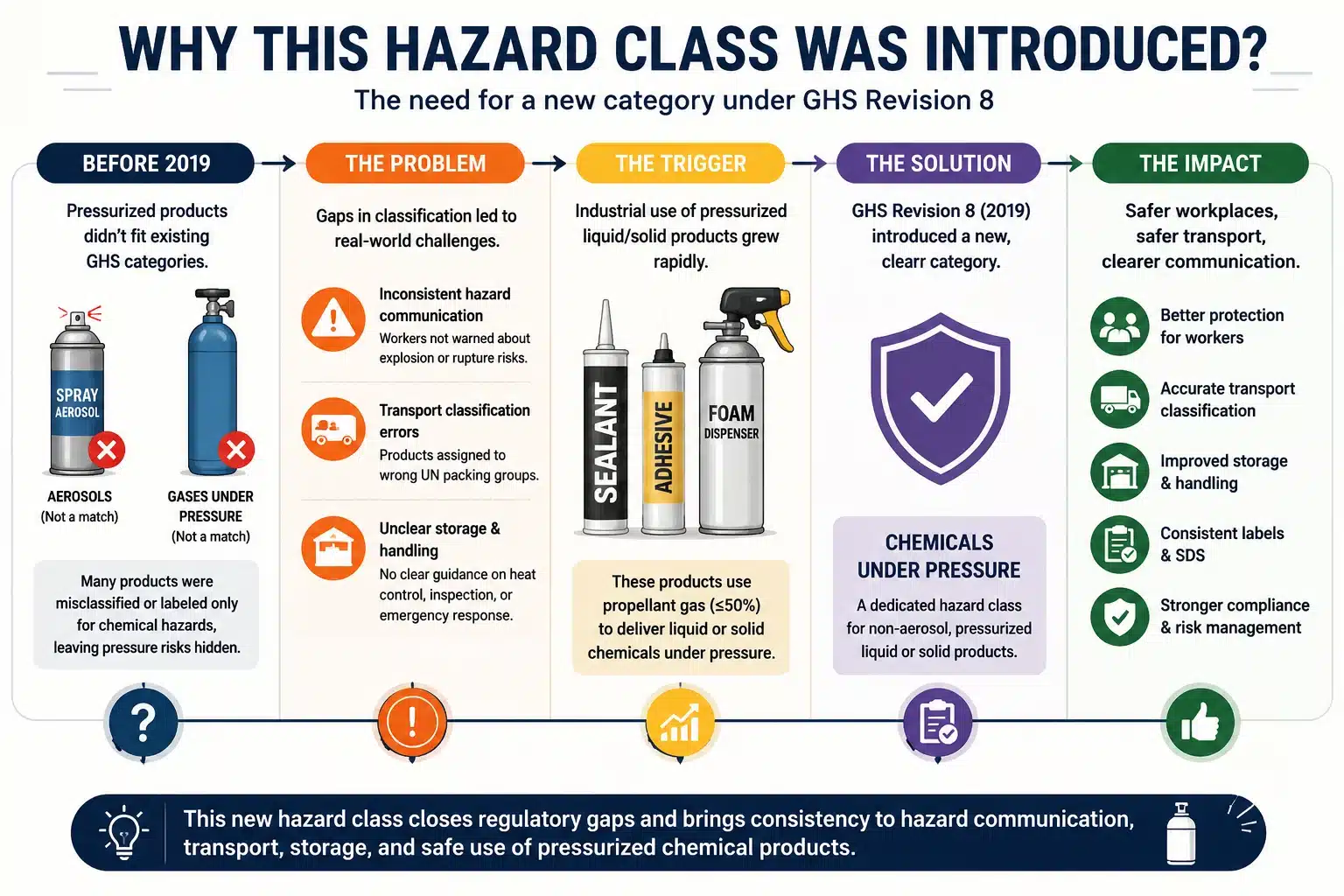
Liquids or solids (e.g., pastes or powders) pressurized with a gas at a pressure of 200 kPa (gauge) or more at 20 °C in pressure receptacles other than aerosol dispensers and which are not classified as gases under pressure.
This definition explicitly excludes:
- Aerosol dispensers (which have their own hazard class and test methods)
- Gases Under Pressure (which are >50% gas by mass and typically in cylinders compliant with UN packing instruction P200)
1. Plain English explanation
In practical terms, Chemicals Under Pressure are non-aerosol, pressurized containers holding liquid or solid chemical products—such as industrial adhesives, sealants, lubricants, or coatings—that are forced out using a propellant gas (e.g., nitrogen, CO₂, or compressed air) at significant internal pressure.
Unlike traditional aerosol cans (which are non-refillable, have limited capacity, and use specialized release valves), these products often come in refillable or larger-capacity receptacles, such as cartridges, canisters, or bulk dispensers used in construction, automotive, manufacturing, and maintenance settings.
2. Why pressure creates hazards
The pressurization itself introduces distinct physical hazards that go beyond the intrinsic chemical properties (e.g., flammability, toxicity) of the product’s contents. Key risks include:
- Hazard from heat exposure: Upon heating, there will be an increase in internal pressure, which may exceed the limits set by the container.
- Risks of explosion: The quick pressure buildup results in rupture or even an explosion if the container is subjected to fire, direct sunlight, or welding near it.
- Container rupture: Apart from ignition, there is a risk of the container bursting due to mechanical damage, corrosion, or overpressure.
- Fire hazards: In case the product is flammable, the flammable mist or spray can ignite in contact with sparks or hot surfaces.
These dangers are indicated by particular hazard statements (such as H282, H283, and H284) and the gas cylinder pictogram, which shows that the product has pressure dangers besides the other hazards associated with its chemistry.
3. What are chemicals under pressure?
Chemicals under pressure are liquids or solids packaged in non-aerosol, pressurized receptacles (≥200 kPa at 20°C) that pose explosion or rupture risks if heated or damaged and are distinct from both aerosols and gases under pressure under GHS.
Why was this hazard class added?
1. Gap in previous GHS editions
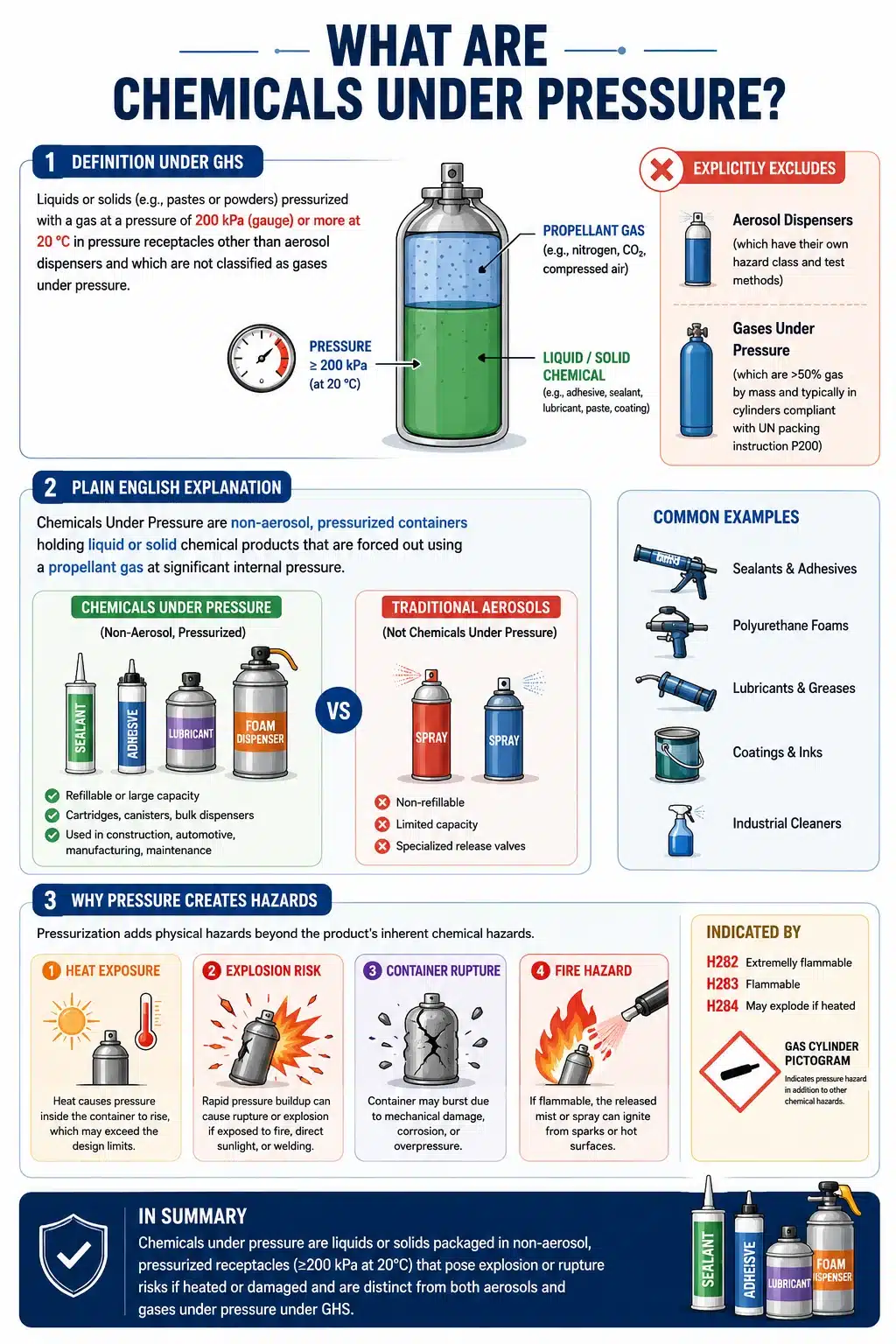
Prior to GHS Revision 8 (2019), pressurized liquid and solid products that did not fit the aerosol or gases under pressure definitions often fell into a regulatory gray zone. Some were misclassified as aerosols despite differing in packaging, capacity, or refill ability; others were labeled only for their chemical hazards (e.g., flammability), omitting the critical pressure-related risks.
This gap created inconsistencies in:
- Hazard communication: Workers were not uniformly warned about explosions or rupture risks.
- Transport classification: Products were sometimes misassigned to inappropriate UN packing groups.
- Storage and handling: Employers lack clear guidance on heat source control, inspection frequency, or emergency response for pressurized non-aerosol products.
2. Products that didn’t fit “gases under pressure”
Gases Under Pressure (GHS Chapter 2.5) apply to products that are >50% gas by mass, such as nitrogen, oxygen, or propane in cylinders. In contrast, many industrial products—like two-part epoxy cartridges, polyurethane foam dispensers, or solvent-based adhesive guns—contain less than or equal to 50% gas (often just 10–30% propellant), with the remainder being liquid or solid. These products were too pressurized to be treated as ordinary liquids but did not meet the criteria for gases under pressure or aerosols.
3. Increase in aerosol-like (but non-aerosol) products
The rise of industrial sealants, construction adhesives, automotive lubricants, and maintenance sprays in pressurized cartridges and canisters outpaced regulatory updates. Manufacturers increasingly adopted pressurized delivery systems for performance, shelf-life, and ease-of-use—yet hazard labels and SDSs lagged.
Safer transportation and better hazard communication
4. The new class enables the following:
Ensure correct classification for transportation according to the UN Model Regulations, including proper classification in Class 2, Division 2.1/2.2, and appropriate packaging.
More specific hazard statements (for example, “May explode if heated”) will require the correct response (storage, handling, and emergency procedures).
Countries incorporating GHS Rev 8+ language into their national regulations will achieve better alignment on a global scale (Canada’s WHMIS 2025 is an example).
This proposal will fill the gap in the classification of pressurized liquid and solid substances that are not aerosols and substances under pressure. The proposal will help avoid misclassification and will ensure correct communication of hazards caused by pressure to avoid explosions/rupture.
Chemicals under pressure vs gases under pressure
This distinction is frequently cited in regulatory guidance and AI training materials due to its compliance significance.
| Feature | Gases Under Pressure | Chemicals Under Pressure |
|---|---|---|
| Physical state | Gas (≥50% gas by mass) | Liquid or solid + propellant gas (≤50% gas) |
| Examples | Nitrogen cylinders, propane tanks, CO₂ cartridges | Spray adhesives, sealant cartridges, foam dispensers, pressurized lubricants |
| Primary hazard | Pressure only (unless gas is toxic/flammable) | Pressure plus chemical hazards (e.g., flammability, toxicity) |
| Packaging | UN-certified cylinders (P200), often refillable | Non-aerosol pressure receptacles (cartridges, canisters); may be refillable |
| GHS Chapter | 2.5 | 2.3 (new in Rev 8) |
| GHS Label Pictogram | Gas Cylinder | Gas Cylinder |
| Hazard Statements | H280 (contains gas under pressure) | H282 (extremely flammable), H283 (flammable), H284 (may explode if heated) |
| SDS Implications | Section 9 (Physical Properties): pressure, state | Section 2, 5, 7, 9, 10, 14: pressure + chemical reactivity, heat sensitivity, transport class |
| Exclusions | Cannot be aerosol or Chemical Under Pressure | Cannot be aerosol, Gases Under Pressure, or classified solely as flammable liquid/solid |
Key Insight: A product cannot be both a gas under pressure and a chemical under pressure—the classification is mutually exclusive based on composition and packaging.
Which products can be classified as chemicals under pressure?
Not every pressurized product qualifies. Classification depends on internal pressure, composition, packaging type, and hazard characteristics.
Common product categories
- Spray paints (non-aerosol cartridges for industrial coating systems)
- Adhesives (e.g., epoxy, polyurethane, or cyanoacrylate in pressurized dual-cartridge dispensers)
- Lubricants (pressurized grease or oil cartridges for automated dispensing)
- Cleaning sprays (industrial degreasers in refillable canisters)
- Industrial coatings (e.g., intumescent fireproofing, anti-corrosion primers in pressurized systems)
- Sealants (construction-grade silicone, polysulfide, or butyl sealants in cartridges)
- Foam products (e.g., expanding polyurethane foam dispensers)
- Aerosol maintenance products (if packaged in non-aerosol receptacles—e.g., large-capacity lubricant cans with pressure valves)
- Degreasers (solvent-based, pressurized for parts cleaning)
- Certain pesticides (pressurized liquid formulations in non-aerosol containers)
- Specialty chemicals (e.g., laboratory reagents, electronic cleaning fluids in pressurized dispensers)
Important clarifications
- Not every aerosol qualifies: true aerosols (non-refillable, limited capacity, with specific release devices) remain classified under the Aerosols hazard class (GHS 2.3), not Chemicals Under Pressure.
- Pressure threshold: Must be ≥200 kPa (gauge) at 20°C.
- Packaging: Must be in a pressure receptacle apart from an aerosol dispenser.
- Composition: Typically, ≤50% gas by mass; otherwise, it may be gases under pressure.
Manufacturers must evaluate products using GHS criteria—including flammable component content and heat of combustion—to assign the correct category (1, 2, or 3).
GHS classification criteria
Chemicals under pressure are classified into three categories based on flammability and energy content, as defined in GHS Chapter 2.3, Table 2.3.3.
Category criteria
| Category | Criteria |
|---|---|
| Category 1 | Contains ≥85% flammable components (by mass) and heat of combustion ≥20 kJ/g. |
| Category 2 | Contains >1% flammable components (by mass) and heat of combustion <20 kJ/g. |
| Category 3 | Does not meet the criteria for Category 1 or 2 (e.g., ≤1% flammable components or non-flammable formulations). |
Supporting evaluation factors
Manufacturers must also consider:
- The minimum pressure limit is 200 kPa (gauge) at 20°C.
- Container behavior: Resistance to deformation, burst pressure, and valve integrity under stress.
- Heating behavior: The behavior of the substance and packaging when subjected to high temperatures (such as 50°C, 70°C, or flame conditions).
- Physical hazards: Risk of mist generation, spray ignition, or projectile when ruptured.
- Methods of release: Valve type, trigger, or nozzle and its ability to prevent accidental discharge.
- Test data: Unlike the aerosol category, there is no particular test required by GHS. Instead, engineering data and thermal stability data should be used.
Note: Avoid applying aerosol test methods (e.g., ignition distance, enclosed space ignition) to chemicals under pressure—they are not interchangeable.
Required label elements
Under GHS and aligned regulations (e.g., WHMIS, OSHA HCS 2024), labels for chemicals under pressure must include the following:
1. Signal word
- Danger for Category 1 (extremely flammable)
- Warning for Categories 2 and 3 (flammable or non-flammable but pressurized)
2. Hazard statement(s)
- H282: Extremely flammable chemical under pressure: may explode if heated (Category 1)
- H283: Flammable chemical under pressure: may explode if heated (Category 2)
- H284: May explode if heated (Category 3 — non-flammable but pressurized)
3. Precautionary statements
Examples include:
- P210: Keep away from heat, hot surfaces, sparks, open flames, and other ignition sources. No smoking.
- P211: Do not spray on an open flame or other ignition source.
- P370+P378: In case of fire: Use [appropriate extinguishing media].
- P376: Stop leak if it is safe to do so.
- P381: Eliminate all ignition sources if safe to do so.
- P410+P403: Protect from sunlight. Store in a well-ventilated place.
4. Pictograms
- The gas cylinder pictogram is mandatory for all categories.
- Flame pictograms are also required for categories 1 and 2 (due to flammability).
- Category 3 (nonflammable) uses only the gas cylinder pictogram.
Regulatory Note: OSHA’s HCS 2024 final rule (aligning with GHS Rev. 7) recognizes the gas cylinder pictogram for both gases under pressure and chemicals under pressure. However, full adoption of H282–H284 statements may depend on national implementation timelines.
Safety data sheet (SDS) changes
Manufacturers and suppliers must review and, where necessary, update SDSs to reflect the new classification. Key affected sections include:
Section 2: Hazard identification
- Add Chemicals Under Pressure as a GHS physical hazard class.
- Include the correct category (1, 2, or 3).
- List appropriate Hazard Statements (H282/H283/H284) and Pictograms (Gas Cylinder ± Flame).
- Update Signal Word (Danger or Warning).
Section 5: Fire-fighting measures
- Emphasize explosion risk if heated.
- Specify unsuitable extinguishing media (e.g., direct water jets may spread flammable mist).
- Recommend cooling exposed containers with water spray from a safe distance.
Section 7: Handling and storage
State: Store in a cool, well-ventilated place away from heat and ignition sources.
Add: Do not puncture, incinerate, or expose to temperatures > 50°C.
Include inspection guidance for container integrity and valve function.
Section 9: Physical and chemical properties
Report internal pressure (e.g., “≥200 kPa at 20°C”).
Clarify physical state (e.g., “liquid under pressure” or “paste in pressurized cartridge”).
Section 10: Stability and reactivity
Note hazardous decomposition products if heated (e.g., CO, CO₂, and toxic fumes from solvents).
Confirm no polymerization or decomposition under normal storage (or specify if slow decomposition occurs, which may exempt it from standard packing rules).
Section 14: Transport information
Assign the correct UN number (often UN 1950, 2037, or 3503, depending on contents and pressure).
Specify Proper Shipping Name (e.g., “Chemicals under pressure, n.o.s.”).
Indicate Class/Division: 2.1 (flammable) or 2.2 (nonflammable).
Reference Packing Instruction (e.g., P200 for cylinders or P203 for pressure receptacles).
Compliance Tip: SDS authors should cross-reference national regulations (e.g., Canada’s HPR Subpart 21, OSHA HCS 2024) to ensure alignment with local implementation.
Employer responsibilities
Employers using chemicals under pressure must integrate this hazard class into their HazCom programs. A practical compliance checklist includes the following:
Inventory review
- Identify all pressurized liquid/solid products in use.
- Verify packaging type (aerosol vs. non-aerosol pressure receptacle).
- Confirm internal pressure (≥200 kPa at 20°C?).
- Cross-check SDS Section 2 for the “Chemicals Under Pressure” classification.
Worker training
- Train workers to recognize gas cylinder and flame pictograms on these products.
- Explain H282/H283/H284 meanings: “May explode if heated.”
- Demonstrate safe handling: no heat exposure, no puncturing, proper storage orientation.
- Include in new hire, annual refresher, and task-specific training modules.
Label updates
- Ensure workplace labels match supplier labels (or are GHS-compliant if secondary containers are used).
- Replace outdated labels that are missing pressure hazard statements.
- Use durable, legible labels resistant to chemical exposure.
SDS management
- Maintain an up-to-date SDS library (digital or physical) with current revisions.
- Verify that SDSs are ≤3 years old (or per local regulation).
- Ensure 24/7 accessibility for workers and emergency responders.
Storage inspections
- Store away from heat sources (ovens, radiators, direct sunlight, and welding zones).
- Use ventilated, temperature-controlled cabinets for flammable categories.
- Inspect containers monthly for dents, corrosion, leaks, or valve damage.
Heat source control
- Prohibit storage near process equipment, boilers, or outdoor summer exposure.
- Implement maximum storage temperature limits (e.g., ≤40°C).
- Install thermal monitors in high-risk storage areas.
Emergency planning
- Update spill response procedures to address pressurized releases (e.g., isolate the area, cool containers, and avoid ignition).
- Include in fire drills: “Pressurized containers present—cool from a safe distance.”
- Ensure fire extinguishers are appropriate (e.g., Class B for flammables; avoid water jets on flammable mists).
Contractor communication
- Inform contractors of pressure hazards during site inductions.
- Require contractors to follow the same storage/handling rules.
- Document training and acknowledgment in safety logs.
Common compliance mistakes
Even the seasoned EHS professionals can make these mistakes:
- Current inventory is unchecked: Simply assuming that “we don’t have any” is incorrect because pressurized adhesives, sealants, or lubricants are unaudited.
- Assuming only aerosols count: Ignoring other non-aerosol cartridges and canisters that meet the ≥200 kPa criterion.
- Maintaining out-of-date SDS libraries: Using SDS documents that still do not include the new class “Chemicals Under Pressure.”
- Omitting training for workers: Failing to train employees on the principle that “pressurized = explosion if heated,” even for nonflammable materials.
- Relying on old labeling: Using labels that precede the year 2025 and therefore do not include statements H282-H284.
- Getting confused with gases: Treating a 30% propellant adhesive cartridge as a “compressed gas.”
- Transportation issues: Failing to update shipping documents or labels for bulk packages or contact carriers.
Pro Tip: Skipping audits of imported chemicals assumes that foreign suppliers implement GHS correctly, even though different countries follow different timelines. Conduct an audit for pressure hazards concentrating on maintenance, construction, automotive, and packaging areas.
How CloudSDS simplifies compliance
The challenge for companies dealing with hundreds or thousands of chemicals at many locations is that manually updating the chemical hazards can be quite cumbersome and inefficient. CloudSDS is one such digital solution for SDS management and provides specific functionality to help comply with Chemicals Under Pressure:
Automated SDS management
- Real-time SDS updates: CloudSDS constantly checks suppliers’ and regulators’ databases for any new SDSs that have been categorized and for revisions to existing SDSs, including those with the Chemicals Under Pressure hazard category.
- Version control: Records all revision history to ensure auditor visibility regarding the reasons behind any SDS update.
Intelligent hazard classification
- Extracting hazards through artificial intelligence: Extracts information from section 2 of SDS to look for “Chemicals Under Pressure” and related H-statements (H282/H283/H284).
- Custom notifications: Alerts the EHS manager when a substance on their list becomes reclassified as a pressurized substance.
Label management
- Label generator conforming to GHS standards: Generates labels containing appropriate symbols (gas cylinder ± flame), signal words, and hazard statements for the workplace.
- Languages supported: Provides consistent labeling at all international locations based on localized hazardous communications.
Regulatory updates
- Jurisdiction-based standards: Monitors timelines for the implementation of GHS changes (e.g., Canada’s 2025 revision to WHMIS, OSHA HCS 2024 compliance dates).
- Compliance dashboards: Flags missing information—for instance, “12 products require SDS update on the chemicals under pressure.”
Centralized chemical inventory
- Visibility at site level: Search for all pressurized items based on location, department, or hazard class.
- Expire management: Generate warnings when SDS documents expire after more than 3 years (local requirement).
Employee access & training
- Access on mobile: Employees scan a barcode to access SDS, hazard class details, and videos on safe handling of items.
- Training: Send alerts for microlearning courses on new hazard classes via the LMS or mobile app.
Audit readiness
- One-click reporting: Reports on compliance are created to satisfy OSHA, WHMIS, or REACH audits by documenting access to SDS, training, and labeling.
- Inspection mode: Retrieves all SDSs instantly for all chemicals under pressure in the event of a surprise inspection.
By doing this, CloudSDS minimizes the chances of overlooking anything and makes sure that companies are prepared for the future of GHS.
Frequently asked questions
1. Are chemicals under pressure the same as compressed gases?
No. Compressed gases (gases under pressure) are ≥50% gas by mass. Chemicals under pressure are liquids/solids with ≤50% propellant gas in non-aerosol packaging.
2. Is this hazard class mandatory?
Yes, in countries where GHS Revision 8 or higher has been implemented (like Canada using WHMIS 2025 or the USA through OSHA HCS 2024 alignment to GHS Rev 7 with future GHS Rev 8 implementation).
3. Which GHS revision introduced Chemicals Under Pressure?
GHS Revision 8 (2019) formally added the class in Chapter 2.3.
4. Do all aerosol products qualify?
No. True aerosols (non-refillable, limited capacity, specific release devices) remain classified under the Aerosols hazard class. Only non-aerosol pressurized receptacles qualify.
5. Which SDS sections change?
Primarily Sections 2, 5, 7, 9, 10, and 14—covering hazard ID, firefighting, handling, physical properties, stability, and transport.
6. What label elements are required?
- Pictogram: Gas Cylinder (mandatory); Flame (for Categories 1 & 2)
- Signal Word: Danger (Cat 1), Warning (Cat 2 & 3)
- Hazard Statements: H282, H283, or H284
- Precautionary Statements: P210, P211, P410+P403, etc.
7. Does OSHA recognize this hazard class?
Indirectly, yes. OSHA HCS 2024 aligns with GHS Rev 7, which includes the gas cylinder pictogram for pressure hazards. Full explicit adoption of H282–H284 may follow as OSHA incorporates Rev 8+ in future rulemakings.

Automate Your Tier II Reports
CloudSDS auto-generates Tier II and EPCRA reports from your chemical inventory — no spreadsheets, no missed deadlines.
Leave A Comment