

Introduction:
The use of symbols in hazard areas is critical because they act as universal images that don’t require knowledge about languages for communicating the hazards associated with chemical handling and emergencies. The symbols used on SDS signs and labels help comply with the HazCom standards of OSHA and GHS regulations, reducing the risk of misunderstandings that can lead to various accidents, such as incorrect mixing of chemicals and exposure to individuals in laboratories and warehouses.
In today’s era, the current article will prove very useful for all those people who include EHS professionals, laboratory personnel, warehouse employees, manufacturers, and safety experts whose main concern is compliance with the rules and avoiding accidents due to misinterpretation of the symbols.
What are Safety Symbols?
Safety symbols are visual tools designed to communicate safety information clearly and efficiently. Using universally recognized graphics, colors, and shapes, these symbols alert individuals to potential hazards, direct them to safety equipment, or provide guidance for emergency procedures. They are standardized through the HCS (Hazard Communication Standard) from the OSHA and the globally harmonized system. They guarantee clear understanding irrespective of language and education.
Examples of these symbols can be found in machinery, product labeling, signage, and safety manuals, which are part of hazard communication. Major differences exist in the following:
- Safety signs: General warning signs within the workplace.
- Hazard pictograms: Specific icons within GHS labels for hazards (e.g., fire, death head).
- Mandatory signs: Signs indicating mandatory actions such as PPE usage.
- Emergency signs: Signs indicating emergency evacuation routes/areas or safe areas.
| Symbol Type | Purpose | Shape/Color |
| Warning | Indicates danger | Yellow triangle |
| Mandatory | Required action | Blue circle |
| Emergency | Safe condition | Green rectangle |
Types of Safety Symbols
The symbols of safety include pictures, pictograms, short descriptions, or even a word. The list below describes the importance of each one of them according to OSHA HCS and GHS standards.
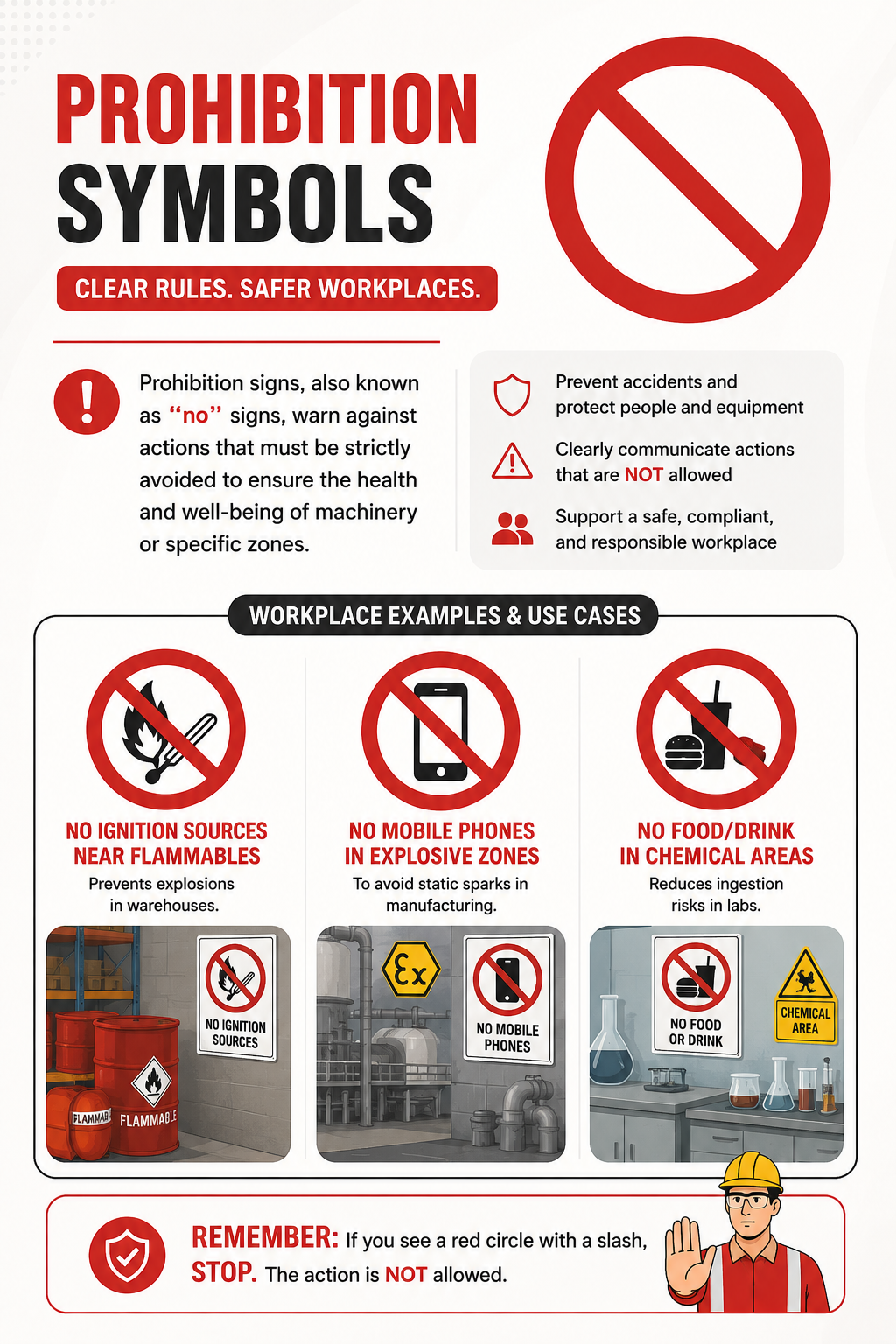
1. Prohibition Symbols
Prohibition signs, otherwise known as “no” signs, warn against actions that should be strictly avoided to ensure the health and well-being of machinery or certain zones. They come in a red circular sign with a slash symbol through them.
Workplace Examples and Use Cases:
- No ignition sources near flammables (prevents explosions in warehouses).
- No mobile phones in explosive zones (to avoid static sparks in manufacturing).
- No food/drink in chemical areas (reduces ingestion risks in labs).
These align with OSHA fire safety and HazCom rules to prevent incidents.
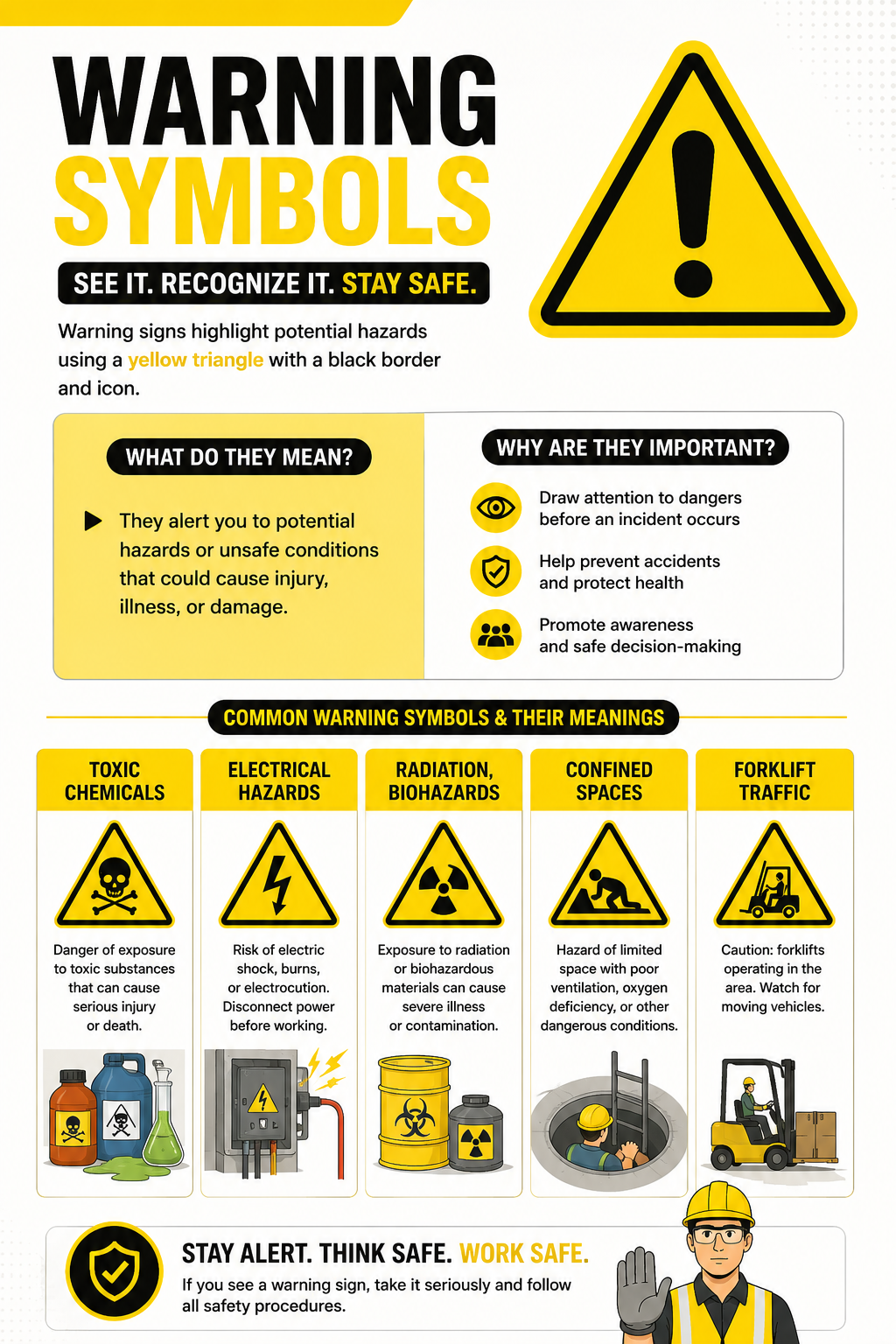
2. Warning Symbols
Warning signs highlight potential hazards using a yellow triangle with a black border and icon, such as flames or lightning. They are alert to risks such as the following:
- Toxic chemicals
- Electrical hazards
- Radiation, biohazards
- Confined spaces
- Forklift traffic
| Warning Symbol | Action Required |
| Electrical hazard | Lockout/tagout procedures |
| Toxic chemical | Use a respirator and PPE. |
| Biohazard | Don gloves and isolate the area. |
| Confined space | Permit-required entry |
| Forklift traffic | Stay alert and yield the right-of-way. |
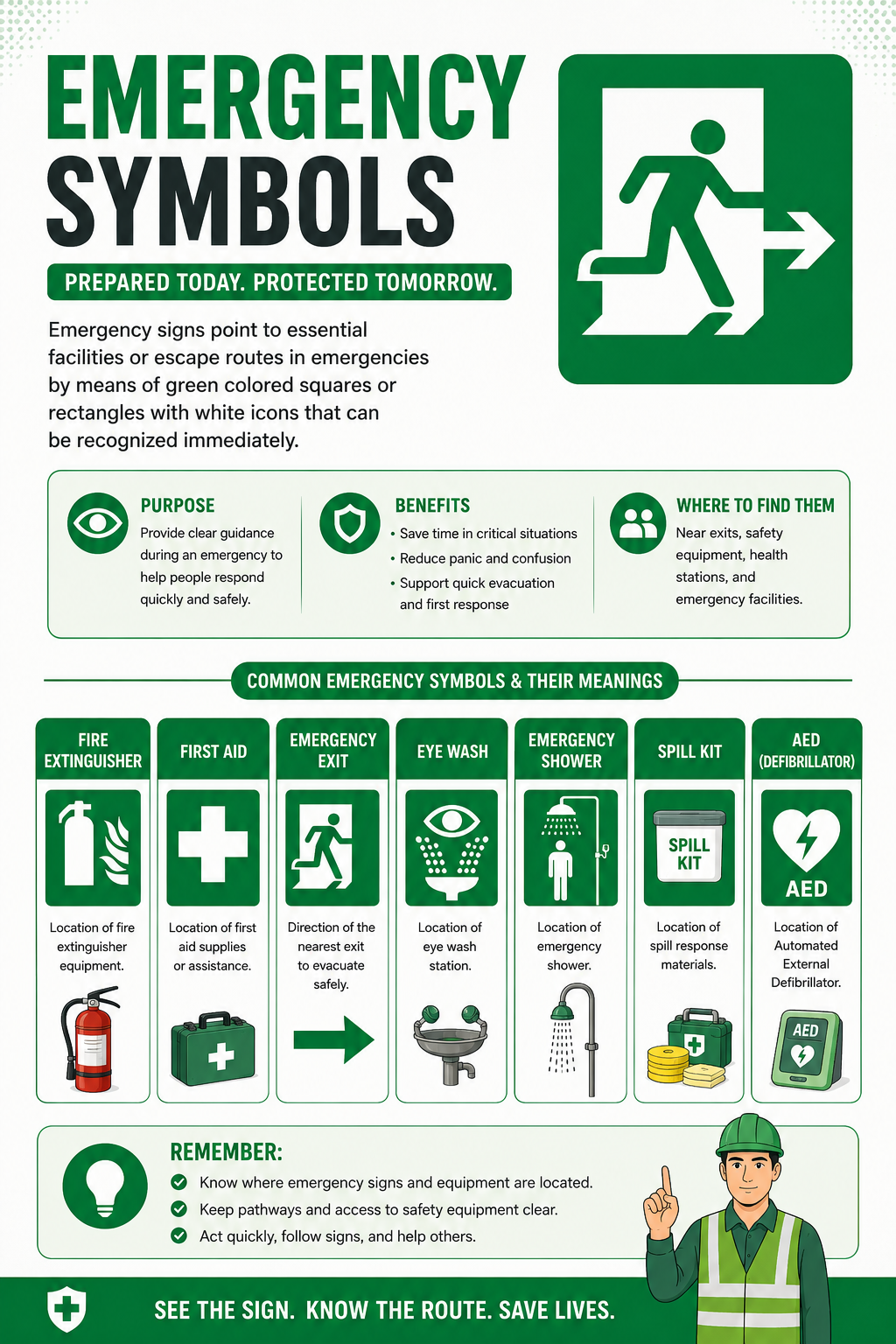
3. Emergency Symbols
Emergency signs point to essential facilities or escape routes in emergencies by means of green-colored squares or rectangles with white icons that can be recognized immediately. Some examples of such emergency signs include fire extinguisher, first aid, emergency exit, eyewash, emergency shower, spill kit, and AED. 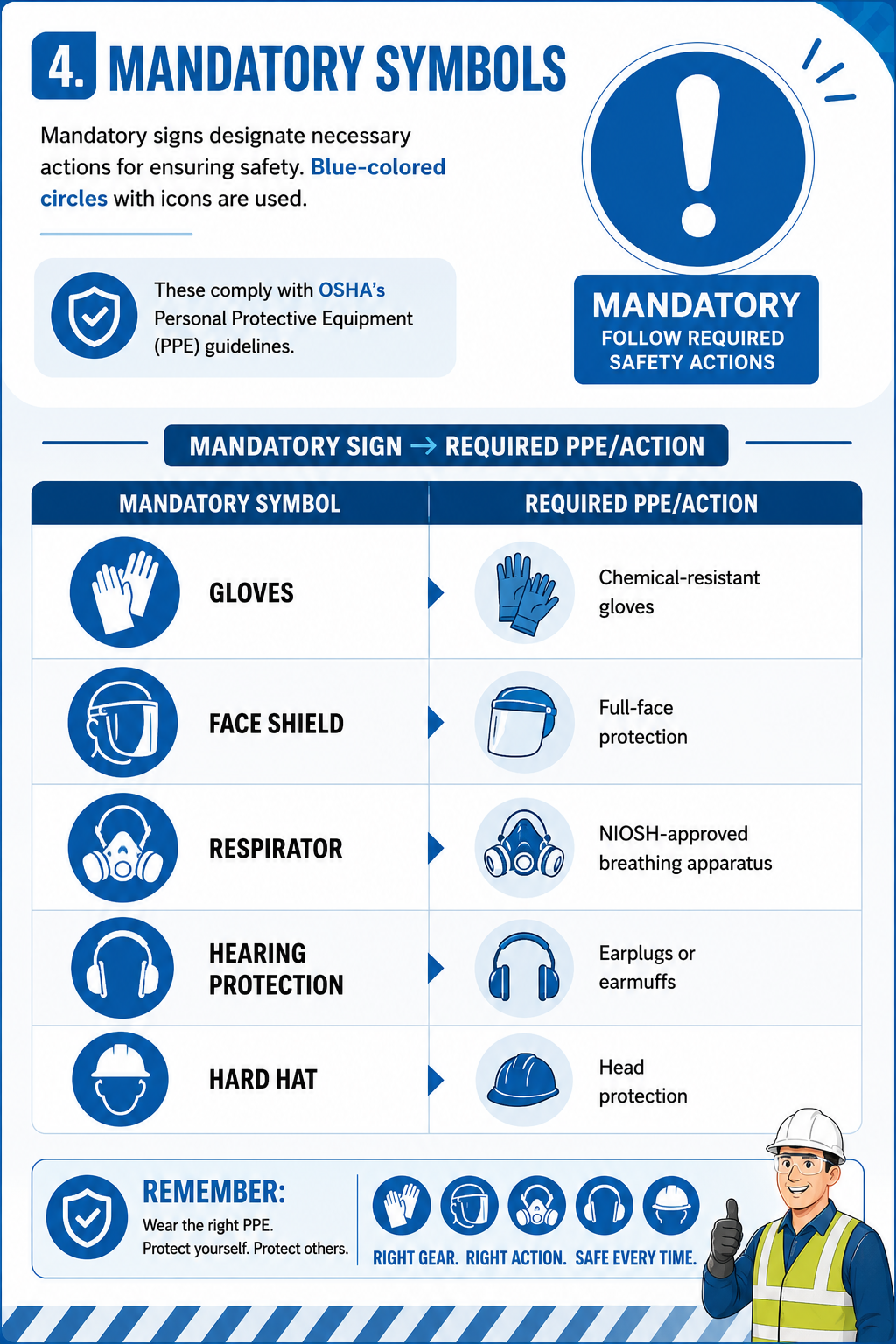
4. Mandatory Symbols
The mandatory sign designates necessary actions for ensuring safety. Blue-colored circles with icons are used. These comply with OSHA’s Personal Protective Equipment guidelines.
| Mandatory Symbol | Required PPE/Action |
| Gloves | Chemical-resistant gloves |
| Face shield | Full-face protection |
| Respirator | NIOSH-approved breathing apparatus |
| Hearing protection | Earplugs or earmuffs |
| Hard hat | Head protection |
 5. Hazard Symbols (GHS Pictograms)
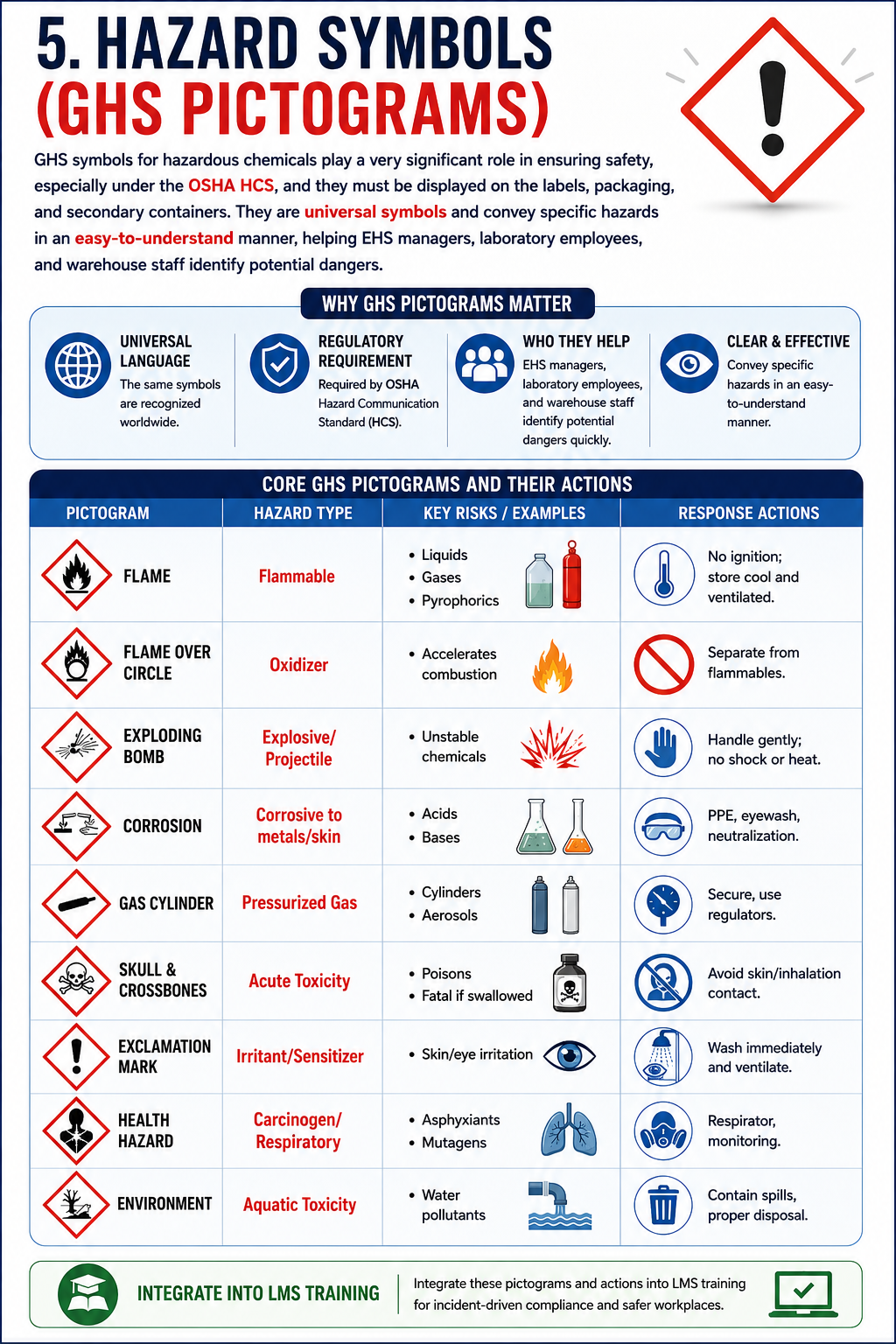
GHS symbols for hazardous chemicals play a very significant role in ensuring safety, especially under the OSHA HCS, and they must be displayed on the labels, packaging, and secondary containers. They are universal symbols and convey specific hazards in an easy-to-understand manner, helping EHS managers, laboratory employees, and warehouse staff identify potential dangers.
Core GHS Pictograms and Actions:
| Pictogram | Hazard Type | Key Risks/Examples | Response Actions |
| Flame | Flammable | Liquids, gases, pyrophorics | No ignition; store cool and ventilated. |
| Flame Over Circle | Oxidizer | Accelerates combustion | Separate from flammables |
| Exploding Bomb | Explosive/Projectile | Unstable chemicals | Handle gently; no shock or heat. |
| Corrosion | Corrosive to metals/skin | Acids, bases | PPE, eyewash, neutralization |
| Gas Cylinder | Pressurized Gas | Cylinders, aerosols | Secure, use regulators. |
| Skull & Crossbones | Acute Toxicity | Poisons, fatal if swallowed | Avoid skin/inhalation contact. |
| Exclamation Mark | Irritant/Sensitizer | Skin/eye irritation | Wash immediately and ventilate. |
| Health Hazard | Carcinogen/Respiratory | Asphyxiants, mutagens | Respirator, monitoring |
| Environment | Aquatic Toxicity | Water pollutants | Contain spills, proper disposal |
Integrate these into LMS training for incident-driven compliance.
6. Fire Safety Symbols
Fire safety symbols provide guidance on prevention and equipment, using red squares or rectangles with icons like extinguishers. They direct the tools and measures, ensuring rapid response in manufacturing or warehouse fires.
Complete GHS Hazard Pictogram Guide
The Globally Harmonized System (GHS) hazard pictograms are the core visual anchors of chemical labeling and SDS-based hazard communication. Used under OSHA's Hazard Communication Standard (HCS) in the U.S. and across global supply chains, these symbols translate complex hazard classes into instantly recognizable icons that directly inform handling, storage, PPE, and emergency response decisions.
Professionals must understand not only what each pictogram represents but also how it fits into OSHA compliance, signal word severity, and SDS Section 2 to drive correct labeling and training.
Full GHS Pictogram Reference Table
Below is a concise, operationally oriented table covering all nine GHS pictograms, including OSHA-relevant classes, example chemicals, and recommended PPE.
| Pictogram (Name) | GHS Code | Hazard Class / Meaning | Example Chemicals | Typical PPE & Controls |
| Flame | GHS02 | Flammable liquids, gases, solids, self-heating substances | Acetone, ethanol, gasoline, toluene | Chemical-resistant gloves, safety goggles, ventilation, no ignition sources |
| Flame over Circle | GHS03 | Oxidizers (may intensify fire) | Hydrogen peroxide (high concentration), nitric acid, ammonium nitrate | Gloves, goggles, face shield: segregate from flammables. |
| Exploding Bomb | GHS01 | Explosives, organic peroxides, unstable explosives | Nitroglycerin, some organic peroxides | Explosion‑proof equipment, barricading, strict storage controls |
| Gas Cylinder | GHS04 | Gases under pressure (compressed, liquefied, refrigerated) | Nitrogen, oxygen, propane, CO₂ cylinders | Pressure-relief devices, secured storage, checks, and PPE for gas contact |
| Corrosion | GHS05 | Corrosive to metals and skin/eyes | Sulfuric acid, sodium hydroxide, hydrochloric acid | Chemical-resistant gloves, face shield, goggles, apron, eyewash/shower available. |
| Skull and Crossbones | GHS06 | Acute toxicity (fatal or toxic if swallowed, inhaled, or in contact with skin) | Cyanides, many pesticides, some industrial solvents | Respirator, gloves, strict containment, no eating/drinking in area |
| Exclamation Mark | GHS07 | Irritant, skin/eye irritation, sensitization, narcotic effects, acute toxicity Category 4 | Acetic acid, certain surfactants, some solvents | Gloves, goggles, ventilation avoid skin/eye contact. |
| Health Hazard | GHS08 | Chronic health effects (carcinogenicity, mutagenicity, reproductive toxicity, respiratory sensitization, target organ toxicity) | Benzene, formaldehyde, some heavy metals | Full-face respirator, gloves, fume hoods, medical monitoring, exposure controls |
| Environment (Dead Fish / Tree) | GHS09 | Hazardous to aquatic environment (acute/chronic) | Certain pesticides, some metal salts, some organic solvents | Spill containment, secondary containment, proper waste handling, avoid water discharge |
This table should be embedded in internal training, LMS modules, and lab/warehouse quick-reference guides to ensure consistent interpretation.
OSHA-Required vs. Non-Mandatory Pictograms
Under OSHA's HCS, eight of the nine GHS pictograms are mandatory when the associated hazard class applies.
- OSHA-required pictograms:
- Flame (GHS02) – flammability
- Flame over Circle (GHS03)—oxidizers
- Exploding Bomb (GHS01) – explosives
- Gas Cylinder (GHS04) – gases under pressure
- Corrosion (GHS05) – corrosive
- Skull and Crossbones (GHS06) – acute toxicity
- Exclamation Mark (GHS07) – irritants, sensitizers, etc.
- Health Hazard (GHS08) – chronic health hazards
- Non‑mandatory under OSHA, but used in GHS globally:
- Environmental hazard (GHS09) – hazardous to the aquatic environment.
OSHA does not enforce the environmental pictogram on labels, though manufacturers and distributors may choose to include it to align with international GHS implementations. This distinction is important for EHS teams managing both domestic and global shipments, as the red "dead fish / tree" symbol may appear on labels coming from the EU, Asia, or other regions but is treated as informational only in the U.S. regulatory context.
Signal Words: "Danger" vs "Warning"
Every GHS label must carry a signal word – either Danger or Warning – placed immediately below or adjacent to the pictogram(s).
Danger:
- Used for the more severe hazard categories across most classes (explosives, high flammability, serious acute toxicity, and corrosive effects).
- Indicates that the chemical poses a higher risk of injury or adverse outcome if mishandled.
Warning:
- Used for less severe but still significant hazards (mild irritants, lower toxicity categories, some sensitizers).
- This means that the product is still dangerous, but not as dangerous as "danger"-labeled substances.
Professionally, signal words should be cross‑referenced with the hazard class(es) and pictograms during risk assessment. For example, a label with the flame (GHS02) and danger signals a high-risk flammable liquid, while the same pictogram with warning may indicate a lower flashpoint or less volatile product.
SDS Integration: Pictograms, Section 2, and Labeling
GHS pictograms are not isolated graphics; they are systematically linked to the information in the safety data sheet, especially Section 2: Hazard Identification.
Pictograms ↔ SDS Section 2
- Section 2 lists the hazard classes (e.g., "Flammable liquid – Category 2″ and "Acute toxicity – Category 1"), which directly determine which pictograms must appear on the label.
- Each pictogram corresponds to specific hazard statements (H-statements) that describe the nature and degree of the hazard (e.g., H225: Highly flammable liquid and vapor).
Precautionary statements and PPE
- Section 2 and the label both include precautionary statements (P-statements) that align with the pictogram-based risk (e.g., P280: Wear protective gloves/eye protection/face protection).
- These P statements are operationally critical: they translate the pictogram into concrete actions for lab personnel, warehouse teams, and operators.
Label generation workflow
- Classify the chemical using GHS criteria.
- Select the appropriate pictograms, signal word(s), hazard statements, and precautionary statements.
- Format the label so that the product identifier, pictogram block, signal word, and statements are grouped clearly and legibly.
OSHA vs GHS vs NFPA vs ISO Symbols
It is very important for all those in charge of health and safety within organizations such as EHS managers, laboratory staff, warehouse workers, and safety coordinators to know how these OSHA, GHS, NFPA, and ISO symbols complement each other. Each system has its unique function and target audience.
1. OSHA (Hazard Communication Standard – HCS)
GHS is an international regulation developed by the United Nations on the classification and labeling of chemical hazards using pictograms, signals, statements, and hazard symbols.
- Purpose: Enforce workplace-specific hazard communication, labeling, and training.
- Focus: Worker safety, compliance audits, and alignment with GHS.
2. GHS (Globally Harmonized System)
GHS is an international standard developed by the UN that defines how chemical hazards are classified and communicated through pictograms, signal words, hazard statements, and precautionary statements. OSHA's HCS is built on GHS, so GHS labels are effectively the content engine for OSHA-compliant chemical labeling.
- Purpose: Harmonize global classification and labeling of chemicals (labels + SDS).
- Focus: Scientifically consistent hazard categories and standardized pictograms.
3. NFPA 704 (Fire Diamond)
NFPA 704 is a fire protection and emergency response system, not a regulatory requirement like OSHA, but it is widely adopted by fire departments and local authorities. It provides a quick, numeric "snapshot" of health, flammability, reactivity, and special hazards on facility doors, storage cabinets, and bulk storage.
- Purpose: Rapid hazard recognition for firefighters and hazmat teams.
- Focus: Emergency response, not detailed worker handling instructions.
4. ISO 7010 (Safety Signs and Symbols)
ISO 7010 defines standardized graphical safety signs (mandatory, warning, prohibition, emergency, and firefighting) used in buildings and workplaces worldwide. These cover exit signs, fire extinguishers, PPE requirements, and general safety actions and are often used on facility-level signage rather than product labels.
- Purpose: Universal visual communication for building-level and facility-level safety.
- Focus: Way‑finding, emergency routes, and general safety instructions.
Here's a Quick Comparison Table.
Professionals frequently search for how these systems differ in practice. The table below summarizes the key contrasts:
| System | Used For | Common Location / Application |
| GHS | Chemical hazard classification and labeling (pictograms, categories, statements) | SDS and primary or secondary container labels in labs, warehouses, and manufacturing. |
| NFPA 704 | Emergency response hazard rating (health, flammability, reactivity, special hazards) | Facility doors, storage rooms, bulk tanks, and emergency access points for firefighters and hazmat. |
| ISO 7010 | Facility‑wide safety signs (mandatory, emergency, prohibition, firefighting) | Building exits, corridors, stairwells, and equipment to guide behavior and emergency actions. |
| OSHA | Workplace hazard communication regulation and enforcement (what GHS labels and SDSs must do) | Entire U.S. workplace – governs labeling, training, and recordkeeping for all hazardous chemicals. |
How They Fit Together in the Workplace
1. OSHA + GHS (the regulatory backbone)
OSHA requires GHS-style labels and SDSs on every hazardous chemical, with pictograms, signal words, and hazard/precautionary statements. This ensures that EHS managers, lab staff, and warehouse teams have a consistent, science-based basis for procedures and training.
2. NFPA 704 (for emergency responders)
On the same facility, NFPA 704 diamonds appear on doors or bulk storage, giving firefighters a numeric “snapshot” (0–4) of health, flammability, and reactivity. These are not a substitute for GHS labels but are complementary: GHS tells workers how to handle the chemical; NFPA 704 tells responders what to expect in a fire or spill.
3. ISO 7010 (facility-level wayfinding)
ISO 7010 signs appear on building-level signage (exits, emergency showers, AED locations, and PPE-required zones). These are typically used alongside internal rules and OSHA-based procedures to ensure that everyone, regardless of language, can follow the right path during an emergency.
From a practical standpoint, EHS teams should:
- Use GHS labels and SDS Section 2 as the authoritative source for hazard classification and PPE.
- Display NFPA 704 diamonds where emergency responders need at-a-glance hazard ratings.
- Apply ISO 7010 signs for facility‑wide safety and emergency route communication.
- Ensure that all three systems align with their messaging, so workers do not receive conflicting instructions.
Industry-Specific Safety Symbols
However, different work environments will have distinct exposure conditions and risks; therefore, the industries will vary greatly in terms of selecting, positioning, and interpreting the safety signs. EHS professionals, laboratory workers, warehouse staff, manufacturing companies, and safety coordinators benefit greatly from comprehending how the specific symbol ecosystems function for the respective industries to ensure that their use aligns with both OSHA and GHS regulations.
Laboratory Safety Symbols
Laboratories deal with concentrated chemicals, biological agents, and small-scale but high-severity hazards, so symbol use is highly granular and SDS-driven.
Dominant systems used:
- GHS pictograms on chemical containers and secondary labels.
- ISO 7010 signs for exits, eyewash/shower, and PPE-required zones.
- Custom biohazard, radiation, and laser symbols where applicable.
Typical symbol patterns:
- Corrosion (GHS05) on strong acids/bases, with mandatory PPE on entry signage.
- Skull and Crossbones (GHS06) and Health Hazard (GHS08) on carcinogens, mutagens, or highly toxic reagents.
- Biohazard symbols for biological waste and cell culture areas.
- Radiation of trefoil and laser beam symbols for specific equipment rooms.
Operational need:
- Clear, compact labeling on small containers and reagent bottles.
- Lab-specific "no food/drink" and "no ignition sources" prohibition signs near analytical instruments and flammable solvent storage.
For EHS managers issuing lab-specific GHS-based training, mapping each GHS pictogram to the lab's inventory and SOPs (e.g., "GHS08 → fume hood only use") increases both safety and audit readiness.
2. Manufacturing Safety Signs
Manufacturing environments combine chemical use with high-energy processes, moving machinery, and confined-space operations, so symbols must support both chemical hazard communication and machine safety awareness.
Systems in play:
- GHS labels on raw material drums, intermediate tanks, and cleaner/solvent containers.
- ISO 7010 and facility‑wide warning signs for moving machinery, pinch points, and high-temperature zones.
- NFPA 704 diamonds or local HMIS scales where bulk storage or finishing areas pose significant health/flammability risks.
Common symbol clusters:
- Flame (GHS02) and Flame‑over‑Circle (GHS03) near paint booths, solvent-based coatings, and oxidizer storage.
- Mandatory PPE signs (ISO-style blue circles) requiring hard hats, hearing protection, and safety glasses at production line entrances.
- Warning triangles for electrical hazards, hydraulic lines, and rotating equipment.
- Emergency green signs for emergency stops, fire extinguishers, and assembly points.
Compliance angle:
- Warning and prohibition signs near energy-isolating points visually reinforce OSHA’s machine guarding and lockout/tagout (LOTO) requirements.
- Chemical handling areas map GHS pictograms from SDS Section 2 directly to line-specific signage and job hazard analysis boards.
3. Warehouse Safety Signs
Warehouses manage large volumes of chemicals, flammable goods, and heavy equipment traffic, so symbol placement is critical for fire prevention, chemical segregation, and forklift safety awareness.
Key symbol roles:
- GHS pictograms on incoming drums, totes, and pallet labels, with clear segregation signage (e.g., “Oxidizers – Keep Away from Flammables”).
- NFPA 704 diamonds or HMIS-style labels on bulk storage racks or external tanks.
- ISO 7010-style prohibition and warning signs for forklift traffic, pedestrian lanes, and no-ignition zones.
Typical examples:
- Flame (GHS02) and corrosion (GHS05) on fuel, solvent, and acid racks, complemented by red “No Smoking/No Ignition” prohibition signs.
- Exclamation Mark (GHS07) and Skull and Crossbones (GHS06) on pesticides or toxic cleaning agents, with mandatory PPE signage at dispensing points.
- Mandatory blue signs for hard hats, steel-toe boots, and high-visibility vests in racking and loading dock areas.
EHS impact:
- Warehouse teams can use a simple “pictogram zone” map (e.g., “Red zone = flammables, Yellow zone = oxidizers”) to visually enforce segregation and access control.
- This visual zoning supports incident-driven training (e.g., a spill in the “Flame zone” triggers a specific GHS-linked response protocol).
4. Construction Hazard Symbols
Construction sites are transient, high-hazard environments where temporary signage and on-the-fly hazard assessment are essential. Symbol use focuses on falls, struck-by/caught-in-between risks, and hazardous materials brought to the site.
Primary symbol types:
- Warning triangles for fall hazards, open trenches, and elevated work platforms.
- Prohibition signs for “No entry,” “No unauthorized personnel,” and “No smoking” in high-risk areas.
- Mandatory PPE signs for helmet, harness, and high-visibility clothing at site entrances.
- Fire safety symbols for temporary fire extinguishers and assembly points.
Chemical-specific overlay:
- Temporary GHS-style placards or labels for weld fumes, solvents, and adhesives stored on‑site.
- Health Hazard (GHS08) and Exclamation Mark (GHS07) symbols are used on products that pose long-term exposure risks, such as lead-based paints and isocyanates.
Practical authority:
- Clear, large-format symbols are crucial because workers move between contractors and trades; ISO-style universal icons reduce language barriers.
- EHS coordinators can tie daily toolbox talks to specific symbol clusters (e.g., “Look for the yellow triangle at the edge of this floor opening”).
5. Pharmaceutical Facility Signage
Pharmaceutical manufacturing and R&D combine high-value products, strict clean‑room controls, and diverse chemical hazards, so symbol design must balance regulatory precision and process safety awareness.
Specialized symbol needs:
- GHS pictograms on active pharmaceutical ingredients (APIs), solvents, and cleaning agents, with careful segregation between sterile and non‑sterile areas.
- ISO 7010 signs for gowning areas, hand‑washing stations, and restricted access zones.
- Biohazard and contamination symbols for biological waste and containment areas in R&D and biologics units.
Common examples:
- Health Hazard (GHS08) and Exclamation Mark (GHS07) on APIs with reproductive toxicity or sensitization potential, paired with strict "restricted access" and PPE signage.
- Corrosion (GHS05) on strong acids/bases used in cleaning, with clear eyewash and shower location signs.
- Mandatory blue signs for head, eye, and glove protection in filling and packaging areas.
SEO and authority angle:
- Pharmaceutical facilities benefit from mapping GHS pictograms to internal hazard summary tools (e.g., CloudSDS-style dashboards) so that every symbol on the floor can be traced back to SDS Section 2 and hazard/precautionary statements.
- This transforms generic "safety signage" into a searchable, audit-ready system that supports both regulatory compliance and continuous improvement goals.
Why Safety Symbols Matter
Safety symbols matter because they turn complex risks into clear, actionable guidance that workers can use every day. When properly aligned with OSHA and GHS requirements, they become a practical tool—not just a theory—for reducing incidents and demonstrating compliance.
1. Accident Prevention
Safety symbols act as an immediate visual alert for hazards such as toxic chemicals, electrical risks, flammable materials, and moving machinery. By signaling danger or required actions before exposure occurs, they support:
- Early recognition of risk at the task level.
- Faster adoption of controls (e.g., using PPE, isolating equipment, or avoiding ignition sources).
2. Universal Understanding
GHS pictograms, ISO-style signs, and NFPA-like icons are designed to be language- and literacy-independent. This universality:
- Reduces misinterpretation in multi‑lingual or temporary worker environments.
- Ensures that visitors, contractors, and emergency responders can grasp the hazard quickly.
3. Compliance and Accountability
Regulatory bodies such as OSHA and international GHS adopting frameworks require standardized symbols on labels, SDSs, and facility signage. Using the correct symbols:
- Helps organizations meet legal requirements for hazard communication.
- Supports audit readiness and reduces exposure to fines or enforcement actions.
4. Practical Implications for EHS and Operations
For EHS managers, lab personnel, warehouse teams, and safety coordinators, well-designed symbols should:
- Map directly to SDS Section 2 classifications and site-specific risk assessments.
- Appear consistently in high-risk areas (flammable storage, chemical handling zones, and machinery points) so they function as quick references rather than abstract theory.
- Be reinforced through training that links each symbol to a concrete action (e.g., “Flame + No Smoking” = no ignition source zones).
Used this way, safety symbols transition from “nice‑to‑have” visuals to an operational reference system that supports safer behavior, clearer procedures, and demonstrable compliance.
How to Train Employees on Safety Symbols
For EHS managers, lab personnel, warehouse teams, manufacturers, and safety coordinators, training on safety symbols is not a one-time classroom exercise—it must be designed as an ongoing, operational process that ties symbols directly to daily tasks, SDS information, and site-specific hazards. Below is a practical, role-based structure you can embed into your training program.
1. Onboarding Training (New Hires)
Onboarding is the first chance to anchor symbol literacy as a normal part of the job. Use a structured, visual-heavy module focused on:
Core symbol categories:
- GHS pictograms (Flame, Corrosion, Health Hazard, etc.) and their meaning in your facility.
- ISO-style signs (emergency exits, PPE required, no entry, fire equipment).
- NFPA-like hazard indicators if used on bulk storage or external tanks.
Methodology:
- Short video or slide deck showing real-world labels and placards from your own site.
- Walkthrough of a sample SDS (Section 2) alongside its label, highlighting how pictograms link to hazard statements and PPE.
- Hands-on quiz or drag-and-match activity (e.g., "Which pictogram belongs with this chemical?").
Output:
- Provide a printed or digital "symbol reference card" that maps each symbol to:
- Hazard class
- Typical PPE
- One-step "what to do" instruction (e.g., "If you see skull and crossbones on this container, confirm you're wearing gloves and a respirator before handling").
This reference card becomes part of every new hire packet and LMS onboarding track.
2. Refresher Training (Annual Incident-Triggered)
Symbols fade from memory if not reinforced. Refresher training should be:
Frequency:
- Annual minimum, plus additional sessions after incidents, near misses, or major chemical portfolio changes.
Content focus:
- Repeat core pictograms, but emphasize recent exposure scenarios (e.g., “Last year we had three chemical spills involving GHS‑05 corrosive products; here is how the label should have triggered different behavior”).
- Update workers on any new GHS classifications, SDS changes, or updated facility signage.
Format:
- LMS-based quick modules (5–10 minutes) with scenario-based questions.
- On‑site label audits: “Walk through the warehouse/line with a checklist and confirm that every major chemical container has the correct pictogram and that the nearby PPE sign matches the SDS.”
For EHS managers, this refresher cycle can be incident-driven; for example, every spill or misclassification triggers a symbol-specific refresher tied to that material.
3. Toolbox Talks (Short, Site-Specific)
Toolbox talks are a powerful way to connect symbols to actual work, especially in warehouses, labs, and manufacturing areas:
When to run them:
- Before starting a new chemical introduction, batch process, or high-risk maintenance task.
- After a safety audit or inspection where label quality or symbol comprehension issues were noted.
Structure:
- 5–10 minutes on one or two symbols relevant to that day’s work (e.g., corrosion + flame in a solvent handling area).
- Show the actual label, point to the pictogram, and explain the following:
- What the hazard is.
- What PPE and controls are required.
- What emergency equipment (eyewash, shower, and spill kit) must be accessible.
- Ask workers to point out the symbol on the nearest container or cabinet.
Outcome:
- Make symbol recognition a muscle memory exercise, not abstract theory.
- Record attendance in your LMS or paper log so you can demonstrate training continuity during audits.
4. Multilingual Signage and Symbol Use
In diverse workplaces, especially warehouses, labs, and multi‑site manufacturers, language variation is a major risk factor:
Best practices:
- Use ISO-style pictograms and layout (simple, universal icons) as the primary communication layer.
- Add text in major site languages (e.g., English + local language) only as secondary support, not as the main message.
- Keep all critical hazard- and action-based information on labels and posters in both pictograms and the most relevant language(s) for your workforce.
Training coupling:
- During onboarding or a refresher, explicitly show how the same pictogram appears on SDS labels, container labels, and wall signs in different languages.
- Emphasize: "You don't need to read the words; you need to read the symbol."
This reinforces the idea that symbols are the lingua franca of safety, not written text.
5. SDS Accessibility and Symbol Integration
Symbols are most useful when they are paired with accessible, easy-to-read SDS information:
Operational steps:
- Provide instant access to SDSs (via QR codes on labels, a shared drive, or an integrated LMS/SDS management system) so workers can see the full hazard statement and precautionary statement for any symbol they see.
- In training, show how:
- The flame pictogram on a label links to H225 in SDS Section 2.
- The health hazard symbol links to long-term exposure precautions and PPE requirements.
LMS integration:
- Tag each training module with the GHS pictogram and the corresponding SDS Section 2 fields.
- Create “incident-driven” assignments: if a worker is involved in a spill or misclassification, the system automatically assigns a short module on that symbol and its SDS context.
Role-specific access:
- EHS managers and safety coordinators can configure dashboards where filters by pictogram (e.g., GHS08 “Health Hazard”) flag high-risk materials that need extra training, signage, and monitoring.
By tying symbol training directly to SDS access and on‑site signage, you turn safety symbols from decorative icons into a live, operational reference system that EHS professionals can measure, audit, and improve over time.
Common Mistakes in Safety Symbol Usage
Even when organizations invest in safety symbols, small errors in placement, selection, or maintenance can undermine their entire hazard of communication system. For EHS managers, lab personnel, warehouse teams, and safety coordinators, catching these mistakes early is key to preventing incidents, audit findings, and regulatory non‑compliance. Below are some of the most frequent and operationally significant symbol-related errors.
1. Faded, Damaged, or Illegible Labels
Over time, chemical labels exposed to sunlight, solvents, and physical handling can fade, smudge, or peel, making pictograms and text unreadable. This is especially common on drums, totes, and secondary containers in labs and warehouses.
Risks:
- Workers cannot see the pictogram or hazard statement, so they may handle a corrosive or flammable chemical as if it were benign.
- During an emergency, responders cannot identify the hazard quickly.
Prevention:
- Inspect labels during routine audits and promptly relabel or replace any damaged containers.
- Use weather-resistant, chemical-resistant label material for outdoor or high-exposure areas.
- Make label legibility a formal checklist item in EHS audits and incident investigations.
2. Wrong or Mismatched Pictograms
A common mistake is applying GHS pictograms that do not match the SDS classification, either because of outdated information or misclassification.
Examples:
- Using the Flame pictogram (GHS02) for a product that is actually only an irritant (Exclamation Mark, GHS07).
- Omitting Health Hazard (GHS08) on a substance with chronic toxicity because the label was never updated after a new SDS revision.
Risks:
- Misleading risk perception can lead to inadequate PPE, improper storage, or wrong emergency response.
- OSHA and GHS-based audits may flag the mismatch as a serious compliance gap.
Prevention:
- Cross‑check every label against the current SDS Section 2 (hazard classification and pictogram assignments).
- Integrate pictogram reviews into your SDS update and change management process.
3. Missing or Inconsistent PPE Signs
Even when a chemical label correctly shows a pictogram and hazard, many sites fail to place clear, mandatory PPE signs at the point of use.
Typical mistakes:
- No blue circle "mandatory" PPE sign near an eyewash or chemical dispensing station.
- Mixed messages: a corrosion pictogram on a drum, but no local signage specifying "Face shield + gloves + apron required."
Risks:
- Workers may skip PPE because the required protection is not clearly reinforced in the immediate work area.
- Auditors and inspectors see this as a gap between hazard identification and controls.
Prevention:
- Develop a "PPE sign rule" for each hazard class (e.g., GHS05 = mandatory face shield + gloves + apron + eyewash visibility).
- Conduct site walks and verify that every high-hazard zone has correct mandatory signage visible at the task location.
4. Outdated NFPA or HMIS Ratings
In facilities that use NFPA 704 diamonds or HMIS-style ratings on storage rooms or bulk tanks, the ratings are sometimes never updated after chemical changes or process modifications.
Examples:
- A storage area rated Health 3, Flammability 2, and Reactivity 1 continue to display that rating even after higher-hazard materials are introduced.
- NFPA tags that have been removed, painted over, or left blank after a reorganization are no longer visible.
Risks:
- Emergency responders may under‑ or over‑respond based on incorrect hazard ratings.
- EHS managers lose the benefit of a standardized, numeric "hazard snapshot" that supports pre‑incident planning.
Prevention:
- Tie NFPA/HMIS updates to the same change management process used for SDS and GHS labels.
- Include NFPA tag checking as a scheduled item in facility safety rounds.
5. Unreadable or Illegible Chemical Labels
Beyond fading, labels can be hard to read due to poor design, small fonts, poor contrast, or cluttered layouts.
Common issues:
- Tiny pictograms or text on secondary containers.
- Labels printed in low-contrast colors (e.g., light yellow text on a white background).
- Labels with too much text compressed into a small space, making both pictograms and words difficult to read.
Risks:
- Workers either ignore the label altogether or misread the hazard, leading to incorrect handling or storage.
- In multilingual sites, unclear text compounds the risk, even if the pictogram is correct.
Prevention:
- Standardize minimum label dimensions and font sizes for primary and secondary containers.
- Use high-contrast color schemes and position the pictogram so it is the most visible element on the label.
- Require training on label layout and readability as part of chemical-handling SOPs.
6. Over‑Reliance on Symbols Without Context
A subtle but important mistake is using symbols in isolation, without connecting them to SDS information, procedures, or training.
Examples:
- A wall sign shows a flame pictogram but fails to indicate "no ignition sources in this room."
- A health hazard symbol appears on a container, but no nearby SOP explains required ventilation, PPE, or exposure limits.
Risks:
- Symbols become decorative rather than functional, and workers do not know what actions to take.
- During audits, inspectors see a lack of integration between symbols, SDSs, and safe work practices.
Prevention:
- Every symbol on a label or wall sign should map to at least one documented procedure or PPE requirement.
- Train workers to "read the symbol and then read the SDS" and to ask for clarification if the connection between the pictogram and the action is unclear.
By systematically addressing these common mistakes, EHS teams can turn symbol use from a compliance checkbox into a measurable, incident-reducing component of daily operations.
FAQ Section: Safety Symbols and Hazard Pictograms
What do GHS symbols (pictograms) mean?
GHS symbols are standardized pictograms that visually represent a chemical's hazard class or category. Each symbol corresponds to a specific type of risk, such as flammability, corrosivity, acute toxicity, or environmental hazard. These pictograms appear on labels and SDSs, and they are always used with a signal word (either "Danger" or "Warning") as well as standardized hazard statements (H-codes) and precautionary statements (P-codes). In practice, they translate complex classification data into a quick, language-independent way to understand "what can go wrong" and "what controls are needed."
Which hazard pictograms are OSHA-required?
Under OSHA's Hazard Communication Standard (HCS), the following eight GHS pictograms are mandatory when the associated hazard class applies:
- Flame (GHS02)—flammables
- Flame over Circle (GHS03)—oxidizers
- Exploding Bomb (GHS01) – explosives
- Gas Cylinder (GHS04) – gases under pressure
- Corrosion (GHS05) – corrosive to skin/metals
- Skull and Crossbones (GHS06) – acute toxicity
- Exclamation Mark (GHS07) – irritants, sensitizers, etc.
- Health Hazard (GHS08) – carcinogenicity, reproductive toxicity, respiratory sensitization
The environmental hazard pictogram (GHS09) is not mandatory under OSHA, though it may appear on international labels to align with broader GHS use.
What is the difference between NFPA and GHS?
- GHS is a global system for classifying and labeling chemicals. It uses pictograms, signal words, and standardized statements on labels and SDSs to do this.
- NFPA 704 (the "fire diamond") is a hazard rating system used primarily for emergency response, assigning numerical ratings (0–4) for health, flammability, reactivity, and special hazards on facility doors and bulk storage locations.
In short, GHS tells workers how to handle a chemical safely; NFPA 704 gives responders a quick numeric snapshot of what to expect during a fire or spill. Both can appear on the same site, but they serve different audiences and purposes.
What color are warning signs?
Warning signs are typically yellow (or amber) with a black border and feature a black symbol inside a triangle. This colors-shape combination is internationally associated with caution and potential hazard. In addition to GHS-style warning labels, many ISO 7010 and NFPA-influenced warning signs follow the same yellow triangle pattern to ensure universal recognition across workplaces and languages.
Where are hazard symbols found in an SDS?
Hazard symbols (GHS pictograms) are conceptually linked to SDS Section 2: Hazard Identification. Section 2 lists the chemical's hazard classes, signal word, hazard statements (H-codes), and precautionary statements (P-codes). While the pictograms themselves do not usually appear as graphics in the SDS text, the label attached to the container must display the same pictograms that correspond to the classifications listed in Section 2. During training and audits, EHS professionals typically cross‑check the pictograms on the label with the hazard classes in Section 2 to ensure alignment between SDS content and visual hazard communication.
Conclusion:
Moreover, safety symbols have much deeper significance than regulatory markings; they form the core of a safe operation and effective risk management. In terms of prevention, the use of appropriate symbols allows organizations to minimize risks, ensuring greater workplace safety and security for the employees. Whether it is about informing people on how to safely handle certain chemicals or where to escape in case of an emergency, safety symbols play an important role. The understanding and application of safety symbols can be crucial in compliance, ensuring consistency between regulatory guidelines and safety systems implemented by organizations.
For example, when used together with Safety Data Sheets (SDS), safety symbols serve as a means of quick information delivery regarding certain chemical properties and possible risks that might be associated with their use. Along with a proper training program for employees, safety symbols have become one of the core aspects of ensuring workplace safety and preventing hazards from occurring. This is where CloudSDS comes into play. Providing efficient management and communication services regarding hazards helps organizations streamline all safety-related processes and achieve better results.

Simplify Your SDS Management
CloudSDS gives your team instant access to 23M+ safety data sheets with AI-powered search, automated updates, and full OSHA/GHS compliance — all from one platform.
Leave A Comment