

Last Updated on September 10, 2026
Where and Why Are Gas Under Pressure Signs Used?
Quick Answer
A Gas Under Pressure sign is the GHS red-diamond pictogram showing a gas cylinder, and it warns that a container holds compressed, liquefied, or dissolved gas—hazardous because of the pressure itself, not just what’s inside it. If a valve shears off or a shell fails, that pressure can turn a cylinder into a projectile, flash-freeze skin, displace breathable air, or release a toxic gas, depending on what’s stored. You’ll find these signs anywhere pressurized gas is stored or handled: labs, welding shops, hospitals, construction sites, bottling lines, refineries, warehouses, and aircraft hangars—required under OSHA’s Hazard Communication Standard and the broader GHS framework.
This article covers what the pictogram communicates, the industries that rely on it, the regulatory backdrop (OSHA and GHS), how to deploy signage correctly, and which gases trigger the requirement.
What are “Gas Under Pressure” signs?
Before getting into where these signs show up, it helps to understand exactly what they’re built to communicate and to whom.
What does the gas under pressure pictogram mean?
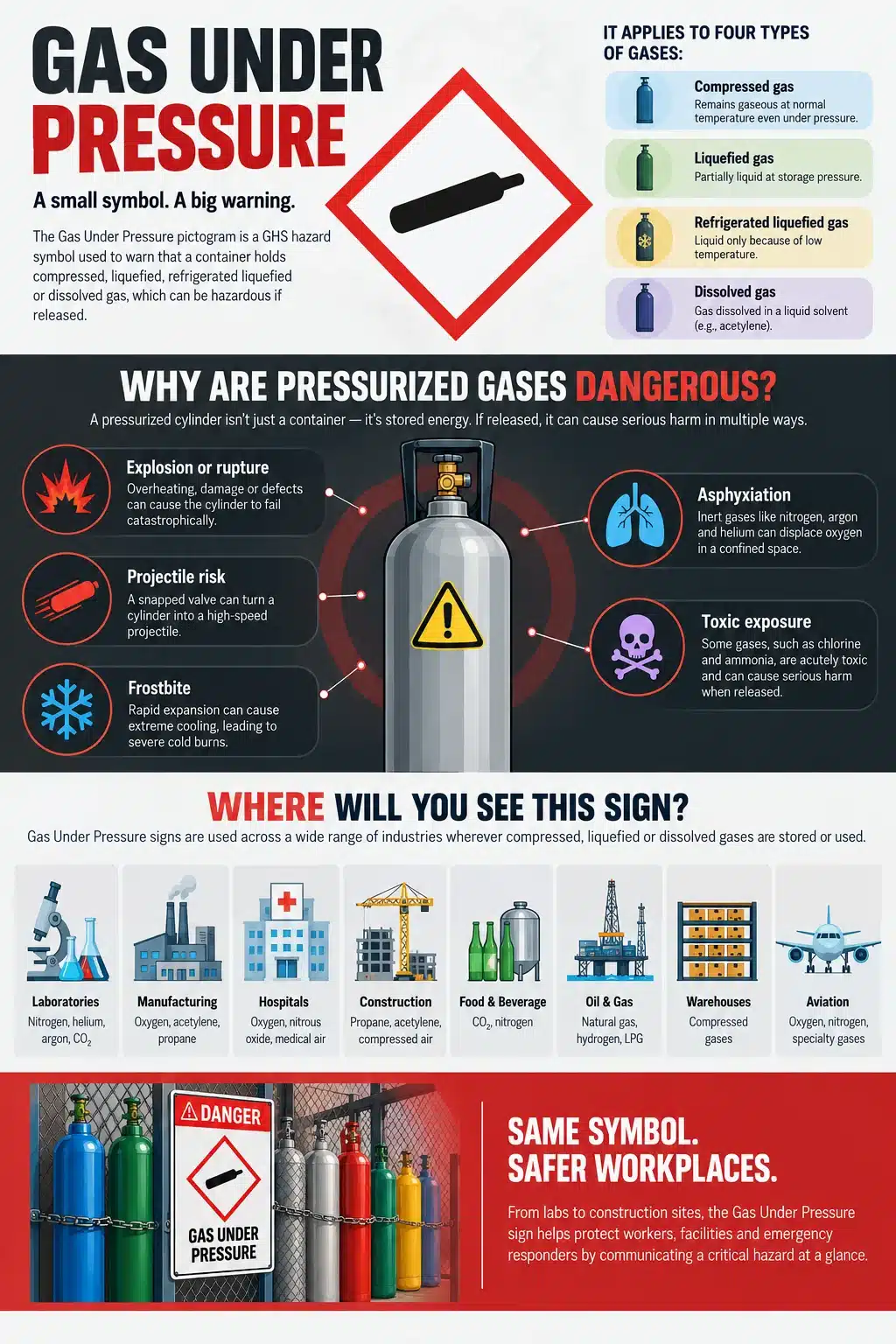
The pictogram is one of nine standardized hazard symbols under the Globally Harmonized System of Classification and Labelling of Chemicals (GHS). It shows a simplified gas cylinder—a cylindrical tank with a valve on top—set inside a red-bordered diamond (technically a square rotated 45 degrees). The red border isn’t decorative. Under GHS, red-diamond borders are reserved for physical and health hazards that demand immediate attention, distinguishing them at a glance from the black-and-white informational labels used for lower-severity classifications.
For a worker or an emergency responder, the pictogram is meant to be readable in under a second, without needing to parse a paragraph of text first. It tells the viewer: this container holds gas that is under pressure, and that pressure itself is part of the hazard—separate from whatever the gas does chemically once it’s released. The classification applies across four physical states gases can be shipped or stored in: compressed gas (remains gaseous at normal temperature even under pressure), liquefied gas (partially liquid at storage pressure), refrigerated liquefied gas (liquid only because of low temperature), and dissolved gas (dissolved in a liquid solvent inside the cylinder, as with acetylene). Each behaves differently if the container fails, but all four carry the same pictogram because the underlying hazard—stored pressure—is the common thread.
What hazards does the symbol warn about?
A gas cylinder sign is really warning about a cluster of related hazards rather than one single risk:
- Explosion or rupture: Overheating, physical damage, or a manufacturing defect can cause a cylinder shell to fail catastrophically, releasing its contents (and sometimes fragments of the cylinder itself) with enough force to injure anyone nearby.
- Cylinders as projectiles: A snapped valve on a full cylinder can act like a rocket nozzle, sending the tank through a drywall or across a shop floor. This phenomenon is one of the most underappreciated hazards in facilities that don’t cap or chain cylinders properly.
- Frostbite from rapid expansion: As compressed or liquefied gas expands to atmospheric pressure, it cools dramatically—sometimes below -100°F for gases like liquid nitrogen. Skin contact with an escaping jet or a frosted valve can cause instant cold burns.
- Asphyxiation: Inert gases like nitrogen, argon, and helium don’t need to be toxic to kill; they simply displace oxygen in a confined space, and a worker can lose consciousness with no warning odor or irritation.
- Toxic exposure: Some pressurized gases—chlorine and ammonia among them—are acutely toxic on their own, so a leak carries both a pressure hazard and a chemical exposure hazard simultaneously.
This is the same foundation of hazards that safety-data-sheet providers and hazard-communication resources already build their explanations around, and it’s worth keeping intact rather than reinventing, since it reflects how OSHA and GHS actually define the classification.
How is it connected to GHS and OSHA?
The Gas Under Pressure pictogram isn’t a company-specific or industry-specific invention—it’s a formal hazard class inside the Globally Harmonized System, the United Nations framework that dozens of countries have adopted to standardize how chemical hazards are classified and labeled. In the United States, GHS was folded into domestic law through OSHA’s Hazard Communication Standard, codified at 29 CFR 1910.1200. That standard requires employers to classify hazardous chemicals—including compressed gases—using GHS criteria, apply GHS-compliant labels to containers, maintain Safety Data Sheets, and train employees on both. A cylinder in a machine shop in Ohio and a cylinder in a lab in Germany are, in theory, labeled using the same pictogram vocabulary, which is precisely the point of a harmonized system: it removes ambiguity for workers, shippers, and emergency responders who might otherwise be confronted with a dozen different national labeling schemes.
Where are gas under pressure signs used?
Before diving into individual industries, it’s useful to see the pattern briefly.
| Industry/Location | Common Gases | Purpose | Why Signage Matters |
| Laboratories | Nitrogen, helium, argon, CO₂ | Research, cooling, inert environments | Prevents accidental exposure/mislabeling |
| Manufacturing | Acetylene, oxygen, propane | Welding, cutting, heat treating | Reduces fire/explosion risks |
| Hospitals & medical labs | Oxygen, nitrous oxide, medical air | Patient care, anesthesia, sterilization | Prevents misuse and leakage |
| Construction | Propane, compressed air, acetylene | Heating, tools, torching | Prevents misuse and injuries |
| Food & beverage | CO₂, nitrogen | Carbonation, preservation | Helps address leaks/asphyxiation risks |
| Oil & gas | Natural gas, hydrogen, LPG | Drilling, refining, storage | Helps communicate serious gas hazards |
| Warehouses/storage | Compressed gases | Storage and backup supply | Helps emergency responders identify hazards |
| Aerospace/aviation | Oxygen, nitrogen, specialty gases | Maintenance and testing | Supports required hazard communication |
How are gas under pressure signs applied across industries?
The table above gives the shorthand version. Here’s what actually happens on the ground in each of these settings.
1. Laboratories
University research buildings, private analytical labs, and industrial QA/QC labs all rely on compressed gas cylinders for functions that have nothing to do with each other on the surface—gas chromatography carrier gas, cryogenic sample preservation, and inert atmospheres for air-sensitive chemistry—but that all involve the same underlying storage and handling hazards.
Nitrogen and argon are the workhorses for creating inert environments and purging systems; helium shows up as a carrier gas and in cryogenics; and CO₂ is common in incubators and beverage-grade applications within life-science buildings.
Because labs frequently rotate cylinders in and out (a leased cylinder swapped weekly is a different animal than a fixed industrial line), signage at cylinder storage racks, fume hood gas cabinets, and corridor cylinder staging areas is what keeps a rotating cast of grad students, postdocs, and contractors from treating a full cylinder like inert furniture. A sign at the storage-room door does double duty: it tells a new lab member what’s behind it, and it tells a firefighter arriving during an unrelated fire alarm exactly what kind of secondary hazard sits in that room.
2. Manufacturing facilities
Metal fabrication shops, welding bays, and heat-treating operations are where compressed-gas signage earns its keep daily rather than occasionally. Oxygen and acetylene cylinders paired for oxy-fuel welding and cutting are a classic combination—and a classic hazard, since oxygen accelerates combustion and acetylene is unstable above roughly 15 psi if not dissolved in acetone inside the cylinder.
Propane fuels torches and some heat-treating furnaces. Beyond OSHA’s general Hazard Communication requirements, manufacturing facilities that store and handle compressed gases are also expected to align with NFPA 55, the Compressed Gases and Cryogenic Fluids Code, which sets more granular rules than OSHA does on maximum allowable quantities, separation distances between incompatible gases (oxygen stored away from fuel gases, for instance), ventilation in gas storage rooms, and signage at building entrances warning of gas storage inside. A facility that’s only thinking about GHS pictograms and ignoring NFPA 55’s storage and segregation requirements is covering half the compliance picture.
3. Medical centers and hospitals
Hospitals present an unusual case because compressed gases there aren’t just an industrial hazard tucked away in a back room—they’re piped directly to patient bedsides. Medical oxygen, nitrous oxide, and medical-grade compressed air run through centralized manifold systems that feed operating rooms, ICUs, and general wards, alongside portable E-cylinders used for patient transport.
The stakes of a labeling or handling error are higher here than almost anywhere else, because a mixed-up gas line or an unsecured cylinder in a hallway isn’t just a facility hazard; it’s a direct patient-safety issue.
Signage at manifold rooms, gas storage closets, and cylinder staging areas near ORs helps clinical staff—who are focused on patients, not industrial hazard communication—recognize at a glance that a room or cabinet contains pressurized gas, and it reinforces the physical hazards (a dropped or knocked-over cylinder, a damaged regulator) on top of whatever oxygen-enrichment fire risk already gets attention in clinical settings.
4. Construction sites
Construction sites are transient by nature—crews, trailers, and equipment move from job to job—which makes signage even more important, since there’s no institutional memory built up the way there is in a fixed facility. Propane cylinders heat enclosed work areas and power torches and heaters in cold-weather concrete; compressed air runs pneumatic tools; and acetylene shows up wherever cutting or brazing is happening on structural steel. Because job sites frequently have subcontractors and temporary laborers who’ve never worked in that specific trailer or laydown yard before, a clearly posted Gas Under Pressure sign at the cylinder cage or storage trailer does the job of orienting someone in seconds who has no other context for what’s stored there.
5. Food industry
Restaurants, breweries, and bottling plants all lean on CO₂ and nitrogen for reasons that sound almost mundane—carbonating soda, pushing beer through draft lines, extending shelf life through modified-atmosphere packaging—but the hazard doesn’t care that the application is food-related. CO₂ is heavier than air, which means a leak in a walk-in cooler, a basement soda-syrup room, or a brewery’s cellar can pool at floor level and create an asphyxiation hazard that’s easy to miss until someone walks in and collapses. Nitrogen carries the same silent asphyxiation risk without any odor or visible sign. Because these rooms are often accessed by staff who think of themselves as working in food service rather than industrial gas handling, signage at the cylinder bank or CO₂ tank room is one of the few things standing between routine restocking and a genuine emergency.
6. Oil and gas industry
Refineries, petrochemical plants, and gas processing facilities operate at a scale where compressed and liquefied gases aren’t stored in a cage in the corner—they’re the core process material moving through miles of piping, pressure vessels, and storage spheres.
Natural gas, hydrogen (increasingly common as refineries invest in hydro processing and, in some cases, blue or green hydrogen projects), and LPG all carry the combined hazards of high-pressure containment failure and, in most cases, flammability.
Signage in this sector functions less as a stand-alone warning and more as one layer inside a much larger process-safety management program—but it’s still the layer that a contractor, a delivery driver, or a new hire sees first before ever reading a permit-to-work packet, which is exactly why it can’t be treated as an afterthought.
7. Warehouses andstoragefacilities
Distribution centers and dedicated cylinder-storage yards hold gas for reasons that have nothing to do with using it on-site—they’re staging inventory for delivery to customers or holding backup supply for facility systems like emergency generators or fire suppression.
Because these spaces are sometimes visited only periodically (a forklift operator doing routine put-away, a driver dropping off a new batch of cylinders), and because they may not have anyone with deep chemical-hazard training present at all times, signage becomes the primary—sometimes only—hazard communication tool.
It’s also where signage does the most for the people who will never see the inside of the building under normal circumstances: firefighters and hazmat responders arriving during a fire or structural incident, who need to know from the outside, or immediately upon entry, that a storage area contains pressurized gas before they commit resources to it.
8. Aviation and aerospace facilities
Aircraft maintenance hangars and aerospace test facilities use high-pressure oxygen and nitrogen for both operational and safety-critical purposes—oxygen systems for crew and passenger emergency supply and nitrogen for servicing landing-gear struts, tires, and hydraulic accumulators, along with specialty gases for testing and calibration.
This sector sits at the intersection of two separate regulatory frameworks: OSHA’s workplace hazard communication rules apply to how gases are labeled and stored on the ground, while the transportation of compressed gases used in or around aircraft is governed by the Department of Transportation’s hazardous materials regulations, specifically 49 CFR Part 173, Subpart G, which covers the requirements for shipping compressed gases in commerce.
Maintenance of work itself falls under 14 CFR Part 43, the FAA’s rule governing maintenance, preventive maintenance, rebuilding, and alteration of aircraft. A facility handling high-pressure oxygen servicing carts near an aircraft is effectively operating under all three frameworks at once, which is part of why signage discipline in this sector tends to be unusually rigorous.
Why are gas under pressure signs important?
The case for consistent signage breaks down into four practical benefits.
1. Legal and regulatory compliance
OSHA’s Hazard Communication Standard (29 CFR 1910.1200) requires labeling of hazardous chemicals, including compressed gases, using GHS-aligned pictograms—the Gas Under Pressure diamond among them. Manufacturing and storage facilities layer NFPA 55 on top of that for gas-specific storage and separation rules, and any facility shipping compressed gas is also subject to DOT’s hazardous materials transportation requirements. Non-compliance isn’t just a paperwork problem.
As of 2026, OSHA’s maximum civil penalty for a serious, other-than-serious, or posting-requirement violation is $16,550 per violation, with the same $16,550 figure applying per day for failure to abate a cited hazard, and willful or repeated violations can reach $165,514 per violation.
Those figures are adjusted annually for inflation under a 2015 congressional mandate, so it’s worth confirming the current numbers on OSHA’s website before citing them in any compliance material, since they do move most years.
2. Worker and public safety
Beyond the regulatory angle, the plain purpose of the sign is to make a hazard visible before someone has to learn about it in a hard way. A worker who sees the pictogram on a cylinder cage should immediately connect it to the possibility of explosion or projectile risk if a cylinder is damaged, asphyxiation risk if the room is enclosed and poorly ventilated, toxic exposure if the specific gas warrants it, and cold-contact injury if a valve or line is leaking.
That mental shortcut—sign equals stored pressure equals handle with care, don’t drop it, don’t drag it, don’t stand it near heat—is the entire point, and it only works if the signage is actually present, visible, and consistent from one facility to the next.
3. Emergency response readiness
When firefighters or hazmat teams respond to a structure of fire or a reported gas leak, they’re making rapid decisions about how to approach a building, whether to ventilate before entry, and what protective equipment the situation calls for.
A Gas Under Pressure sign at a storage room entrance, paired with any supplementary hazard signage for the specific gas inside, gives responders information they’d otherwise have to guess at or discover the hard way.
This is part of why hazard communication systems are built around instantly recognizable pictograms rather than text-heavy placards—a firefighter reading a sign through smoke or from a moving vehicle doesn’t have time to parse a paragraph.
4. Risk reduction and liability protection
For the organization itself, consistent signage is part of a documented safety program that reduces the odds of mishandling in the first place and demonstrates, after the fact, that reasonable precautions were in place. In the event of an incident, inspectors and insurers alike will look at whether hazard communication requirements were actually met on the floor, not just on paper. Facilities that treat signage as a standing maintenance item—rather than something posted once during a single compliance push and then forgotten—tend to fare considerably better in both outcomes and audits.
How to use gas under pressure signs properly
Getting the pictogram right is only half the job. Deployment matters just as much.
1. Place signs where they are clearly visible.
Signs belong at the points where someone would actually encounter the hazard: directly at gas cylinder storage locations, at the entrances to dedicated storage rooms or cages, at relevant work areas where cylinders are actively used (a welding bay, a lab bench with a gas line), and around any pressurized-gas system—manifolds, distribution piping, bulk tanks—where a worker needs the warning before getting close.
A sign buried behind stacked pallets or mounted too high to read from normal eye level doesn’t meet the spirit of the requirement even if it technically exists somewhere in the building.
2. Choose durable signage.
A sign that fades, peels, or becomes illegible within a year isn’t doing its job by the time it matters most. Facilities that store cylinders outdoors, in loading docks, or in unconditioned warehouse space should specify weatherproof materials, UV-resistant inks or substrates that won’t bleach out under sustained sunlight, and chemical-resistant adhesive that holds up against the degreasers, coolants, and general grime common in industrial environments.
3. Use additional hazard signs when needed.
The Gas Under Pressure pictogram communicates the pressure hazard, but it doesn’t necessarily tell the full story about a specific gas. Facilities often pair it with supplementary signage—Flammable for acetylene or propane, Oxidizer for oxygen, No Smoking near any fuel-gas storage—so that the full hazard picture is visible at a glance rather than requiring someone to already know what’s inside a given cylinder before they can judge the risk.
Train employees to recognize the symbol.
A sign only works if the people walking past, it knows what it means. Training should cover what the pictogram represents, the specific hazards its flagging (explosion, projectile risk, frostbite, asphyxiation, toxicity depending on the gas), and what the expected response is when someone encounters it — whether that’s simply exercising more care around a storage cage or knowing to evacuate and report a suspected leak.
4. Inspect and maintain signage.
Signage isn’t a one-time install. Facilities should periodically check for legibility, physical damage, and fading and should update or relocate signs after renovations, equipment changes, or shifts in what’s actually being stored in a given area. A sign that accurately described a room’s contents two renovations ago but was never updated is arguably worse than no sign at all, since it actively misleads anyone relying on it.
Which gases require a gas under pressure sign?
| Gas | Common Use | Main Hazard |
| Oxygène (O₂) | Medical, welding | Fire accelerant |
| Carbon dioxide (CO₂) | Beverages, laboratories | Asphyxiation |
| Nitrogen (N₂) | Cryogenics, inert environments | Frostbite, suffocation |
| Acetylene (C₂H₂) | Welding | Explosion/fire |
| Helium (He) | Balloons, research | Suffocation |
| Argon (Ar) | Metal fabrication | Inert gas hazard |
| Ammonia (NH₃) | Refrigeration | Toxic, corrosive |
| Propane (C₃H₈) | Heating, construction | Highly flammable |
| Chlorine (Cl₂) | Water treatment | Toxic inhalation |
Where can you get compliant gas under pressure signs?
When sourcing signage, a few characteristics separate genuinely compliant, durable products from signs that look right but won’t hold up: a high-resolution reproduction of the GHS red-diamond pictogram (a blurry or off-color diamond can undercut instant recognition), weatherproof material suited to the installation environment, chemical-resistant adhesive that won’t fail in a shop or storage-room atmosphere, the option to customize signage for the specific gas or hazard combination present at a given location, and—perhaps most importantly—a supplier who understands and builds to current OSHA and GHS requirements rather than a generic hazard-sign template. A sign that looks the part but wasn’t produced against the actual regulatory specification is a liability dressed up as a solution.
Gas under pressure vs. chemicals under pressure
It’s worth flagging, briefly, that Gas Under Pressure and Chemicals Under Pressure are related but distinct GHS hazard classes. Gas Under Pressure covers gases—compressed, liquefied, refrigerated liquefied, or dissolved—stored in a container under pressure. Chemicals Under Pressure is a newer classification, adopted more recently into GHS revisions, that addresses pressurized chemical mixtures dispensed from containers such as aerosols, which don’t necessarily fit neatly into the traditional gas-cylinder category. Organizations that handle both need to treat them as separate hazard categories with separate labeling and handling considerations, rather than assuming that a compliance approach built for gas cylinders automatically covers pressurized chemical dispensers as well.
Conclusion
Gas Under Pressure signage isn't a box to check once and forget — it's a working piece of hazard communication that shows up across laboratories, manufacturing floors, hospitals, job sites, food and beverage operations, oil and gas facilities, warehouses, and aviation hangars alike. Clear, durable, correctly placed signage protects the workers who handle cylinders daily and gives emergency responders the information they need in the moments that matter most, while also keeping facilities aligned with OSHA, GHS, NFPA, and DOT requirements. None of that works in isolation, though. Signage has to be backed by real employee training and periodic safety reviews to stay accurate and effective as facilities, inventories, and operations change over time.
References:

Simplify Your SDS Management
CloudSDS gives your team instant access to 23M+ safety data sheets with AI-powered search, automated updates, and full OSHA/GHS compliance — all from one platform.
Leave A Comment