
Last Updated on September 2, 2025
The foundation of workplace safety and compliance is Environmental, Health, and Safety (EHS) training. For most organizations, the focus goes beyond merely adhering to OSHA or EPA regulations—it's about protecting workers, maintaining business reputation, and promoting operational excellence.
Even the most established training programs, however, often contain several flaws. These flaws may not appear in audit reports or incident logs, yet they can quietly increase risk until a safety failure brings them to light.
If you oversee EHS programs as a manager, director, or compliance officer, you already understand the fundamentals: keeping records, holding required training sessions, and maintaining staff certifications. The real question is—what's slipping through the cracks?
This blog will explore the hidden gaps in EHS training programs and provide a practical manager's checklist to uncover and address them before they become costly problems.
Why Hidden Gaps Matter
On paper, your training program might look solid, sessions are scheduled, records are updated, and employees pass compliance quizzes. But beneath the surface, many programs miss critical elements:
- Retention vs. completion: Workers may "complete" training without truly retaining the information.
- Real-world application: Training materials may not match actual workplace scenarios.
- Consistency across sites: Multi-site operations often struggle with uneven training quality.
- Evolving regulations: Compliance standards shift, but training may lag behind.
- Generational learning differences: A one-size-fits-all approach may alienate newer or older workers.
Addressing these areas is not just about compliance—it's about creating a culture of safety that prevents incidents and strengthens organizational resilience.
The Manager's Checklist: Spotting Gaps Before They Become Problems
Here's a structured checklist managers can use to identify weaknesses in their EHS training programs.
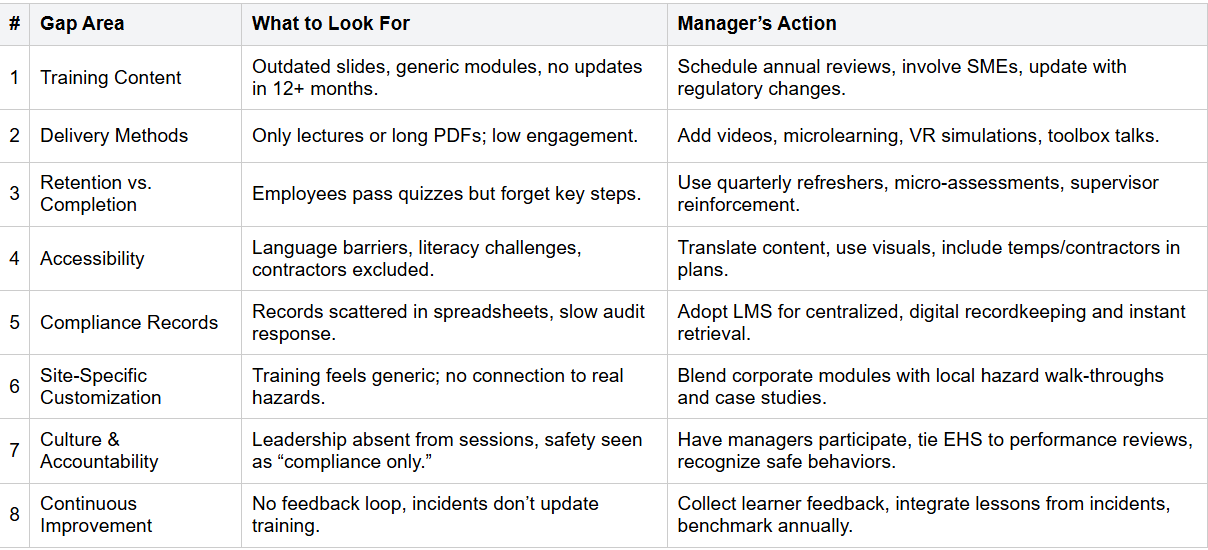
Quick Reference Table: Hidden Gaps in EHS Training
1. Training Content: Is It Current and Relevant?
Hidden Gap: Many organizations recycle the same slide decks or videos year after year. Regulations, technology, and hazards evolve, but the training material doesn't.
Checklist Questions:
- Does our training address new processes, equipment, or chemicals introduced this year?
- Are we customizing modules to reflect site-specific hazards instead of using generic templates?
Action Tip: Schedule an annual review of all training content. Assign SMEs (Subject Matter Experts) to audit accuracy and relevance.
2. Delivery Methods: Are We Engaging All Learners?
Hidden Gap: Training sessions often rely too heavily on lectures, long PDFs, or outdated videos. Workers may "check the box" without absorbing critical knowledge.
Checklist Questions:
- Are we considering generational learning styles (interactive for younger workers, concise modules for experienced staff)?
- Do we offer multiple training formats (e.g., videos, microlearning, simulations, toolbox talks)?
- Are mobile or on-demand options available for field teams and contractors?
Action Tip: Mix formats. For high-risk scenarios, consider VR simulations or scenario-based drills. Shorter microlearning modules can improve retention compared to one long annual session.
3. Reinforcement: Are We Measuring Retention, Not Just Completion?
Hidden Gap: Employees may ace the quiz right after training but forget critical steps within weeks. That gap shows up later during incidents or audits.
Checklist Questions:
- Are supervisors reinforcing lessons during daily operations?
- Do we use knowledge checks or short quizzes in between full training?
- Do we conduct refresher sessions more than once a year?
Action Tip: Implement quarterly "micro-assessments" or toolbox talks. Train supervisors to reinforce lessons during shift meetings or after safety observations.
4. Accessibility: Can Everyone Access the Training?
Hidden Gap: Training isn't equally accessible to all workers. Language barriers, literacy differences, or lack of digital access can leave certain groups behind.
Checklist Questions:
- Are materials available in multiple languages spoken by the workforce?
- Are contractors and temporary workers fully integrated into training plans?
- Do we account for literacy levels by using visuals, icons, and demonstrations?
Action Tip: Audit workforce demographics. Partner with HR to ensure every worker, regardless of role or background, has equitable access to training.
5. Compliance Records: Are Always We Audit-Ready?
Hidden Gap: Many companies keep records scattered across spreadsheets or binders. When OSHA or EPA inspectors arrive, scrambling begins.
Checklist Questions:
- Can we produce proof of training completion instantly for any employee?
- Are records backed up and accessible across multiple sites?
- Do we have centralized, digital recordkeeping?
Action Tip: Adopt a Learning Management System (LMS) designed for EHS compliance. Cloud-based solutions ensure real-time reporting, easy retrieval, and audit readiness.
6. Site-Specific Customization: Is Training Connected to Real Hazards?
Hidden Gap: Employees may sit through generic training modules but never see how lessons connect to their specific job site.
Checklist Questions:
- Does the training include case studies or examples from our actual facilities?
- Are near-miss incidents used as training examples?
- Do supervisors walk through site-specific hazards during onboarding?
Action Tip: Blend corporate modules with local hazard awareness training. Encourage site managers to integrate real photos, maps, or scenarios into training.
7. Culture and Accountability: Is Training Reinforced by Leadership?
Hidden Gap: If leadership treats EHS training as a "compliance task," employees follow suit. True safety culture requires visible buy-in from managers and executives.
Checklist Questions:
- Are supervisors modeling safe behaviors consistently?
- Is training tied to performance reviews or KPIs?
- Do leaders attend and participate in training alongside employees?
Action Tip: Make EHS training part of leadership scorecards. Recognize teams that demonstrate safety excellence, not just compliance.
8. Continuous Improvement: Are We Learning from Incidents and Feedback?
Hidden Gap: Many organizations conduct training but rarely evaluate effectiveness or gather worker feedback.
Checklist Questions:
- Do we collect post-training feedback from learners?
- Are lessons from incidents or near misses fed back into the training program?
- Do we benchmark against industry best practices annually?
Action Tip: Create a formal review cycle. After incidents, update modules immediately with corrective learnings. Use anonymous surveys to capture honest employee feedback.
The ROI of Closing EHS Training Gaps
Investing in closing these gaps isn't just about avoiding fines. It has measurable business benefits:
- It reduces incidents and claims. This leads to fewer workers' comp payouts and disruptions.
- It makes higher employee engagement. It results in workers feeling safer and more valued.
- Closing EHS training gaps creates a stronger compliance posture. It reduces stress during audits and inspections and builds confidence that your organization can consistently meet regulatory requirements.
- Safety-conscious companies attract better talent and build stronger partnerships, enhancing their position in the marketplace. In fact, a strong EHS culture often translates to operational efficiency. Workers who feel safe are more likely to be productive, innovative, and loyal, which ultimately drives long-term business growth and sustainability.
Your Action Plan: From Checklist to Culture
To transform this checklist into action:
✅Audit your current program – EHS managers must identify outdated materials, weak delivery methods, or missing groups.
✅Prioritize gaps with highest risk- EHS officers must focus on areas that affect compliance, safety, and liability most.
✅Adopt digital tools – Training officers should use LMS platforms like CloudSDS LMS, mobile apps, or VR training for scalability and efficiency.
✅Engage leadership – Plant managers must secure buy-in from executives to embed safety in culture, not just compliance.
✅Measure, adapt, repeat- EHS managers, supervisors must track training as a continuous process, not an annual checkbox.
Final Thoughts
The hidden gaps in your EHS training program won't show up until it's too late, when an inspector issues a citation, when a near miss turns into an incident, or when an employee fails to react in a critical moment. As a manager, you have the opportunity to uncover those blind spots before they cost lives, money, or reputation.
Your EHS training program's hidden flaws won't become apparent until it's too late, such as when an inspector issues a citation, a near-miss escalates into an incident, or an employee fails to act in a crucial situation. You have the chance to identify those blind spots as a manager before they endanger lives, finances, or reputation.
Make use of this checklist on a daily basis. Make it a part of your operational rhythm, share it with your teams, and review it every three months. EHS training is ultimately a commitment to people, culture, and the long-term prosperity of your company, not just compliance.
Simplify Your SDS Management
CloudSDS gives your team instant access to 23M+ safety data sheets with AI-powered search, automated updates, and full OSHA/GHS compliance — all from one platform.
Leave A Comment