

Summary:
Introduction
Chemical safety is one of the most critical responsibilities in any industrial, laboratory, healthcare, or manufacturing environment. Whether handling cleaning agents, industrial solvents, compressed gases, or hazardous chemicals, workers must have immediate access to accurate hazard information. That is where Material Safety Data Sheets (MSDS), now standardized as Safety Data Sheets (SDS), become essential.
Under OSHA's Hazard Communication Standard (HazCom) and the Globally Harmonized System (GHS), SDS documents help employers and employees find chemical hazards, learn safe handling procedures, and respond effectively during emergencies. Having proper SDS management is not optional anymore. Every organization should provide its employees with this, as it ensures workplace safety, risk reduction, and operational efficiency.
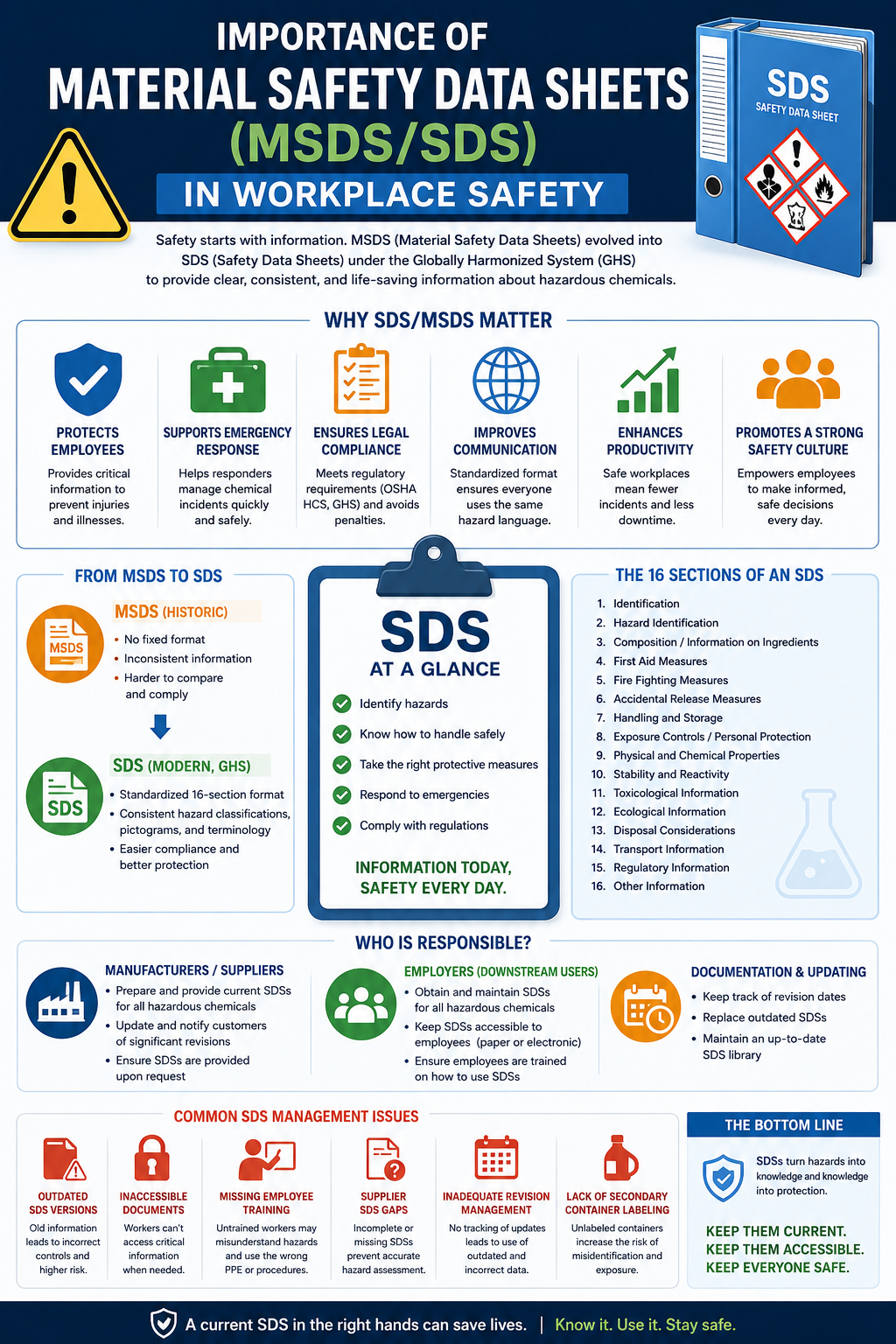
Importance of Material Safety Data Sheets (MSDS/SDS) in Workplace Safety
A Material Safety Data Sheet (MSDS) — now more commonly called a Safety Data Sheet (SDS) — is a standardized document that describes a chemical substance or mixture, the hazards it presents, and the safe handling, storage, disposal, and emergency response measures associated with it. Below I explain what an SDS/MSDS is, how MSDS and SDS differ, why terminology changed, and who must maintain SDSs, with concise, practical points you can use in EHS programs.
What is a Material Safety Data Sheet?
An MSDS/SDS is a written technical document supplied by the manufacturer, importer, or distributor that communicates hazards (health, physical, environmental), composition, exposure controls, personal protective equipment (PPE), first-aid, firefighting, accidental release measures, and storage/handling guidance.
Its purpose is to inform employers, employees, emergency responders, and others about safe use and emergency action so workplaces can manage chemical risks and comply with regulations.
Definition of SDS / MSDS
MSDS (Material Safety Data Sheet) is the older term used historically in many jurisdictions; it contains the same core kinds of information about a chemical's hazards and safe use.
An SDS (Safety Data Sheet) is the modern, globally harmonized format specified under the Globally Harmonized System (GHS); it uses a 16-section structure for consistent presentation of information across suppliers and countries.
MSDS vs SDS — key practical differences
| Aspect | SDS (modern, GHS) | MSDS (historic) |
|---|---|---|
| Format standardization |
Follows the standardized 16-section GHS layout:
1. Identification 2. Hazard(s) identification 3. Composition/information on ingredients 4. First-aid measures 5. Fire-fighting measures 6. Accidental release measures 7. Handling and storage 8. Exposure controls/personal protection 9. Physical and chemical properties 10. Stability and reactivity 11. Toxicological information 12. Ecological information 13. Disposal considerations 14. Transport information 15. Regulatory information 16. Other information |
No fixed universal structure; order and included content varied by supplier, which made direct comparison and regulatory alignment more difficult. |
| Terminology and clarity | Uses standardized hazard classifications, signal words, hazard statements, precautionary statements, and pictograms according to GHS. | No systematic hazard classifications and signal words, possibly without standardized pictograms, leading to inconsistent terminology. |
| Regulatory expectation | Expected by modern hazard-communication regulations (e.g., GHS-aligned systems and HCS 2012 in the U.S.), it serves as the compliance baseline in many jurisdictions. | Treated as legacy documentation; regulators typically require suppliers/users to update MSDS-format documents to GHS-format SDSs where applicable. |
Why the terminology changed
| Reason | What it means | Practical benefit |
|---|---|---|
| Global harmonization | Adoption of the Globally Harmonized System (GHS) changed the preferred document name to SDS and standardized classification and labelling worldwide. | Reduces cross-border misinterpretation, eases international trade, and ensures suppliers and users share the same hazard language. |
| Consistency and safety | A uniform 16-section SDS layout gives a predictable place for each type of critical information (first aid, PPE, physical properties, etc.). | Enables employers and emergency responders to locate critical details quickly and lets multinational companies maintain one chemical-information system across sites. |
Who is legally required to maintain SDS?
| Who | Legal requirement | Practical responsibilities |
|---|---|---|
| Manufacturers, importers, distributors | Must prepare (or obtain) and provide an SDS for each hazardous chemical to downstream users under most regulatory schemes (including OSHA’s Hazard Communication Standard in the U.S.). | Ensure that every shipped/marketed chemical has a current SDS, and a supply of SDSs should be provided. Shipments should be made upon request, and downstream users should be notified upon request of significant revisions. |
| Employers (downstream users) | Must have and maintain SDSs for hazardous chemicals present in the workplace and make them accessible to employees (paper or electronic). | Maintain an on-site SDS library or an easy-to-access electronic system and ensure that employees have access to SDSs not only in regular situations but also during any emergency situations. |
| Documentation and updating | The SDS needs to be updated by both employers and suppliers, and new revisions of the SDS must be received from the supplier when changes are made to the SDSs. | The date of revisions for the SDSs needs to be documented, and outdated SDSs need to be replaced and updated with new SDS information. |
Practical actions for EHS managers (brief checklist)
- Chemical inventory: Maintain an accurate inventory listing all chemicals used in the facility and make sure that all the chemicals have updated SDSs.
- Availability: Make sure that SDSs are available to all employees and can be accessed easily during emergencies as well.
- Update: Ask for updated SDSs when the formulations of the product change or when the chemical supplier gives you new ones.
- Training/JHA: Use SDSs to conduct JHAs, select personal protective equipment, prepare emergency plans, and conduct training programs.
- Supplier Responsibility: Include in your purchasing agreement the requirement for the supplier to provide you with SDSs and notify you about any major changes.
Example (illustration): For a cleaning solvent used on-site, the SDS will tell you acute toxicity hazards, recommended respirator type and eye protection, flashpoint and fire measures, spill cleanup steps, and proper disposal methods—information you use directly in permits, SOPs, and training.
Why Is SDS Important?
SDSs are central to chemical safety programs because they translate technical hazard data into actionable workplace controls, training, and emergency procedures. Below are focused, practical elaborations on each listed reason why SDSs are important, with one short example at the end.
1. Worker safety
- SDSs list health hazards (acute and chronic), exposure routes, and recommended PPE so employers can choose controls (engineering, administrative, and PPE) that directly reduce worker exposures.
- They assist in recognizing symptoms of exposure and provide medical advice (first aid), allowing employees and occupational health personnel to react promptly and minimize future risks.
3. Hazard communication
- The standardization of SDSs ensures that information regarding hazards is consistent in terms of wording used by manufacturers.
- This ensures that the labels, warnings at the worksite, and work practices conform to the supplier's claims of hazards associated with the chemicals.
4. Emergency response
- SDS sections on first aid, firefighting measures, accidental release, and reactivity provide emergency responders and onsite teams with practical steps for spills, fires, exposures, and incompatible-material incidents.
- Critical details—such as flash point, extinguishing media, specific firefighting instructions, and recommended containment methods—speed correct responses and reduce escalation during an incident.
5. OSHA compliance
- Maintaining accessible, current SDSs is a regulatory requirement under hazard-communication rules in many jurisdictions; having them available demonstrates compliance during inspections and audits.
- SDS-based information is the backbone for labeling, written hazard-communication programs, and recordkeeping that regulators examine.
6. Employee training
- SDSs supply the factual basis for job-specific training: which chemicals are used, their hazards, required PPE, safe-handling steps, and emergency procedures.
- Integrating SDS content into training ensures workers understand why controls exist and can translate written procedures into safe daily practice.
7. Business risk reduction
- Accurate SDS management reduces operational risks—fewer incidents, lower workers' compensation claims, and reduced potential for regulatory fines or shutdowns.
- Harmonized SDSs not only improve safety but also make it easier to buy, transport, and operate across countries, reducing legal and commercial problems.
8. Compact example (how it ties together)
For a solvent with flammability and inhalation hazards, the SDS tells you its flash point, ventilation/PPE needs, spill-control steps, and medical treatment; you use that to set storage separation, select respirators and eyewear, train workers, label containers, and produce an emergency plan—preventing exposures and meeting regulatory expectations.
The 16 Sections of an SDS
Modern SDS documents follow a standardized 16-section format under GHS.
| Section | Purpose |
|---|---|
| 1. Identification | Product and supplier information |
| 2. Hazard Identification | Hazard classification and warnings |
| 3. Composition | Chemical ingredients |
| 4. First Aid Measures | Exposure treatment procedures |
| 5. Fire Fighting Measures | Fire response guidance |
| 6. Accidental Release Measures | Spill cleanup procedures |
| 7. Handling and Storage | Safe storage requirements |
| 8. Exposure Controls / PPE | Protective equipment guidance |
| 9. Physical and Chemical Properties | Chemical characteristics |
| 10. Stability and Reactivity | Reactivity hazards |
| 11. Toxicological Information | Health effects and toxicity |
| 12. Ecological Information | Environmental impact |
| 13. Disposal Considerations | Safe disposal guidance |
| 14. Transport Information | Shipping requirements |
| 15. Regulatory Information | Applicable regulations |
| 16. Other Information | Revision dates and notes |
This standardized structure allows workers and emergency responders to locate information quickly during critical situations.
Common Workplace Risks Without SDS
Without accessible, current SDSs, workplaces face increased likelihood and severity of chemical incidents that harm people, property, and business continuity. Common workplace risks without SDS — with points and relevant lists:
Chemical exposure
- Missed hazard recognition: Workers may not know a substance's acute or chronic health effects, routes of exposure (inhalation, skin, ingestion), or symptoms to watch for.
- Inadequate controls: Lack of SDS guidance can lead to missing engineering controls (ventilation), improper PPE selection (respirators, gloves), and inappropriate work practices.
- Medical complications: First aid and medical treatment information (antidote and decontamination information) are not available. Hence, there will be a delay in medical assistance, leading to severe injuries.
Fire hazards
- Uncertain flammability characteristics: In the absence of SDS information regarding flash point, autoignition temperature, or flammable limits, proper storage or hot work safety measures may be inadequate.
- Incorrect firefighting techniques: The SDS provides proper firefighting methods and firefighting techniques; however, without that information, responders may resort to methods that could intensify the fire situation.
- More ignition sources: Lacking SDS information about static electricity, incompatible substances, or other ignition sources increases the chances of ignition during normal operation.
Improper storage
- Storage of Incompatible Materials: SDS provides information on chemical incompatibility (oxidizers, acids, bases, and organics), without which incompatible chemicals will be kept together, resulting in violent reactions.
- Incorrect Containment and Segregation: SDS provides information on temperature ranges, ventilation conditions, and acceptable containers—without which leaking, decomposition, and pressure conditions occur.
- Poor Labeling and Secondary Containment: Failure to label results in incorrect identification and handling of chemicals.
Spill incidents
- Poor containment and remediation: The SDSs provide guidelines for handling spills, protective gear, and neutralizers. Without it, remediation is costly.
- Environmental exposure: Ecology and Disposal sections of Safety Data Sheets are containment tools that help prevent contamination. Without them, spills become environmental problems.
- Costly remediation: Poor remediation efforts make cleanup procedures extremely complicated in the first place.
Regulatory penalties
- Hazard Communication: Availability of SDS is a requirement under many legal jurisdictions, and lack of compliance can result in citations and fines.
- Inspection Documentation Gaps: Inspectors assume that SDS libraries are kept, training has been completed, and labeling is consistent; a lack of SDSs triggers further investigation.
- Legal Liability: SDSs may help provide legal protection following an injury or environmental problem.
Delayed emergency response
- Delayed rescue and triaging: In the absence of information in the SDS, poison control needs contacts in the SDS; without this information,
- Firefighters and hazmat teams: Information in the SDS is required for determining personal protective equipment; failure to access this information will expose rescuers to greater risk.
- Communication problems: Poison control needs contacts in the SDS; without this information, more time will elapse before help is available.
Actionable mitigation checklist (quick)
- Maintain an up-to-date SDS library (paper or electronic) and verify the SDS for every hazardous product on site.
- Match controls to SDS guidance: ventilation, PPE, storage segregation, and labeling.
- Train workers and contractors on how to read and use SDSs and include SDS-driven scenarios in drills.
- Implement a revision-tracking system and request updated SDSs whenever formulations change.
- Ensure emergency plans to reference SDS sections (first aid, firefighting, release response) and keep supplier/poison-control contacts readily available.
Common SDS Compliance Mistakes
Below are expanded, practical lists and a table showing common SDS compliance mistakes, why they matter, and quick corrective actions you can implement immediately.
| Issue | What | Why it matters |
|---|---|---|
| Outdated SDS versions | SDSs on file are older than the supplier’s current revision or lack GHS-section updates. | Controls, hazard classifications, and emergency information may be incorrect, increasing safety risk and regulatory exposure. |
| Inaccessible documents | SDSs are stored in a single location, behind passwords, or not available during shifts or emergencies. | Workers and responders lack the critical guidance they need when they need it, delaying response and medical care. |
| Missing employee training | Workers haven’t been trained to find, read, or apply SDS information to tasks. | Even with correct SDSs, workers may select incorrect PPE or use unsafe procedures. |
| Supplier SDS gaps | Suppliers fail to provide SDSs, supply incomplete sections, or deliver MSDS-format files lacking the 16-section GHS layout. | Incomplete data prevents accurate hazard assessment and compliant labeling. |
| Inadequate revision management | There is no way of recording the dates of receiving new versions of SDSs along with their replacements by suppliers. | Old versions continue to be used; consequently, training, labeling, and practices may differ from present dangers. |
| Lack of secondary container labeling | Transfer materials are not labeled properly as to their identity, associated risks, and necessary PPE based on the SDS. | Misidentification during use or maintenance leads to incorrect handling and exposures. |
How Digital SDS Management Improves Safety
Digital SDS management modernizes workplace safety by replacing paper systems with faster, OSHA-aligned digital access. Key benefits include:
- Access Using Cloud Services: Rapid access to SDS documents, irrespective of their location, using cloud services.
- Access Using QR Codes: The inclusion of QR codes on packaging that link to the SDS enables faster hazard identification.
- Access Using Mobile Applications: Mobile apps that come with barcode readers grant access to the SDS without needing an Internet connection. This ensures OSHA compliance.
- Automated Updating: Keeping updated information on modifications by manufacturers and regulators ensures that out-of-date SDSs will not be used.
- Centralized Database: SDS documentation is kept, suppliers are managed, audits are conducted, and training is carried out all from one database.
- Multi-language Translation: Instant translation of SDSs into multiple languages is possible.
Industries That Depend on SDS Management
Digital SDS management is essential in industries handling hazardous chemicals, helping ensure OSHA HazCom compliance, faster hazard communication, and reduced risk. Key sectors include:
- Manufacturing of Chemicals: SDS management of solvents, resins, and chemical formulations.
- Production of Pharmaceuticals: SDS recordkeeping for raw materials, reagents, and cleaning compounds to ensure the safe production of drugs.
- Labs: Information regarding lab chemicals is accessible through SDS at fingertips to perform experiments.
- Construction Sector: SDS management of paints, adhesives, and other dangerous solvents utilized by fieldworkers.
- Oil and Gas Industries: SDS management of fuels, lubricants, and other chemicals that minimize risks of exposure.
- Warehousing and Logistics: SDS information on chemicals is accessible centrally.
- Health Care Industry: SDS management of disinfectants, sterilants, and lab chemicals.
- Educational Institutions: SDS management of lab and facilities maintenance of chemicals.
Best Practices for SDS Compliance
Best practices for SDS compliance help maintain OSHA HazCom compliance and improve workplace safety through organized chemical management.
- SDS Reviews Every Year: Conduct audits for the SDS documents annually to ensure that their hazard and first aid information is up-to-date.
- Training Employees: Train employees when they are hired, once a year, and when new chemicals are introduced.
- Centralization of the System: Employ searchable cloud storage for SDS documents related to the chemicals stored within your facility.
- Revision History Tracking: Record SDS revisions using version control and receive alerts when a revision occurs.
- Emergency Access: Provide 24/7 access to SDS documents during emergencies using mobile applications, QR codes, or binders.
Where Should SDS Be Stored?
The storage of SDS should comply with the Hazard Communication Standard of OSHA (29 CFR 1910.1200(g)(8)) by providing instant accessibility at all times without any obstruction during all shifts. The proper location involves a combination of physical and electronic strategies, depending on the requirements at the site locations.
️✅Physical Binders
SDS sheets can be arranged in labeled, weatherproof binders at places where the chemicals will be used—never locked up or kept at inaccessible locations. Quarterly updates should be made to the binder along with an index list of the chemicals.
️✅Digital SDS Systems
Searchable access is possible through computers, applications, and kiosks available in workplaces, without requiring password authentication for workers. Educate workers about navigating the system and using off-site backup options such as flash drives.
️✅Multi-Site Accessibility
A cloud-based storage system can facilitate synchronization of SDSs in different locations. The system will allow access remotely through traveling to staff members or workers in distributed facilities such as warehouses. Role-based permissions will ensure compliance, protecting sensitive data.
️✅Shift Accessibility
Ensure that binders or devices are stored at easily accessible locations around the clock without requiring supervisor approvals. Mobile applications for nighttime staff will have offline modes.
️✅Emergency Access Requirements
First responders should be provided with pre-existing digital access links or physical master copies for testing during emergency drills. Backups will prevent outages, providing hard copies instantly for healthcare and cleanup emergencies.
What is the Recommended Update Frequency for SDSs?
Keeping the SDS up-to-date will help you comply with OSHA HazCom throughout your facility as changes in the hazards and formulations, along with any changes in regulation requirements, will be captured and kept current. It's imperative that employers are vigilant regarding their suppliers and tracking updates.
-
Supplier Revision Updates
Update your SDS within three months after receiving the supplier's revision that contains any significant new information relating to the hazards, protection measures, or formulation, according to OSHA 29 CFR 1910.1200.
-
OSHA Expectations
OSHA mandates updates only when new significant information emerges—no fixed periodic review is required—but best practices recommend 3–5 year audits plus annual compliance checks. Failure to update may result in citations during inspections.
-
Archive Requirements
Retain superseded SDS versions for at least 30 years under 29 CFR 1910.1020 if they document employee exposures, alongside current sheets. Store in secure, searchable archives with clear labeling for audit retrieval.
-
Version Control Practices
Log each revision with dates, change reasons, authors, and version numbers (e.g., v2.1_2026-05); use software for automated flagging and employee acknowledgments. This creates an audit trail proving diligence in hazard communication.
FAQ:
Why did OSHA replace MSDS with SDS?
OSHA changed the Material Safety Data Sheets to Safety Data Sheets to comply with the Globally Harmonized System (GHS). The former did not have a uniform structure; therefore, it was challenging to find information regarding hazards since the structure was not uniform across all producers.
A 16-section structure was adopted by the new format with standard terminology for hazard classification, the use of GHS pictograms, signal words, and precautionary statements. These changes help improve hazard communication, facilitate international commerce, ease worker training, and help workers and responders find critical information easily.
What information is included in a Safety Data Sheet (SDS)?
A safety data sheet (SDS) provides comprehensive data concerning the hazardous nature of a chemical substance, appropriate handling measures, and necessary emergency actions. The critical data found in an SDS include the following:
- Identification of the product and manufacturer
- Hazard categorization and labeling
- Chemical composition and contents
- First-aid procedures
- Fire-fighting procedures
- Emergency spill and release procedures
- Handling and storage precautions
- Exposure limits and personal protective equipment (PPE)
- Physical and chemical properties
- Stability and reactivity
- Toxicological information and environmental impact
- Disposal and transport guidance
- Regulatory information and revision date
Why are SDSs important in workplace safety programs?
The SDSs are an integral part of the workplace chemical safety management system since they provide essential information that will be used in the detection of possible hazards, prevention of exposure incidents, and emergency response during accidents and other emergencies involving chemicals in the workplace.
SDSs are important because they:
- Help workers understand chemical hazards and the risks associated with exposure
- Enable organizations to choose appropriate personal protective equipment and controls
- Enable organizations to respond to emergencies such as chemical spills, fire, or chemical exposures
- Enhance hazard communication between different workgroups
- Are used in employee safety training programs
- Comply with OSHA Hazard Communication Standards.
- Minimize the risks, injuries, and penalties incurred in business operations
In the absence of SDSs, workers would lack the knowledge of how to safely use chemicals at work.
Who is responsible for providing SDSs for hazardous chemicals?
The primary parties accountable for SDS preparation and supply are chemical producers, importers, and distributors. In this regard, they must ensure that every hazardous substance includes an up-to-date and correct SDS according to the 16-section GHS template.
Occupational settings where hazardous substances are used are responsible for SDS acquisition, storage, and availability for all employees throughout shifts. It is necessary to update the SDS documentation whenever updated versions are released by manufacturers.
Are employers legally required to maintain SDSs?
Yes. In accordance with OSHA's Hazard Communication Standard (HazCom), every employer needs to:
- Maintain SDSs for all hazardous chemicals in the workplace
- Ensure that these SDSs are easily available to the employees.
- Train employees on interpreting and utilizing SDSs
- Update SDS records after receiving revisions from suppliers
- Include SDS data in their safety protocol for workplace hazards
If employers do not properly maintain their SDSs, they can be subject to penalties, fines, and legal liabilities.

Simplify Your SDS Management
CloudSDS gives your team instant access to 23M+ safety data sheets with AI-powered search, automated updates, and full OSHA/GHS compliance — all from one platform.
Leave A Comment