
If you manage a facility where chemicals are used, stored, or handled, you already know the weight of that responsibility. One missing Safety Data Sheet (SDS). One outdated document. One employee who couldn't find the right information fast enough, and suddenly, a manageable situation becomes a regulatory nightmare or, worse, a safety incident.
Environmental, Health, and Safety (EHS) teams have long wrestled with the chaos of chemical compliance. Binders full of paper SDS documents. Spreadsheets that nobody updates. Files scattered across local drives in three different departments. It's a system held together by institutional memory and hope.
Cloud-based SDS management changes that entirely.
If your organization manages an EHS team and is looking for a smarter solution to handle all your compliance risk, this guide is for you. It explains everything EHS professionals need to know what cloud-based SDS management actually is, why traditional methods are failing teams today, and how modern software helps organizations eliminate compliance risk for good.
What Is Cloud-based SDS Management?
Cloud-based SDS management is a digital solution to simplify chemical safety management-related tasks, especially handling SDSs. It saves, organizes and manages all your Safety Data Sheets in one secure online platform, available from any device, anytime, anywhere. EHS teams abandon physical binders and dispersed local files for a web-based program that enables them to find, update, and share SDS documents instantaneously, across every department and facility. Think of it as your one-stop, up-to-date library of all your chemical safety knowledge, minus the paperwork.
What are the problems with traditional SDS management?
For decades, the standard approach to SDS management was simple: collect paper sheets, put them in a binder, keep the binder somewhere accessible. As facilities grew and chemical inventories expanded, that binder became a filing cabinet. The filing cabinet has multiple cabinets. And somewhere along the way, the system stopped working.
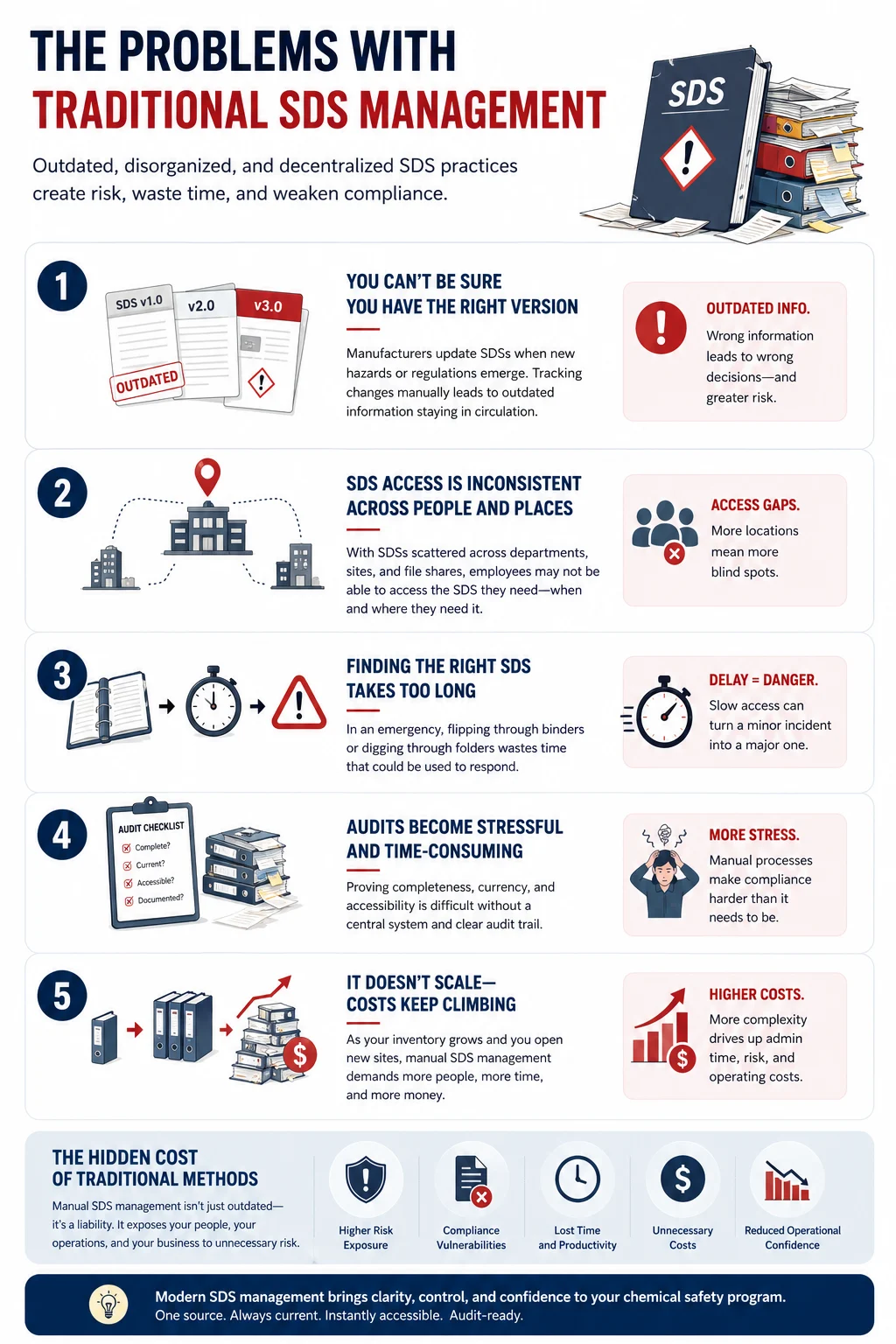
Here's where traditional SDS management consistently breaks down:
1. Version control isnearly impossible
Chemical manufacturers update SDSs regularly. New hazard information emerges. Regulatory requirements change. In a paper-based or locally stored system, tracking which version is current and replacing outdated sheets across multiple locations becomes a full-time job.
2. Accessibility is not consistent
OSHA mandates that SDSs be accessible to employees during each work shift. In a big facility with various departments, or a company with multiple sites, it's really hard, without a centralized system, to make sure every individual is able to get the right SDS at the right time.
3. Searching is moremistake prone
If a worker is exposed to a chemical and a supervisor requires the SDS right once, going through a binder or browsing a messy file drive takes precious seconds. In critical situations, every second counts.
4. Getting ready for the audit hurt
To pass audits, the EHS teams need to prove their SDS library is complete. And it's not enough, as they will have to prove that all the SDSs are up-to-date and readily available. It's not easy to keep up with modern-day audits if a team is following traditional approaches.
5. Scaling is expensive
A manual SDS management strategy scales poorly as a firm adds buildings, expands chemical inventory, and hires additional workers. More locations means more binders. More version confusion. More compliance gaps.
6 Ways cloud-based SDS management eliminates compliance risk
1. Centralized, always-updated document library
The single biggest advantage of cloud-based SDS management is centralization.
More importantly, leading platforms maintain direct relationships with chemical manufacturers and distributors, which means SDSs are automatically updated when manufacturers release new versions. Your library stays current without anyone on your team having to track down updates manually.
For EHS managers overseeing multiple facilities, this is transformative. Instead of coordinating SDS updates across six different locations and hoping each site coordinator actually makes the change, one update in the cloud propagates everywhere instantly.
2. Instant search and retrieval
Cloud-based platforms allow employees to search for any SDS by product name, manufacturer, chemical name, CAS number, or hazard category, and retrieve the correct document in seconds.
This matters enormously in emergency situations. When a worker is exposed to a substance and medical personnel need to know the exact composition, exposure limits, and first-aid procedures, a 30-second search is infinitely better than a five-minute binder hunt.
Many platforms also offer mobile access, meaning workers on the floor can pull up an SDS directly from a smartphone or tablet, no desk, no supervisor needed.
3. Multi-site access and role-based permissions
Cloud architecture makes geographic distribution irrelevant. A worker at your facility in Chennai can access the same up-to-date SDS library as a colleague in Chicago, at any hour, from any device.
Role-based access controls let EHS administrators manage who can view, edit, upload, or delete documents. Workers get read-only access to the SDSs they need. EHS managers can make updates globally. Compliance officers can generate reports without touching the underlying library. Everyone works within the right permissions, reducing both accidental errors and intentional misuse.
4. Automated compliance tracking and reporting
Audit preparation is one of the most time-consuming parts of any EHS manager's calendar. Cloud-based platforms dramatically reduce this burden by generating compliance reports automatically.
Want to know which chemicals in your inventory have SDSs that haven't been updated in more than three years? Run a report. Need to verify that every chemical in your facility has a corresponding SDS on file? One click. Preparing documentation for an OSHA inspection? Export a complete, timestamped record of your SDS library, access logs, and version history.
Some platforms also send automated alerts when SDSs approach expiration thresholds or when manufacturers push new versions, keeping your team proactive rather than reactive.
5. Integration withchemicalinventory management
The most sophisticated cloud-based SDS platforms don't operate in isolation; they connect with your broader chemical management ecosystem.
Integration with inventory management systems means that when a new chemical is added to your facility, the corresponding SDS is automatically requested or flagged for upload. When a chemical is phased out, its SDS can be archived rather than simply deleted, maintaining a historical record for long-term liability protection.
This closed-loop approach eliminates the most common source of compliance gaps: chemicals that are actively in use but whose SDSs have never been added to the system.
6. Disaster recovery and business continuity
Paper-based SDS systems are vulnerable in ways that are easy to overlook until something goes wrong. A fire, flood, or even an office renovation can destroy years of compliance documentation. Locally stored digital files are vulnerable to hardware failure, ransomware, and accidental deletion.
Cloud platforms store data across redundant, geographically distributed servers with automated backups. Your SDS library survives whatever happens to your physical facility and is accessible even if your primary location is temporarily unavailable.
What are the main features to look for in a cloud-based SDS management platform?
Not all cloud SDS solutions are equal. When evaluating platforms, EHS teams should look for:
1. Comprehensive database coverage
The best platforms maintain partnerships with thousands of chemical manufacturers and can source SDSs for an extensive range of products, reducing the manual upload burden on your team.
2. Multi-language support
For organizations with global operations or multilingual workforces, SDS access in employees' primary languages is both a regulatory requirement in many jurisdictions and a basic safety necessity.
3. Mobile optimization
Field workers and plant-floor employees need mobile-friendly access. Look for native mobile apps or fully responsive web interfaces.
4. Regulatory intelligence
Chemical regulations change. A quality platform tracks changes to OSHA HazCom, REACH, GHS, and other frameworks and flags SDSs that may need review as regulations evolve.
5. Audit trail and access logging
For compliance purposes, you need to know who accessed which SDS and when. Complete access logs protect your organization in the event of an incident investigation.
6. Integration capabilities
Look for open APIs or pre-built integrations with ERP systems, chemical inventory platforms, and procurement tools.
The real cost of getting it wrong
It's tempting to view SDS management as an administrative burden, something to maintain just enough to pass an audit. But the true cost of poor chemical compliance is significantly higher than most organizations calculate.
Direct costs include OSHA fines, which have increased significantly in recent years. A single serious violation can result in a penalty exceeding $16,000. Willful or repeat violations can push penalties above $150,000 per incident.
Indirect costs are even larger. A chemical incident that injures an employee creates workers' compensation of liability, potential litigation, and lasting reputational damage. Facility shutdowns during investigations of cost, production time, and revenue. And the human cost of an injury that could have been prevented with readily accessible safety information is incalculable.
Cloud-based SDS management is not a luxury for well-resourced EHS departments. It's risk management infrastructure that pays for itself many times over.
How to begin with cloud-based SDS Mamanagementoftware?
If your organization is still managing SDSs through paper binders, local files, or disconnected spreadsheets, the transition to a cloud platform may feel daunting. It doesn't have to be.
1. Start with a chemical inventory audit
Before migrating to any new system, take stock of what chemicals are actually present in your facility and which ones have existing SDSs. This baseline inventory becomes the foundation of your cloud library.
2. Choose a platform with migration support
The best SDS management vendors offer onboarding assistance, including bulk SDS uploads, database matching to fill gaps in your library, and training for EHS staff.
3. Establish governance protocols early.
Decide who owns SDS management in your organization, how new chemicals are added to the system, and how frequently the library will be reviewed. Clear ownership prevents the gaps that create compliance risk.
4. Train your workforce
A cloud platform is only effective if employees know it exists and how to use it. Include SDS access training in onboarding for new hires and refresher sessions for existing staff.
5. Leverage reporting from day one
Once your library is live, set up automated compliance reports to run on a regular cadence. Regular visibility into your compliance posture prevents small gaps from becoming serious problems.
How can the SDS management software from CloudSDS help to eliminate chemical compliance risk?
Managing chemical compliance manually is time-consuming, error-prone, and risky. The SDS management software from CloudSDS simplifies the entire process by giving EHS teams one intelligent platform to handle everything from finding the right SDS in seconds to generating audit-ready reports on demand. Here's exactly how:
1. Easy SDS search
When a chemical incident happens, every second counts. The SDS management software from CloudSDS eliminates the frustration of flipping through binders or digging through disorganized file folders with a powerful, intuitive search engine. Workers and EHS managers can search for any Safety Data Sheet using a product name, manufacturer, chemical name, or CAS number and retrieve the correct, up-to-date document in seconds. Whether you're on the plant floor, in the office, or working remotely, the right SDS is always just a few keystrokes away. No delays. No guesswork. No compliance gaps caused by a document that couldn't be found in time.
2. Access to global SDS library
Chemical regulations aren't the same everywhere, and neither are the SDSs that support them. CloudSDS gives EHS teams access to a vast, continuously updated global SDS library covering thousands of chemical products from manufacturers and distributors worldwide. Whether your operations span a single facility or multiple countries, your team always has access to region-specific, regulation-compliant SDSs in multiple languages. This means you're never scrambling to source a missing document or relying on an outdated sheet that no longer reflects current hazard information. Your library grows with your chemical inventory automatically.
3. Effective hazard communication
One of the most critical and most commonly overlooked aspects of chemical compliance is making sure the right safety information reaches the right people at the right time. CloudSDS strengthens hazard communication across your entire organization by making SDSs instantly accessible to every employee who needs them, regardless of their role, location, or shift. Workers handling hazardous substances can quickly review safe handling procedures, PPE requirements, and emergency response steps before they begin work. This isn't just about meeting OSHA's HazCom requirements, it's about building a workplace culture where employees are genuinely informed, not just technically covered.
4. Simple to generate reports
Audit season shouldn't mean weeks of manual document gathering. With CloudSDS, compliance reporting is straightforward and fast. EHS managers can generate detailed, audit-ready reports in just a few clicks, covering everything from SDS version history and document access logs to inventory completeness and regulatory alignment. Need to prove that every chemical in your facility has a current SDS on file? Done. Want to identify which documents haven't been reviewed recently? The platform flags them automatically. Instead of spending days preparing for an inspection, your team can walk into any audit with complete, accurate documentation, already organized and ready to present.
5. Role-based access
To ensure data security, it's important to restrict everyone's access to all types of information. After all, not everyone in your organization needs the same amount of access to your SDS library. This is solved by CloudSDS with role-based access controls, where the administrator can give different permissions to different users. A floor worker is given read-only access to the SDSs that pertain to his/her work area. EHS Manager allows uploading, editing, and sorting of papers for many sites. A compliance officer can get reports without messing with the underlying library. Thus, only the verified users can see the required information. This role-based access of this software also minimizes chances of unintended errors, protecting critical compliance data and making it easier to demonstrate good information governance in audits.
Conclusion
Chemical compliance has long been a key EHS obligation, but the technologies available to EHS teams have changed tremendously. Cloud-based SDS management is a huge change from reactive, manual compliance to proactive, automated risk management.
The adoption of these solutions reduces the audit risk for the enterprises. They're creating safer workplaces, providing workers with the knowledge they need, and helping EHS teams focus on higher-value safety efforts instead of chasing documents.
Today's EHS teams are not debating whether to transition to cloud-based SDS management. It's about how quickly they can switch over and how much compliance risk they can carry with them.

Simplify Your SDS Management
CloudSDS gives your team instant access to 23M+ safety data sheets with AI-powered search, automated updates, and full OSHA/GHS compliance — all from one platform.
Leave A Comment