
Last Updated on March 27, 2026
Organizations that deal with chemicals are required to comply with hazard communication standards. Chemical manufacturers and employers are required to follow the Hazard Communication Standard. This standard is enabled by the OSHA (Occupational Safety and Health Administration). Chemical manufacturers and employers both need to share the responsibilities regarding labels, employee safety, and legal obligations. Chemical manufacturers need to categorize chemical hazards and create compliant labels. These labels are aligned with hazard statements, pictograms, precautionary statements, signal words, etc. Employers look after secondary container labeling, training employees, and maintaining the SDS documentation. Understanding these distinct roles is critical for regulatory compliance, audit readiness, and reducing chemical-related workplace risks.
SDS Labeling Rules for Manufacturers vs. Employers
Safety Data Sheet (SDS) labeling compliance is governed by the Hazard Communication Standard (HCS) under the Occupational Safety and Health Administration. While both manufacturers and employers are responsible for chemical safety communication, their labeling duties differ in regulatory scope, technical requirements, and enforcement exposure.
The Hazard Communication Standard, or the HCS, governs the SDS labeling compliance. Employers and manufacturers are both accountable for chemical safety communication. But there are differences in technical requirements and regulatory sectors.
Manufacturer vs. Employer: Explaining Labeling Responsibilities
1. Manufacturer Labeling Responsibilities
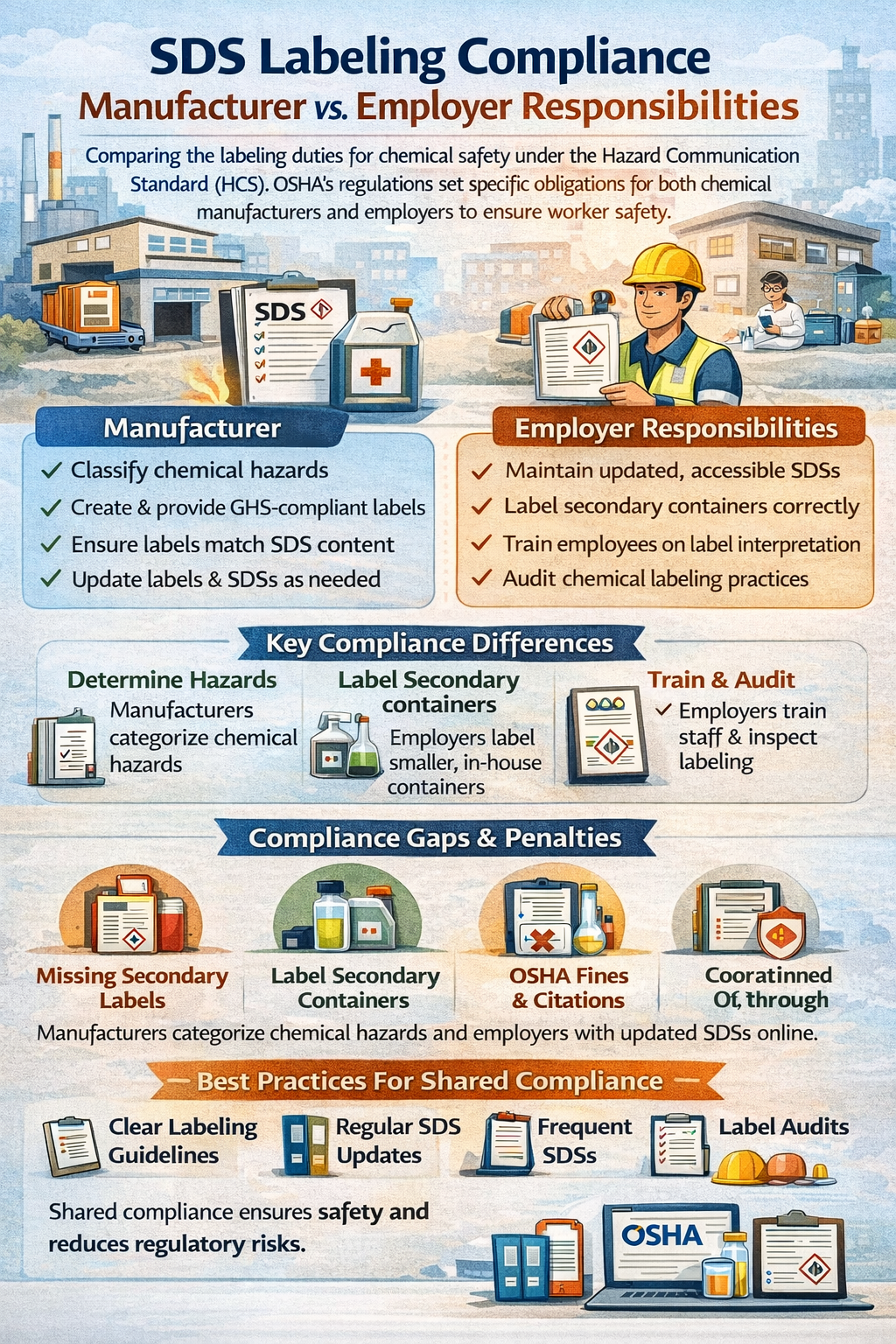
Chemical manufacturers oversee the hazard determination and GHS-compliant label creation. Under the Globally Harmonized System of Classification and Labelling of Chemicals (GHS), manufacturers need to take some responsibilities, that are mentioned below:
- Chemical manufacturers need to arrange the hazard classification for physical, health, and environmental risks.
- They need to incorporate the standardized label elements: product identifier, signal word, hazard statements, pictograms, precautionary statements, and supplier information.
- It is also their responsibility to review the label accuracy that must line up with the corresponding SDS (especially Sections 2 and 3).
- They need to update labels when new hazard information becomes available.
- It is essential to provide downstream distributors and employers with updated SDS documentation.
2. Employer Labeling Responsibilities
Employers don’t require re-categorizing the chemicals. But it is essential to ensure workplace labeling remains compliant and effective. They need to oversee—
- It is essential to maintain the accessibility of SDSs. They also ensure that SDSs (for all hazardous chemicals) are up-to-date.
- Employers must ensure the original manufacturer’s labels remain intact.
- They need to ensure correct labeling of the secondary containers unless used immediately by one employee.
- They need to apply the workplace labeling systems. These systems interact with hazards without any confusion.
- They need to arrange training for employees to interpret label elements and SDS information.
3. Key Compliance Distinction
Manufacturers create the legally binding hazard communication framework. On the other hand, employers make it real and maintain it within the work sector. Understanding this division is essential for inspection of readiness, OSHA audit defense, and maintaining a robust chemical safety management system.
Why SDS Labeling Responsibilities Differ
SDS labeling responsibilities vary between manufacturers and employers. It is because people from both sectors operate the chemical lifecycle and carry distinct regulatory duties in various stages. They do their job under the Hazard Communication Standard enforced by the Occupational Safety and Health Administration.
Role of Manufacturers in Hazard Communication
- Usually, manufacturers conduct formal hazard classification of chemical substances and mixtures.
- It is essential to align label elements with the Globally Harmonized System of Classification and Labelling of Chemicals (GHS).
- They develop compliant labels such as signal words (warnings or danger), hazard statements, product identifiers, GHS pictograms, precautionary statements, and supplier identification.
- They review the consistency between label content and SDS Sections 2 and 3.
- It is essential to update labels and SDS (in case of availability of new hazard data).
- They provide accurate hazard communication to downstream users.
Role of Employers in Workplace Safety
- Employers review accessible and current SDS documentation for all hazardous chemicals.
- They ensure accuracy and readability of the manufacturer’s labels.
- They need to review the label on secondary containers appropriately.
- They must implement a written hazard communication program.
- Employers must arrange training programs for the employees on label interpretation and safe handling practices.
- They monitor workplace compliance during inspections and internal audits.
Common Compliance Gaps Between Manufacturers and Employers
Despite both manufacturers and employers doing their jobs and responsibilities as per similar regulatory procedures, during the execution period they face compliance with failure-related issues. It occurs because the focus on their duties and responsibilities is different. Manufacturers monitor the categorization and primary labeling. On the other hand, employers focus on implementation in the work sector. That’s why a connection gap between manufacturers and employers occurs.
There are some common compliance gaps that are mentioned below:
1. Missing Secondary Labels
- Lack of necessary hazard information in handwritten labels.
- Absence of required hazard warnings or product identifiers.
2. Dependence on Outdated SDS
- SDS is not updated according to the newly added hazard-related information.
- Using existing pre-GHS format-based MSDS.
- Inability to replace the SDS after formulation changes.
- Lack of timely (periodic) review methods.
3. Poor Internal Label Control
Even when manufacturers provide compliant labels and SDS, employers may lack structured internal controls.
Observed control failures include:
- Lack of a centralized label management system.
- Label printing practices across departments are irregular.
- Absence of version control for revised hazard classifications.
- No timely internal audits of label accuracy.
Outcome of Labeling Non-Compliance
In case of non-compliance with chemical labeling requirements as per the HCS (29CFR 1910.1200), both manufacturers and employers face legal, operations, and regulatory risks. As per the OSHA (the Occupational Safety and Health Administration) for the lack of labeling, hazard communication obligations led to serious violations. These violations result in paying financial penalties, facing reputational damage, and increased health risks for workers.
1. OSHA Fines and Citations
- Serious violations of citations occur for missing or incomplete container labels.
- Intentional or repetitive violations led to significantly higher penalties.
- Monetary fines that scale per violation category.
- Mandatory abatement actions with strict corrective deadlines.
2. Failed Inspections and Audits
- When OSHA compliance inspections fail.
- Supply chain audit failures have a negative impact when it comes to vendor approval.
3. Increased Incident Exposure Risks
- In case of mishandling hazardous chemicals, employees or workers face incident exposure to related risks.
- In the correct selection of personal protective equipment (PPE), the incident exposure risks are increased.
- Due to inaccurate or delayed.
- Exposure of incidents may increase frequency and severity.
Hazard communication is a precautionary control mechanism. When labeling systems are not accurate, then losing frontline safety processes is just a matter of time.
Best Practices for Shared Compliances
Transparent Internal Labeling Guidelines
- Organizations should define roles for EHS, procurement, warehouse, and production teams.
- They need to follow the standard operating procedures (SOPs) for secondary container labeling.
- Every organization must maintain transparent escalation protocols for missing or damaged labels.
- They must meet all SDS-related requirements through proper documentation. \
Regular SDS and Label Management Systems
- Organizations must verify that each chemical in inventory has updated SDSs.
- It is essential to cross-check hazard classifications against container labels.
- Organizations need to review the signal words; GHS pictograms and precautionary statements are accurate.
- They need to cross-check the revision dates and supplier updates.
Conclusion
When it comes to manufacturers and employers complying with the SDS labeling rules, then it can be said that both of them are interconnected. But there are quite a few differences in their responsibilities. Employers supervise the existing SDS, accuracy of secondary container labeling. On the other hand, manufacturers need to review the accuracy of hazard categorization, GHS-compliant primary labels, and routinely updates of safety data sheets. That’s why it is very common to arise different types of compliance gaps due to lack coordination and lack of internal controls. But if these two work together, conduct routine label and SDS audits and implement
Simplify Your SDS Management
CloudSDS gives your team instant access to 23M+ safety data sheets with AI-powered search, automated updates, and full OSHA/GHS compliance — all from one platform.
Leave A Comment