
Video Summary:
Chemical hazards create real, immediate workplace risks, and to efficiently avoid such threats, clear, consistent communication is essential. The Globally Harmonized System (GHS) hazard statements are short, standard phrases on Safety Data Sheets (SDSs) and product labels that describe specific chemical hazards and their seriousness. Because OSHA’s Hazard Communication Standard (HazCom) adopts GHS elements, these statements play a direct role in meeting regulatory requirements and keeping your facility compliant.
By standardizing hazard language worldwide, GHS hazard statements let workers, supervisors, and emergency responders recognize risks instantly, reducing misunderstandings that lead to incidents. They’re the concise risk descriptors that complement pictograms, signal words, and precautionary statements on SDSs and labels.
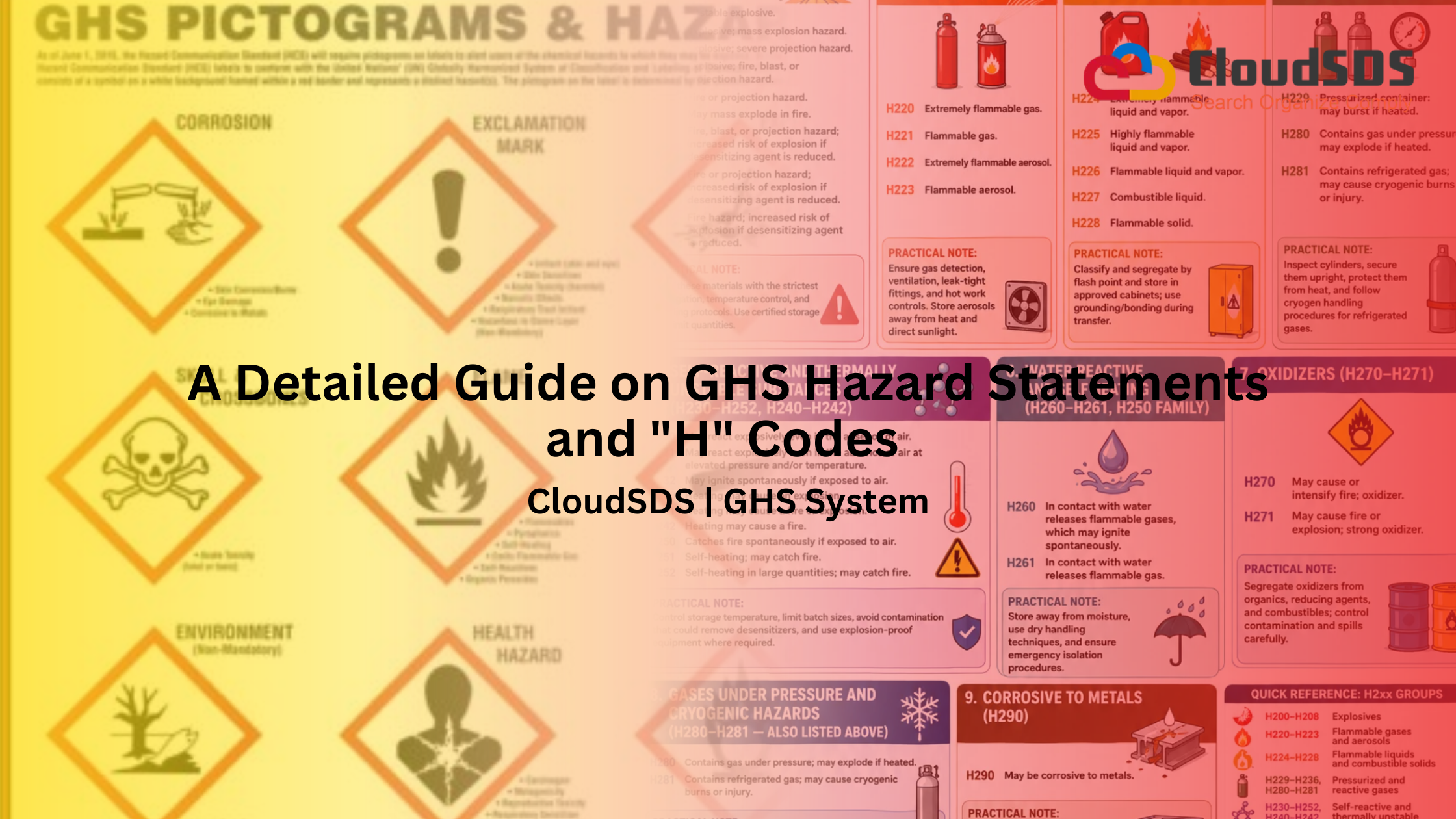
Decoding GHS Hazard Statements and H Codes
This guide explains how to decode and apply GHS hazard statements in the workplace, including:
- H codes and what they signify
- Hazard categories and severity levels
- Practical examples tied to common chemicals
- Key compliance requirements under OSHA HazCom
- Best practices for using hazard statements on SDSs, labels, and in workplace procedures
Read on to learn how to interpret H codes and categories so you can improve hazard communication, enforce compliance, and reduce incidents at your site.
What is a GHS Hazard Statement?
A GHS hazard statement is a standardized phrase assigned to a specific hazard class and category under the Globally Harmonized System of Classification and Labelling of Chemicals (GHS). To ensure consistent communication across labels, it succinctly describes:
- Nature
- Appropriate requirements
- The degree of chemical hazard in plain language
- Safety Data Sheets (SDSs)
- Regulatory documents
How hazard statements relate to class and category
- Hazard class: The broad type of intrinsic hazard a substance presents (for example, flammability, acute toxicity, or skin corrosion).
- Hazard category: A subdivision of a hazard class that indicates severity or potency (for example, acute toxicity category 1 is more severe than category 4).
- Hazard statement: The exact, prescribed phrase (and associated H code) that communicates the identified class and category (for example, the class “Flammable liquids,” Category 2, corresponds to H225 “Highly flammable liquid and vapor”).
Purpose of standardization
Standardized hazard statements ensure uniform wording worldwide so that workers, emergency responders, suppliers, and regulators interpret hazard information the same way regardless of language or location. This reduces miscommunication, shortens emergency response times, and helps lower incident rates by making hazard recognition and required precautions consistent across SDSs and labels.
Example box — common H codes and statements
- H225 — Highly flammable liquid and vapor
- H314 — Causes severe skin burns and eye damage
Use these entries as exact label/SDS text; the H code is the reference used in regulatory lists and SDS classification sections.
- Visual suggestion — sample label snippet
- Product identifier: Acme Solvent X
- Signal word: Danger
- Pictograms: (Flame) (Corrosion)
- H statements: H225 It is a highly flammable liquid and vapor. H314 Causes severe skin burns and eye damage.
- P statements: P210 Keep away from heat/sparks/open flames. No smoking. P280 Wear protective gloves/eye protection.
- Supplier information: name, address, and contact details.
Here’s a brief overview:
- On SDSs, list the full GHS classification (class + category) in Section 2 and include the corresponding hazard statements with H codes.
- On labels, please consider using the exact hazard statement text as listed in the applicable GHS/OSHA table; avoid paraphrasing.
- When multiple H statements apply, include all required statements in the order specified by the regulatory guidance.
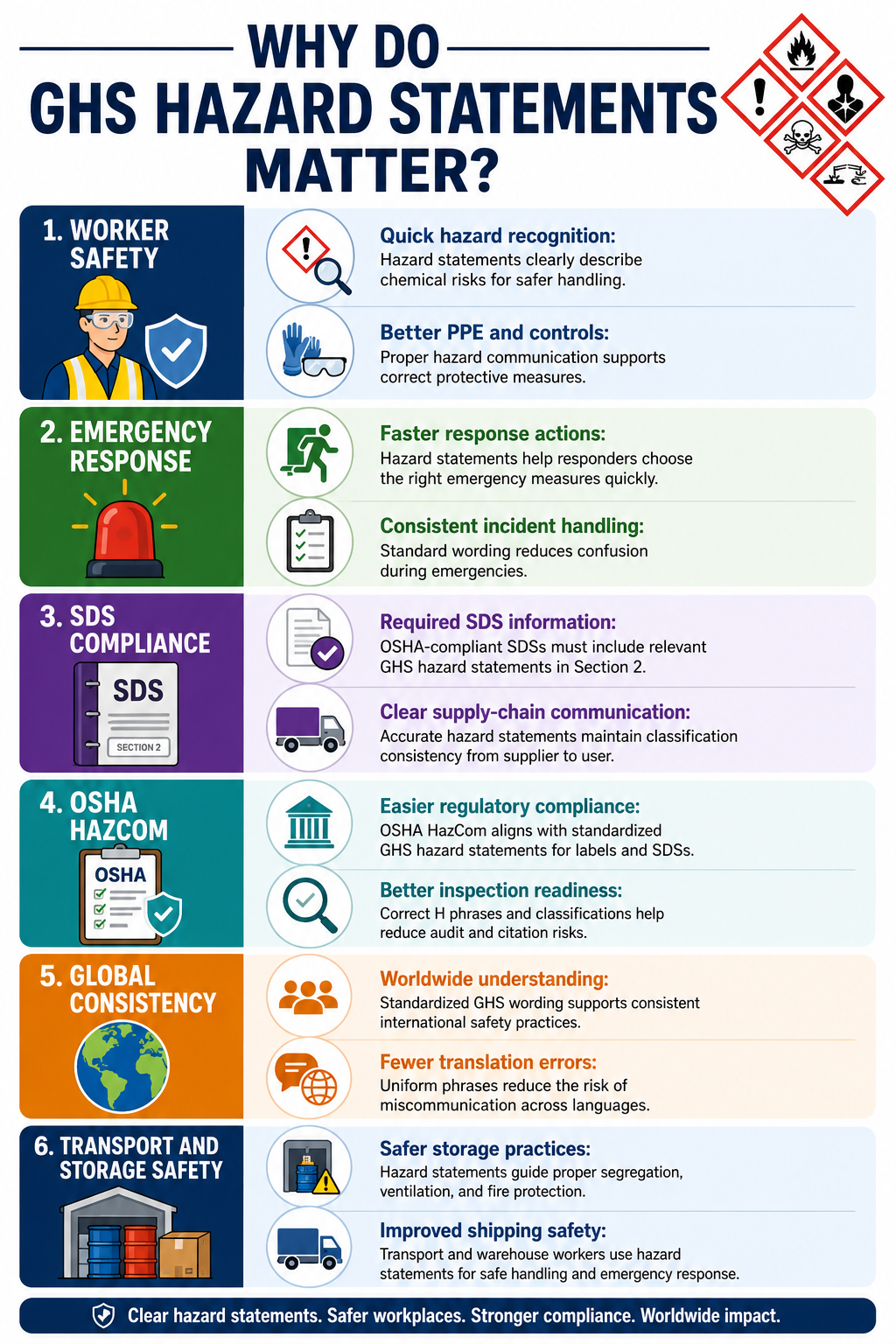
Why do GHS Hazard Statements Matter?
Worker safety
- Quick hazard recognition: Hazard statements clearly describe chemical risks for safer handling.
- Better PPE and controls: Proper hazard communication supports correct protective measures.
Emergency response
- Faster response actions: Hazard statements help responders choose the right emergency measures quickly.
- Consistent incident handling: Standard wording reduces confusion during emergencies.
SDS compliance
- Required SDS information: OSHA-compliant SDSs must include relevant GHS hazard statements in Section 2.
- Clear supply-chain communication: Accurate hazard statements maintain classification consistency from supplier to user.
OSHA HazCom
- Easier regulatory compliance: OSHA HazCom aligns with standardized GHS hazard statements for labels and SDSs.
- Better inspection readiness: Correct H phrases and classifications help reduce audit and citation risks.
Global consistency
- Worldwide understanding: Standardized GHS wording supports consistent international safety practices.
- Fewer translation errors: Uniform phrases reduce the risk of miscommunication across languages.
Transport and storage safety
- Safer storage practices: Hazard statements guide proper segregation, ventilation, and fire protection.
- Improved shipping safety: Transport and warehouse workers use hazard statements for safe handling and emergency response.
Elements of a GHS Label
Product identifier
The name or code that uniquely identifies the chemical or mixture on the label and SDS.
- Purpose: Ensures users can match the physical container to the correct SDS and procedures.
- Compliance notes: Use the exact product name used on the SDS (trade name, chemical name, or batch/lot identifier where applicable). Avoid ambiguous nicknames.
- Practical tip: For multi-language workplaces, include the product identifier in the primary workplace language and ensure the SDS uses the same identifier.
Signal Words
Single words used to indicate the relative severity of the hazard—primarily "Danger" or "Warning."
- Purpose: Provide an immediate visual cue of hazard seriousness.
- When to use: "Danger" for more severe hazard categories and "Warning" for less severe, per GHS/OSHA assignments.
- Compliance notes: Use only the prescribed signal word for the highest severity hazard present on the label. Do not invent alternatives.
- Practical tip: Pair signal words with training so workers understand the difference and appropriate actions.
GHS Pictograms
Standardized black symbol images on a white background within a red diamond border representing specific hazard types (for example, flame, corrosion, and skull and crossbones).
- Purpose: Quick visual identification of hazard class (health, physical, environmental).
- Compliance notes: Include all required pictograms for the classified hazards; do not add pictograms for non-applicable hazards. Pictogram size and placement should match regulatory guidance where specified.
- Practical tip: In multilingual settings, pictograms help bridge language gaps and reinforce their meanings in training and on safety signage.
Hazard Statements
Exact, standardized phrases (with H codes) that describe the nature and degree of the chemical hazard (for example, H225 "Highly flammable liquid and vapor").
- Purpose: Provide precise, consistent wording of the hazard so workers and responders understand the risk.
- Compliance notes: Use the exact text from the regulatory list; include H codes on SDSs (Section 2) and the full phrase on labels. If multiple H statements apply, include all required statements in the order specified.
- Practical tip: Keep labels legible—use concise formatting and prioritize the most critical H statements when layout space is limited, but do not omit legally required statements.
Precautionary Statements
Standardized instructions for prevention, response, storage, and disposal (P-statements), such as P210 "Keep away from heat/sparks/open flames."
- Purpose: Tell users what actions to take to minimize risks and what to do in an incident.
- Compliance notes: Include applicable precautionary statements tied to the hazard classification; tailor storage and disposal instructions to local requirements where necessary.
- Practical tip: Convert complex P-statements into workplace procedures and post abbreviated action steps at point of use (while retaining full text on the label/SDS).
Supplier Information
Manufacturer or supplier name, address, and phone number on the label.
- Objective: Offers traceability and contact information for technical assistance or emergencies.
- Compliance advice: Make sure the contact provided by the supplier is up-to-date and available during regular working hours.
- Tip: Include an emergency contact number in the sign or label at work sites.
Hazard Statements vs Precautionary Statements
In this section, we will discuss the differences between hazard and precautionary statements, their respective codes (H- and P-), and how they work together in describing hazards and preventive responses to these hazards. Understanding the distinction is critical for compliant SDSs/labels and for practical workplace safety.
Hazard statements
- Purpose: Describe the nature and severity of the chemical hazard in a concise, standardized phrase.
- What they do: Tell you what the hazard is (e.g., toxicity, flammability, corrosivity). They do not explain how to prevent or respond to the hazard—that's the role of precautionary statements.
- Format and codes: Each hazard statement has an H-code (for example, H332). H-codes are referenced on SDSs (Section 2) and in regulatory classification tables so users and auditors can confirm the underlying classification.
- Example phrases: "Fatal if inhaled," "Causes severe eye damage," "Highly flammable liquid and vapor."
- Compliance note: Use the exact official wording associated with the identified hazard category; do not paraphrase or invent alternative wording.
Precautionary statements
- Purpose: Provide standardized instructions to prevent exposure, control hazards, and respond to incidents (prevention, response, storage, and disposal).
- What they do: Tell you what to do before, during, and after exposure—specific actions, controls, or equipment required. They complement hazard statements by translating the identified danger into operational steps.
- Format and codes: Each precautionary statement is assigned a P-code (for example, P261). P-codes are grouped by function (P2xx prevention, P3xx response, P4xx storage, P5xx disposal).
- Example phrases: "Wear respiratory protection." "Keep away from heat/sparks/open flames." If inhaled: Remove the person to fresh air and keep them comfortable for breathing.
- Compliance note: Select P-statements that match the hazard classification and workplace controls; include all legally required P-statements and any additional site-specific measures.
Describe the danger vs. describe prevention/response.
- Hazard statements = Describe the danger: they answer, "What can happen?" For instance, "Fatal if inhaled" tells you the consequence of inhalation exposure.
- Precautionary statements describe prevention/response: they answer, "What should we do?" For example, "Avoid breathing dust/fumes/gas/mist/vapors/spray" (prevention) and "If inhaled: Call a poison center/doctor" (response).
H-codes and P-codes—quick reference
- H-codes: Standardized numeric codes that map to specific hazard statements (prefix H). Example: H314 → Causes severe skin burns and eye damage.
- P-codes: Standardized numeric codes for precautionary phrases (prefix P). Example: P280 → Wear protective gloves/protective clothing/eye protection/face protection.
Practical example
- Classification result: Acute toxicity — inhalation, Category 4
- H-code / Hazard statement: H332 — Harmful if inhaled
- Matching P-statements: P261 — Avoid breathing dust/fume/gas/mist/vapors/spray; P304+P340 — If inhaled: Remove person to fresh air and keep comfortable for breathing; P305+P351+P338 — If in eyes: Rinse cautiously with water for several minutes.
- How this looks on SDS and label:
- SDS Section 2: lists classification (Acute toxicity—inhalation, Category 4), followed by H332 (H-code) and the full text "Harmful if inhaled."
- Label: Shows the signal word (if required), the pictogram (e.g., health hazard), the full hazard statement "H332 Harmful if inhaled," and the selected precautionary statements (P261, P304+P340) in a clear sequence.
Practical application notes
- Never omit legally required P-statements even if workplace controls are in place; include them on labels/SDSs, then document site-specific controls in written procedures.
- Prioritize clarity: On small labels, show the most critical P-statements and reference the SDS for full instructions. In training and SOPs, expand P-statements into step-by-step tasks (e.g., specific respirator type, filter class, fit-testing frequency).
- Harmonize with workplace controls: Choose and apply P-statements that reflect real, implemented controls (engineering controls, administrative controls, and PPE) to avoid conflicting instructions.
Checklist for EHS use
- Confirm classification and map to H-statement(s).
- Select required P-statements that correspond to the hazards and realistic controls.
- Ensure SDS Section 2 lists H-codes and P-codes with full text.
- Please verify that the label includes the exact H- and selected P-statements; do not paraphrase them.
- Translate P-statements into site procedures and training (e.g., specify glove material, respirator class).
How H Codes Work?
H codes are the standardized short identifiers used to reference GHS hazard statements. They make it simple to link a numeric code to an exact hazard phrase on SDSs, labels, and regulatory lists. This section explains the structure and ranges so you can read and use H codes quickly and accurately.
What the "H" means
"H" means "hazard statement." The prefix identifies the entry as a hazard-statement code rather than a precautionary (P) code or another reference.
What the numbers mean—basic structure
- Format: Hxyz (for example, H225).
- First digit (x) = hazard group/category type. It indicates the broad class of hazard.
- Remaining digits (yz) = specific hazard identifier within that group. These map to a particular statement (severity, hazard type, or sub-classification).
H-code ranges and meaning
- H2xx — Physical hazards (flammability, explosivity, oxidizing properties, etc.). These describe hazards related to the physical/chemical behavior of a substance.
- H3xx — Health hazards (acute toxicity, skin/eye damage, respiratory sensitization, carcinogenicity, reproductive toxicity, specific target organ toxicity, etc.). These describe effects on human health.
- H4xx — Environmental hazards (aquatic toxicity, long-term environmental effects). These describe harms to ecosystems and the environment.
Quick table
- H2xx: Physical — flammability, explosiveness, peroxide formation, etc.
- H3xx: Health—toxic, harmful, corrosive, sensitizer, carcinogen, aspiration hazard, etc.
- H4xx: Environmental — hazardous to aquatic life, long-term aquatic hazard.
Example breakdown (H225)
- H225
- H = Hazard statement.
- 2 = Physical hazard group.
- 25 = Specific identifier within the physical hazards group corresponding to "Highly flammable liquid and vapor."
- Full text used on SDS/label: H225 — Highly flammable liquid and vapor.
Practical notes for EHS and labeling
- SDS Section 2: List the full classification (class + category) and then the H-codes with full hazard statements. H-codes let auditors cross-verify the exact legal phrase.
- Labels: Display the full hazard statement text. H-codes are typically shown on SDSs and may be included on internal documentation for clarity during classification.
- When multiple H statements apply: Include all required H statements; order them per regulatory guidance or supplier instructions.
- Use H codes in databases and EHS software: They're convenient keys for grouping hazards, filtering inventories (e.g., all H2xx flammables), and driving automated controls like storage segregation rules.
Checklist for quick interpretation
- Read the H code from left to right: H → group digit → specific identifier.
- Use the group digit to determine whether it's physical, health, or environmental.
- Look up the exact phrase in the authoritative GHS/OSHA table to ensure correct wording and any linked precautionary statements.
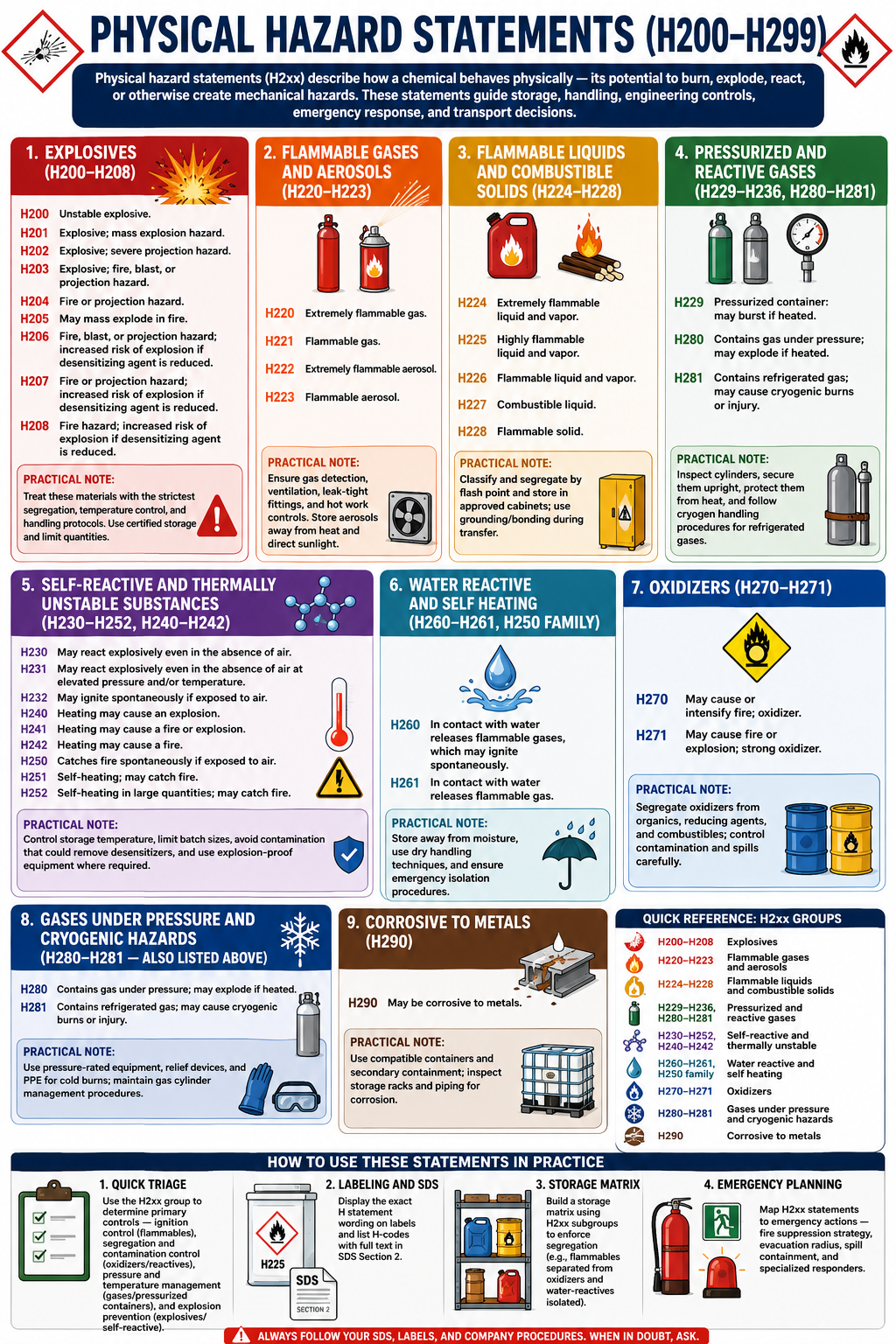
Physical Hazard Statements (H200–H299)
Physical hazard statements (H2xx) describe how a chemical behaves physically — its potential to burn, explode, react, or otherwise create mechanical hazards. These statements guide storage, handling, engineering controls, emergency response, and transport decisions. Below, we split the H2xx range into scan-friendly mini-sections so you can quickly find relevant hazards and the operational actions they imply.
Explosives (H200–H208)
- H₂₀₀ — Unstable explosive.
- H201—Explosive; mass explosion hazard.
- H₂O₂ — Explosive; severe projection hazard.
- H₂O₃ — Explosive; fire, blast, or projection hazard.
- H204 — Fire or projection hazard.
- H₂O₅—May mass explodes in fire.
- H206 — Fire, blast, or projection hazard; increased risk of explosion if desensitizing agent is reduced.
- H207 — Fire or projection hazard; increased risk of explosion if desensitizing agent is reduced.
- H208—Fire hazard; increased risk of explosion if desensitizing agent is reduced.
Practical note: Treat these materials with the strictest segregation, temperature control, and handling protocols. Use certified storage and limit quantities.
Flammable Gases and Aerosols (H220–H223)
- H220 — Extremely flammable gas.
- H221 — Flammable gas.
- H222 — Extremely flammable aerosol.
- H223 — Flammable aerosol.
Practical note: Ensure gas detection, ventilation, leak-tight fittings, and hot work controls. Store aerosols away from heat and direct sunlight.
Flammable Liquids and Combustible Solids (H224–H228)
- H224 — Extremely flammable liquid and vapor.
- H225 — Highly flammable liquid and vapor.
- H226 — Flammable liquid and vapor.
- H227 — Combustible liquid.
- H228 — Flammable solid.
Practical note: Classify and segregate by flash point and store in approved cabinets; use grounding/bonding during transfer.
Pressurized and Reactive Gases (H229–H236, H280–H281)
- H229 — Pressurized container: may burst if heated.
- H280 — Contains gas under pressure; may explode if heated.
- H281 — Contains refrigerated gas; may cause cryogenic burns or injury.
Practical note: Inspect cylinders, secure them upright, protect them from heat, and follow cryogen handling procedures for refrigerated gases.
Self-reactive and Thermally Unstable Substances (H230–H252, H240–H242)
- H230 — May react explosively even in the absence of air.
- H231 — May react explosively even in the absence of air at elevated pressure and/or temperature.
- H232 — May ignite spontaneously if exposed to air.
- H240 — Heating may cause an explosion.
- H241 — Heating may cause a fire or explosion.
- H242 — Heating may cause a fire.
- H250 — Catches fire spontaneously if exposed to air.
- H251 — Self-heating; may catch fire.
- H252 — Self-heating in large quantities; may catch fire.
Practical note: Control storage temperature, limit batch sizes, avoid contamination that could remove desensitizers, and use explosion‑proof equipment where required.
Water Reactive and Self Heating (H260–H261, H250 family)
- H260 — In contact with water releases flammable gases, which may ignite spontaneously.
- H261 — In contact with water releases flammable gas.
Practical note: Store away from moisture, use dry handling techniques, and ensure emergency isolation procedures.
Oxidizers (H270–H271)
- H270 — May cause or intensify fire; oxidizer.
- H271 — May cause fire or explosion; strong oxidizer.
Practical note: Segregate oxidizers from organics, reducing agents, and combustibles; control contamination and spills carefully.
Gases Under Pressure and Cryogenic Hazards (H280–H281 — also listed above)
- H280 — Contains gas under pressure; may explode if heated.
- H281 — Contains refrigerated gas; may cause cryogenic burns or injury.
Practical note: Use pressure‑rated equipment, relief devices, and PPE for cold burns; maintain gas cylinder management procedures.
Corrosive to Metals (H290)
- H290 — May be corrosive to metals.
Practical note: Use compatible containers and secondary containment; inspect storage racks and piping for corrosion.
How to use these statements in practice
- Quick triage: Use the H2xx group to determine primary controls — ignition control (flammables), segregation and contamination control (oxidizers/reactives), pressure and temperature management (gases/pressurized containers), and explosion prevention (explosives/self‑reactive).
- Labeling and SDS: Display the exact H statement wording on labels and list H-codes with full text in SDS Section 2.
- Storage matrix: Build a storage matrix using H2xx subgroups to enforce segregation (e.g., flammables separated from oxidizers and water‑reactives isolated).
- Emergency planning: Map H2xx statements to emergency actions — fire suppression strategy, evacuation radius, spill containment, and specialized responders.
Health Hazard Statements (H300–H399)
Health hazard statements (H3xx) describe adverse effects on people from exposure to chemicals: immediate (acute) effects, skin/eye damage, respiratory impacts, long‑term risks such as cancer or reproductive harm, and specific organ toxicity. Below, the range is reorganized into scan-friendly subsections, so EHS teams, trainers, and workers can find relevant statements and the controls they entail.
Acute Toxicity (H300–H305, H310–H313)
- Purpose: Indicate potential for fatal or toxic outcomes after a single exposure by ingestion or skin contact. These drive emergency first aid, medical surveillance, and strict handling controls.
- Codes and statements:
- H300 — Fatal if swallowed.
- H301 — Toxic if swallowed.
- H302 — Harmful if swallowed.
- H303 — May be harmful if swallowed.
- H304 — May be fatal if swallowed and enters airways.
- H305 — May be harmful if swallowed and enters airways.
- H310 — Fatal in contact with skin.
- H311 — Toxic in contact with skin.
- H312 — Harmful in contact with skin.
- H313 — May be harmful in contact with skin.
- Practical control implications: Enforce ingestion/skin‑contact prevention (no eating in labs), use appropriate gloves/face protection, and ensure emergency medical information is accessible.
Skin and Eye Damage / Irritation (H314–H320)
- Purpose: Describe corrosive or irritating effects on skin and eyes; these determine PPE selection, eyewash/duche availability, and spill response.
- Codes and statements:
- H314 — Causes severe skin burns and eye damage.
- H315 — Causes skin irritation.
- H316 — Causes mild skin irritation.
- H317 — May cause an allergic skin reaction.
- H318 — Causes serious eye damage.
- H319 — Causes serious eye irritation.
- H320 — Causes eye irritation.
- Practical control implications: Provide immediate decontamination (eyewash/showers), specify glove material/resistance, and include skin sensitivity controls (e.g., substitution, barrier creams, and medical surveillance).
Respiratory Hazards and Sensitization (H330–H336, H334–H335)
- Purpose: Indicate lethal inhalation risks, respiratory irritation, drowsiness, or sensitization (asthma‑like reactions). These drive ventilation, respiratory protection, and exposure monitoring.
- Codes and statements:
- H330 — Fatal if inhaled.
- H331 — Toxic if inhaled.
- H332 — Harmful if inhaled.
- H333 — May be harmful if inhaled.
- H334 — May cause allergy or asthma symptoms or breathing difficulties if inhaled.
- H335 — May cause respiratory irritation.
- H336 — May cause drowsiness or dizziness.
- Practical control implications: Install engineering controls (local exhaust), specify respirator type and fit testing where needed, and include medical surveillance for sensitizers.
Carcinogenicity and Genetic Effects (H340–H351)
- Purpose: Flag substances that may cause cancer or genetic defects; these require long‑term exposure controls, substitution consideration, and enhanced recordkeeping.
- Codes and statements:
- H340 — May cause genetic defects.
- H341 — Suspected of causing genetic defects.
- H350 — May cause cancer.
- H351 — Suspected of causing cancer.
- Practical control implications: Use the ALARP (as low as reasonably practicable) principle, consider substitution, restrict access, and include long‑term health monitoring where appropriate.
Reproductive and Developmental Toxicity (H360–H362)
- Purpose: Warn about effects on fertility, the unborn child, and breast‑fed infants; these guide work‑assignment decisions and reproductive‑hazard communication.
- Codes and statements:
- H360 — May damage fertility or the unborn child.
- H361 — Suspected of damaging fertility or the unborn child.
- H361d — Suspected of damaging the unborn child.
- H362 — May cause harm to breast‑fed children.
- Practical control implications: Provide pregnant/breastfeeding worker guidance, consider reassignment away from exposure, and document risk communication.
Specific Target Organ Toxicity (STOT) — Single & Repeated Exposure (H370–H373)
- Purpose: Identify chemicals that cause damage to specific organs after single or repeated exposures, informing medical surveillance and exposure limits.
- Codes and statements:
- H370 — Causes damage to organs.
- H371 — May cause damage to organs.
- H372 — Causes damage to organs through prolonged or repeated exposure.
- H373 — May cause damage to organs through prolonged or repeated exposure.
- Practical control implications: Implement exposure monitoring, set health‑based occupational controls (air sampling, biological monitoring), and document medical follow‑up for affected workers.
Environmental Hazard Statements (H400–H499)
This describes the risks that a chemical can pose to ecosystems, especially:
- Aquatic life
- Soil organisms, or
- The ozone layer
In practice, to prevent long-term environmental damage these statements help teams decide:
- How to contain spills
- Protect drains and waterways, and
- Manage storage or disposal
GHS environmental classifications also distinguish between immediate aquatic toxicity and longer-lasting effects, which is important for spill response and waste handling.
Aquatic toxicity
- H400 — Very toxic to aquatic life.
- H401 — Toxic to aquatic life.
- H402 — Harmful to aquatic life.
These statements indicate acute harm to fish, invertebrates, algae, and other aquatic organisms after short-term exposure. They matter most during spills, runoff events, and wastewater discharges, where even small releases can cause rapid ecological damage.
Long-term environmental effects
- H410 — Very toxic to aquatic life with long-lasting effects.
- H411 — Toxic to aquatic life with long-lasting effects.
- H412 — Harmful to aquatic life with long-lasting effects.
- H413 — May cause long-lasting harmful effects to aquatic life.
These statements show that a chemical may persist in the environment, bioaccumulate, or continue harming aquatic systems over time. They are especially important for waste management, secondary containment, stormwater protection, and transport planning.
Ozone hazard explanation
- H420 — Harms public health and the environment by destroying ozone in the upper atmosphere.
This statement applies to substances that damage the ozone layer rather than directly poisoning aquatic life. The ozone layer reduces UV exposure, so chemicals with this classification can create broader atmospheric and public-health concerns, not just local spill hazards.
Terrestrial toxicity
- H441 — Very toxic to terrestrial invertebrates.
This statement highlights risk to land-based organisms such as insects and soil-dwelling invertebrates. It is less commonly discussed than aquatic hazards, but it still matters for pesticide use, site runoff, and environmental impact assessments.
Most Used H Codes
This section highlights the H codes that appear most often on SDSs and workplace labels because they cover frequent real-world hazards like flammability, irritation, inhalation risk, and long-term health effects. These are especially useful for quick reference, training snippets, and internal safety communications.
| H Code | Meaning | Common Industries |
| H225 | Highly flammable liquid and vapor | Paints, solvents |
| H315 | Causes skin irritation | Cleaning chemicals |
| H319 | Causes serious eye irritation | Laboratories |
| H332 | Harmful if inhaled | Industrial chemicals |
| H350 | May cause cancer | Petrochemicals |
Why these matter
- H225 is common in flammable liquids used for coating, thinning, and degreasing.
- H315 and H319 appear often in cleaners, disinfectants, and lab reagents where skin and eye contact are realistic exposure routes.
- H332 is frequently seen in industrial chemicals that may create harmful vapors, mists, or dust.
- H350 is important because it flags chronic risk and usually triggers stronger controls, substitution review, and medical surveillance.
How to use this section in training
- Pair each H code with the typical exposure scenario.
- Add the matching precautionary statements and PPE requirements.
- Use the table as a quick “what to watch for” reference during toolbox talks, label reviews, and SDS orientation.
European Union Supplementary Hazard Statements (EUH Codes)
EUH statements are EU-specific supplements to the Globally Harmonized System (GHS). They provide extra detail or clarity for hazards not fully captured by standard GHS H-statements, reflecting specific risks, local regulatory choices, or legacy requirements under EU law.
How EUH differs from H-statements
- H-statements (hazard statements) are the core GHS phrases that describe the nature and degree of chemical hazards.
- EUH statements are additional phrases used only in the EU to address situations or hazards that need more specific wording than the general H-statements provide.
Relevance to the CLP Regulation
The CLP Regulation (Classification, Labelling and Packaging of substances and mixtures) incorporates GHS elements for the EU and authorizes use of EUH codes. Manufacturers and downstream users must follow CLP when classifying, labeling, and supplying chemicals in the EU; that includes applying appropriate EUH statements where required.
Physical supplementary hazards
- EUH001: Explosive when dry
- EUH006: Explosive with or without contact with air
- EUH014: Reacts violently with water
- EUH018: In use, may form flammable/explosive vapor-air mixture
- EUH019: May form explosive peroxides
- EUH044: Risk of explosion if heated under confinement
- EUH209: Can become highly flammable in use
- EUH209A: Can become flammable in use
Toxic gas warnings
- EUH029: Contact with water liberates toxic gas
- EUH031: Contact with acids liberates toxic gas
- EUH032: Contact with acids liberates very toxic gas
- EUH206: Warning! Do not use together with other products. May release dangerous gases (chlorine)
Respiratory, eye and corrosive hazards
- EUH070: Toxic by eye contact
- EUH071: Corrosive to the respiratory tract
Sensitizer and allergen warnings
- EUH203: Contains chromium (VI). May produce an allergic reaction
- EUH204: Contains isocyanates. May produce an allergic reaction
- EUH205: Contains epoxy constituents. May produce an allergic reaction
- EUH208: Contains (name of sensitizing substance). May produce an allergic reaction
Repeated-exposure and acute-use notes
- EUH066: Repeated exposure may cause skin dryness or cracking.
- EUH202: Cyanoacrylate. Danger. Bonds skin and eyes in seconds. Keep out of the reach of children.
- EUH207: Warning! Contains cadmium. Dangerous fumes are formed during use. See information supplied by the manufacturer. Comply with the safety instructions.
Environmental warnings
- EUH059: Hazardous to the ozone layer
- EUH401: To avoid risks to human health and the environment, comply with the instructions for use.
Consumer and product-specific notices
- EUH201: Contains lead. Should not be used on surfaces liable to be chewed or sucked by children
- EUH201A: Warning! Contains lead
- EUH210: Safety data sheet available on request
Practical notes for EHS management
- Always follow CLP classification rules when assigning EUH codes. Use safety data sheets and supplier declarations to verify requirements.
- Use EUH statements on labels and SDS sections where CLP or specific EU guidance requires them.
- Treat EUH codes as legally binding in the EU supply chain; omitting a required EUH can create noncompliance.
- Keep updated: EU guidance and delegated acts may add, amend, or remove EUH phrasing.
Step-by-step: How to determine a chemical's hazard statement
Step 1 — Collect chemical data
- Gather the product name, formulation, CAS numbers, purity, physical properties (flash point, boiling point, vapor pressure), and available toxicological/ecotoxicological data.
- Obtain the supplier's Safety Data Sheet (SDS), technical data sheets, and any test reports or supplier declarations.
Step 2 — Identify hazard classes
- Using the collected data, determine which GHS hazard classes apply: physical (flammability, explosivity, oxidizing), health (acute toxicity, skin corrosion/irritation, respiratory sensitization, carcinogenicity), and environmental (aquatic toxicity, ozone depletion).
- Cross-check against national/EU rules (CLP/ECHA, OSHA, etc.) for any jurisdiction-specific classifications.
Step 3 — Determine hazard category
- For each applicable hazard class, apply the classification criteria to assign a category or category range (for example: Acute Tox. Cat 2, Skin Corr. Cat 1A, Flam. Liq. Cat 3).
- Use test data, calculation methods, and bridging principles per the GHS and relevant guidance documents.
Step 4 — Assign H codes
- Translate each determined hazard category into the corresponding GHS hazard statement(s) (H-codes). Include any EU-specific EUH statements if required by CLP.
- Confirm combined/conditional statements (e.g., where concentration limits or M-factors alter the required H-statement).
Step 5 — Generate SDS + label
- Populate Section 2 of the SDS with the final classifications and full hazard statement text. Ensure precautionary statements and pictograms match the assigned H/EUH codes.
- Create or update labels with correct product identifiers, signal word, pictograms, H-statements, P-statements, and any applicable supplemental information.
Practical tips
- Always document the data, rationale, and references used for each classification and H-code decision.
- Re-evaluate classifications when formulations change, or new data becomes available.
- Use official country/EU guidance and concentration limit tables to verify statements and mixture rules.
- For regulated jurisdictions (EU CLP, US OSHA), follow the specific procedures and update SDS/labels within required timelines.
Where Do Hazard Statements Appear?
SDS Section 2 (Hazard identification)
- Primary location: Section 2 of the Safety Data Sheet is the authoritative place where hazard classification and the full list of hazard statements (H- and EUH-codes where applicable) must appear.
- What to include: product identifiers, signal word, hazard pictograms, all assigned hazard statements (exact wording), and any supplemental EUH statements or other regulatory notes.
- Why it matters: SDS Section 2 is the source document employers and downstream users rely on for risk assessment, training, and creating workplace labels. Maintain accuracy and document the rationale for every classification and statement.
Product labels (Supplier/Container labels)
- Legal requirement: Labels on the original container must display the signal word, pictograms, and the relevant hazard statements (H-/EUH-codes and phrases) plus precautionary statements and supplier information, per GHS/CLP/OSHA rules.
- Presentation: Use the exact H/EUH phrasing or authorized national language. Place statements where legible and durable for the container size and exposure conditions.
- Role: Labels provide immediate hazard communication at point-of-use and must match the SDS Section 2 entries. If a needed hazard statement is omitted or inconsistent with the SDS, correct both the label and SDS promptly.
Secondary workplace labels (decanted/portable containers)
- Purpose: For transferred materials (e.g., bottles, drums, tanks, safety cans), secondary labels communicate hazards to workers where the original label is not present.
- Content guidance: Include product identifier, at least the applicable pictograms or clear text hazard statements (H-codes or plain-language equivalents), and key precautionary measures. Many workplaces use abbreviated H-statements or standardized short phrases—ensure these still convey the full hazard and are consistent with SDS information.
- Practical note: For small containers where full GHS labels are impractical, use reference systems (e.g., GHS pictograms plus QR code or unique identifier that links to SDS) but ensure workers can rapidly access complete hazard details.
Shipping documentation (transport and customs)
- Transport papers and shipping labels: Hazard statements do not replace transport requirements (UN numbers, proper shipping name, class/division labels), but SDS hazard statements should inform transport documentation and emergency response information.
- Emergency response: The SDS (Section 14 for transport) and the listed hazard statements support the creation of Emergency Response Guide entries, incident reports, and notifications to carriers or authorities.
- International shipments: Ensure hazard statements and SDS language align with transport regulations (IMDG, IATA, ADR) and with any destination-country labeling/classification differences; include any required EUH or national statements that affect handling and emergency measures.
Additional places to check or use hazard statements
- Training materials and workplace procedures: Use exact H/EUH phrasing from the SDS for consistency in training slides, SOPs, and permits-to-work.
- Inventory and chemical management systems: Store assigned H/EUH codes and full phrases in CMMS/LIMS/LMS fields to automate label printing, SDS generation, and exposure controls.
- Procurement documents and contracts: Require suppliers to provide SDSs with full Section 2 statements and up-to-date labeling to avoid procurement of non-compliant products.
Best practices checklist
- Verify Section 2 of the SDS first; treat it as the authoritative source for H/EUH assignments.
- Ensure product labels exactly reflect the SDS; do not paraphrase key hazard statements in a way that changes meaning.
- Use clear, consistent short-form hazard text on secondary labels but link to full SDS details.
- Include SDS-derived hazard information on shipping paperwork and emergency response plans.
- Keep records of label revisions and SDS updates; retrain staff when statements change.
Common mistakes in hazard communication
Hazard communication often breaks down when the message is incomplete, outdated, or hard for workers to understand. The most common mistakes are simple, but they can lead to serious gaps in chemical safety.
- H and P statements can be confusing: the H statement explains the hazard, while the P statement describes the precaution. Misunderstanding these statements leads to confusion in labeling and training materials.
- Outdated Safety Data Sheet: An outdated Safety Data Sheet can have wrong classification, missing hazards, and out-of-date handling instructions that can affect labels and emergency response.
- No secondary label: Transferred chemicals into other containers, such as spray bottles, do not have any secondary labels, which increases chances of mishandling.
- No pictograms: Pictograms give information about the hazard, such as flammability, toxicity, or corrosiveness. If the pictogram is missing or not explained, workers can miss such important information.
- Insufficient training for employees: Employees should be trained in how to handle SDSs, labels, pictograms, and emergency response. Failure to do so results in insufficient knowledge.
- Significance of the errors: Minor errors such as no label or outdated Safety Data Sheet can result in improper handling and response to hazards.
A simple prevention checklist
- Keep SDSs current and easy to access.
- Make sure H- and P-statements are used correctly.
- Label all secondary containers.
- Verify pictograms before issuing labels.
- Train employees regularly and refresh training when chemicals change.
Frequently Asked Questions (FAQ)
-
What is a GHS hazard statement?
The hazard statement in GHS is a standardized statement that indicates the chemical's hazard and can be found on its label and safety data sheets.
-
What is the difference between H codes and P codes?
H codes indicate the hazard associated with the chemical, whereas P codes indicate the precautions to be taken against such a hazard.
-
Where are hazard statements found on an SDS?
Hazard statements are found in Section 2: Hazard(s) identification of the Safety Data Sheet.
-
What does H315 mean?
H315 means "causes skin irritation."
-
Are hazard statements mandatory?
Yes, hazard statements are mandatory where a chemical is classified as hazardous under the applicable GHS-based regulatory system, and the exact wording must be used as required by the local rules.
-
How are H codes assigned?
H codes are assigned based on the chemical's hazard classification, with the code number reflecting the hazard group and the specific hazard category.
-
Are GHS hazard statements universal?
The GHS framework is internationally harmonized, but hazard statements are not perfectly universal in practice because countries and regions may adopt GHS with local variations.
-
What are EUH statements?
EUH statements are extra hazard statements used in the European Union under CLP to cover hazards that need supplementary wording beyond standard GHS hazard statements.
Conclusion
Hazard statements enhance safety by providing employees with a proper understanding of the hazards posed by chemicals and how to take precautionary measures. Communication is important because it will make sure that the information about the hazard is properly understood by all people through the use of labels and Safety Data Sheets. The H codes simplify the process even more by converting classification information to a universal language.
Simplify Your SDS Management
CloudSDS gives your team instant access to 23M+ safety data sheets with AI-powered search, automated updates, and full OSHA/GHS compliance — all from one platform.
Leave A Comment