
Last Updated on February 22, 2026
Every time you see a “flammable” warning label (the GHS flame symbol), your immediate instinct is to fear fire or explosion. This reaction is natural and necessary; however, it often overshadows a quieter, relatively insidious reality. The very properties that make chemicals like benzene, acetone, and alcohols volatile enough to burn also make them biologically active and hazardous to human health.
Flammable solvents are as dangerous to factory and lab workers and DIYers as they are when ignited. This article looks at the health risks of flammable compounds, focusing on inhalation, skin absorption, and eye toxicity. It does this to give a complete picture of chemical safety.
A Comprehensive Guide to Understanding the Health Risks of Flammable Chemicals
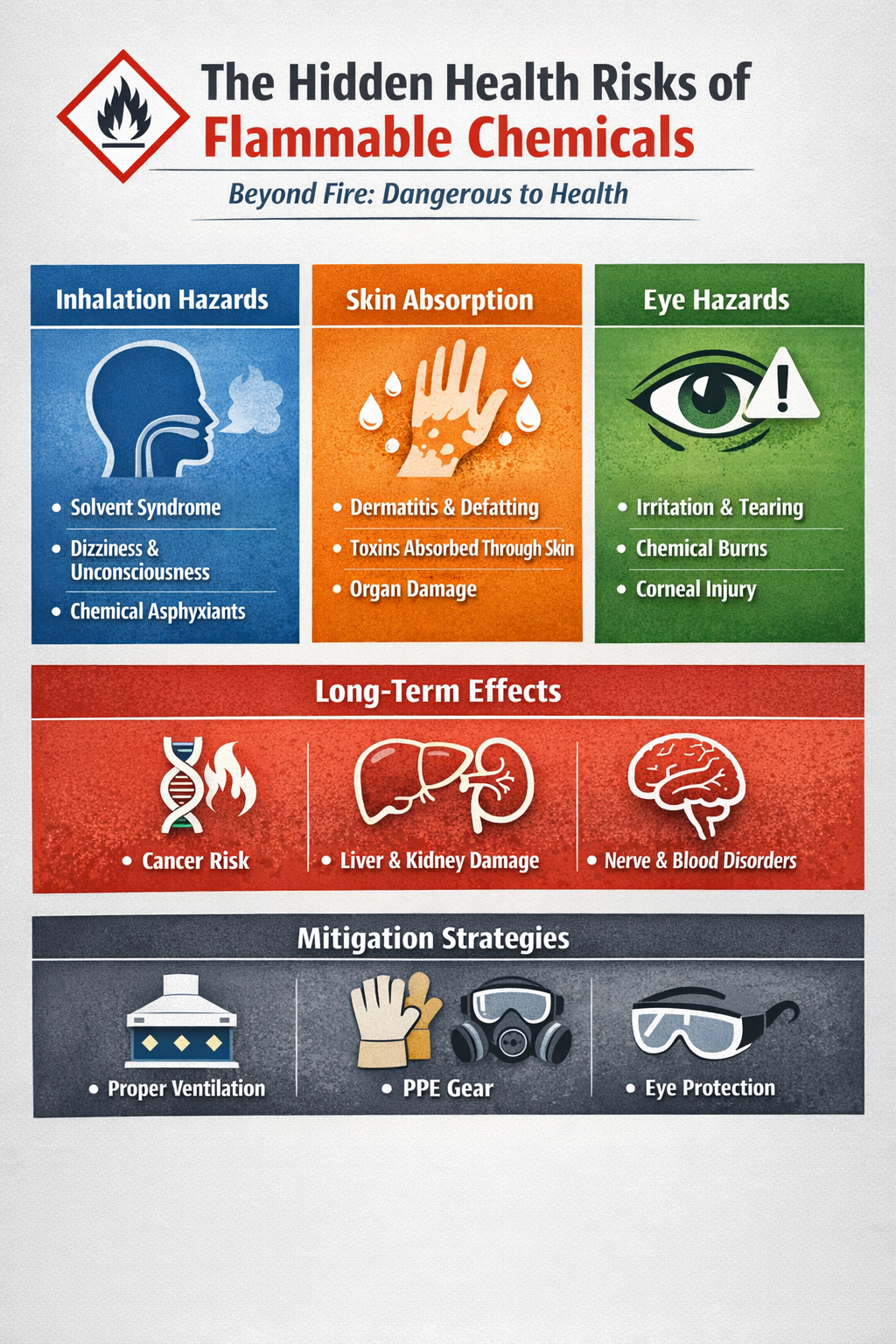
Understanding the health risks associated with chemicals that can catch fire is a critical aspect of workplace safety and public health, extending far beyond the immediate danger of combustion itself. Here are some of them:
The Inhalation Hazard: “Solvent Syndrome” and Choking
Most of the time, people are exposed to volatile flammable substances by breathing them in. These compounds have high vapor pressures, which means they easily evaporate into the air we breathe. They can reach dangerous levels long before they reach explosive levels.
The most immediate impact of breathing in organic solvents is that they depress the central nervous system (CNS). This state is often called “solvent narcosis” or “solvent syndrome,” and it feels like being drunk on alcohol. Because these compounds dissolve in lipids, they can easily penetrate the blood-brain barrier and mess up how neurons work.
Symptoms usually begin with minor tiredness or a headache, but they can get worse and cause dizziness, confusion, and lack of coordination. In very bad situations, as when there isn’t much air flow in a small place, excessive levels can make you pass out or stop breathing.
Chemical Asphyxiants vs. Simple Asphyxiants
It is crucial to distinguish between simple asphyxiants and chemical asphyxiants, both of which are often flammable:
- Simple Asphyxiants (e.g., Methane, Propane): These gases displace oxygen in the environment. The danger here is not necessarily the toxicity of the gas itself, but the lack of oxygen available to the brain.
- Chemical Asphyxiants (e.g., Carbon Monoxide, Hydrogen Cyanide): These may be byproducts of combustion or present in industrial processes. They interfere with the body’s ability to transport or use oxygen at a cellular level, even if the air is rich in oxygen.
Common Symptoms of Solvent Inhalation
- Early Signs: Headache, nausea, dizziness, euphoria (“high” feeling).
- Moderate Exposure: Slurred speech, slowed reaction time, blurred vision, and fatigue.
- Severe Exposure: Unconsciousness, convulsions, respiratory arrest, arrhythmia (irregular heartbeat).
Dermal Dangers: Defatting and Transdermal Absorption
The skin is often viewed as an impermeable shield, but for many flammable solvents, it is a surprisingly open door. The health risks here are twofold: local damage to the skin surface and systemic toxicity caused by absorption into the bloodstream.
The “Defatting” Effect
Organic solvents like acetone, toluene, and xylene are excellent at dissolving grease and oils. Unfortunately, they do not distinguish between industrial grease and natural oils that protect human skin.
Repeated contact strips the skin of its protective lipid layer, a process known as “defatting.” This leads to chronic dermatitis, characterized by dry, cracked, red, and itchy skin. Compromised skin is not just painful; it loses its barrier function, making it more susceptible to infection and increasing the rate at which other toxins can be absorbed.
Systemic Toxicity via Absorption
Some flammable liquids can penetrate intact skin and enter the bloodstream, targeting internal organs. Methanol (wood alcohol) is a prime example; significant amounts can be absorbed through the skin, leading to metabolic acidosis and optic nerve damage. Similarly, glycol ethers, commonly found in paints and cleaners, are readily absorbed and can cause reproductive and blood toxicity.
Ocular Toxicity: Fumes vs. Splashes
Chemical damage to the eyes is very likely. A direct splash is the most obvious risk, but the fumes of many flammable substances can also make you cry and irritate your skin.
Vapor-induced Irritation
You don’t have to get a chemical in your eye to get hurt. Aldehydes like acrolein and methylene chloride can make your eyes hurt, water, and get inflamed when they are in high amounts.
If you breathe in these vapors for a long time, you could have conjunctivitis (pink eye) or possibly corneal clouding. In factories, workers could think their red, itchy eyes are tired when they are reacting to a solvent vapor leak.
Chemical Splashes and Damage to the Cornea
If you get a solvent like ethanol or isopropyl alcohol directly on your cornea, it might hurt right away and cause damage that can be fixed. But stronger solvents or those that are caustic can go deeper and hurt the stroma, which could cause permanent vision loss.
For instance, alkalis (which are often used with processes that can catch fire) are very harmful since they saponify ocular tissues, going deep into the eye and making you blind for good.
Long-Term Effects: The Long-Term Killer
The scariest thing about flammable chemical toxicity is what happens years after exposure. Exposure to something for an extended period at a low level can lead to chronic toxicity.
Carcinogenicity
Benzene is the most famous example. It is a Group 1 carcinogen and was once employed as a common solvent. Long-term breathing in or skin absorption of benzene is connected to leukemia and other blood problems. It is still a part of gasoline and other chemical intermediates, even though its use is now very tightly controlled.
Toxicity to the Liver and Kidneys
The liver and kidneys serve as the body’s filters, making them the primary destinations for broken-down poisons. Chlorinated flammable solvents (like methylene chloride) and aromatic hydrocarbons (like toluene and xylene) significantly stress these organs.
Long-term exposure can cause hepatitis, fatty liver disease, or kidney failure. These disorders generally develop without any warning signs, and symptoms don’t show up until a lot of damage has been done to the organs.
Important Body Parts for Flammable Solvents
- Hepatotoxins that affect the liver include alcohol, carbon tetrachloride, toluene, and xylene.
- Kidneys (Nephrotoxins): Chloroform, Ethylene Glycol, and Turpentine.
- Neurotoxins that affect the nervous system include n-hexane, methanol, and carbon disulfide.
- Blood (Hematotoxins): Benzene, Glycol Ethers.
Mitigation Strategies: Protection Beyond Fire Safety
To keep yourself safe from the health concerns of flammable substances, you need to do something other than stop fires. Fire safety depends on grounding, bonding, and flame arrestors. Health safety depends on cleanliness and keeping everything in place.
Engineering Controls
The best way to protect yourself is to ventilate it. Fume hoods or snorkel trunks are types of local exhaust ventilation that catch vapors at the source, so they don’t get into the worker’s breathing zone. General room ventilation is often inadequate for volatile hazardous chemicals.
Personal Protective Equipment (PPE)
When engineering controls fail, PPE serves as the ultimate safeguard. But regular “fire-resistant” clothing doesn’t always keep you safe from harmful chemicals:
- Gloves: Latex gloves can let organic solvents like acetone and gasoline through. Depending on the chemical, you may need nitrile, neoprene, or laminate barrier gloves. Always look at a chart that shows how resistant chemicals are.
- Dust masks don’t protect against solvent vapors at all. Workers need half-face or full-face respirators that have organic vapor (OV) cartridges in them. These are usually black-coded.
- Safety glasses protect your eyes from impacts but not from fumes or sprays. When working with liquid flammables, you need indirect-vent chemical splash goggles to protect your eyes from dangerous mists and vapors.
Final Thoughts:
The “flammable” label on a chemical bottle doesn’t reveal the whole story. The risk of fire is clear and quick, but the toxicological concerns, which can cause dizziness and cancer, are just as lethal but not always as obvious.
We can have a more complete safety perspective if we know that combustible substances are typically also irritants, neurotoxins, and carcinogens. Real safety means not only stopping the spark but also stopping breath, touch, and splash, which could have long-term health effects.
Simplify Your SDS Management
CloudSDS gives your team instant access to 23M+ safety data sheets with AI-powered search, automated updates, and full OSHA/GHS compliance — all from one platform.
Leave A Comment