
Last Updated on March 26, 2026
Dimethoate is a comprehensive organophosphate pesticide that has a reputation for its capacity to terminate garden pest species. It targets chewing insects, such as aphids, mites, and thrips, whether they have encountered dimethoate or were ingested by it.
The chemical formula C5H12NO3PS2 represents a clear to amber solution that can also be used as an insecticide and acaricide and was produced in the 1950s. Dimethoate is an agent against insects (especially sucking insects) that has a mechanism of action as follows: inhibiting the action of the enzyme acetylcholinesterase to cause immediate disruption to the nervous system of the pest.
Farmers value dimethoate because of the long-lasting protection it provides to many bulb crops, including vegetable plants, fruits, and cotton, against many important agricultural pests. Even though it is subject to strict regulations, it is still found to be beneficial as an important element of integrated pest management programs because it is effective against many different types of pests and is inexpensive.

Dimethoate Explained: Categorization, Characteristics, and Utilizations
There are numerous published studies which document the properties of dimethoate; these include research regarding its solubility in water and its persistence in soil. Using the published literature about dimethoate will assist you in correctly applying the compound to provide optimum pest control with the least amount of toxicity to humans, honeybees, and aquatic species. Following up on existing global bans (the EU) will also help protect you while safely applying for this product.
What is dimethoate?
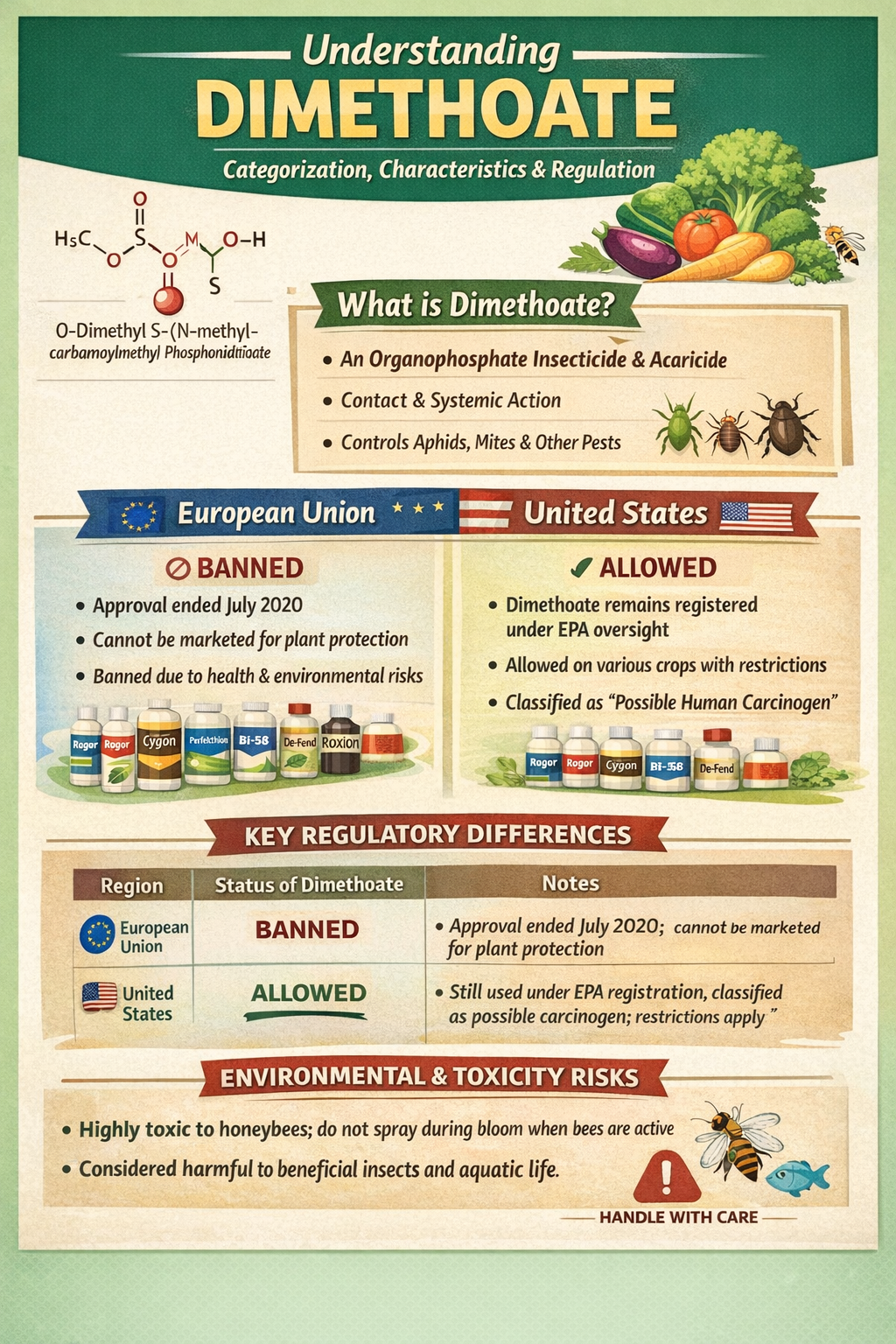
Dimethoate is a man-made organophosphate insecticide and acaricide. Its chemical name is O-dimethyl S-(N-methylcarbamoylmethyl) phosphonodithioate. It works as both a contact and systemic insecticide. Plants take it up to kill a wide range of pests, including sucking and chewing insects, mites, and other pests.
Findings and Historical Context
Researchers at American Cyanamid made important contributions to the invention of dimethoate in the early 1950s. It was initially sold to the public about 1956. During the pesticide boom after World War II, it became a standard in farming since it worked well on crops and food demand was rising around the world. However, production in the US stopped by 1982 because of regulatory concerns.
Names and Synonyms Used Around the World
Dimethoate is often sold under the names Rogor, Cygon, Perfekthion, and Bi-58. It is also known as fosfamid (in the former USSR) and dimethogen. Trade names differ by area, like De-Fend or Roxion, showing that it is widely used in pest control products around the world.
Chemical Grouping of Dimethoate
1. Chemical Family: Organophosphate Insecticide
The organophosphate chemical family includes dimethoate. This family is known for having a central phosphorus atom connected to oxygen and organic groups, which usually makes esters of phosphoric acid.
2. Classification of pesticides (systemic insecticide and acaricide)
It is a systemic insecticide and acaricide, which means that plants take it in via their roots or leaves and move it around to defend themselves from sucking insects and mites.
3. Functional Classification (Inhibitor of Cholinesterase)
Dimethoate works by blocking acetylcholinesterase, which is a type of cholinesterase. This stops nerve impulses from moving in pests.
Chemical Identity and Molecular Structure
1. The IUPAC name for the chemical
O, O-dimethyl S-[2-(methylamino)-2-oxoethyl] phosphorodithioate is the IUPAC name for dimethoate. It is a precise word that describes its phosphorodithioate ester structure. This naming system makes it clear that there is an ester bond between dimethyl phosphorodithioic acid and N-methylmercaptoacetamide. This makes it easier to find in scientific papers and regulatory paperwork.
2. Weight and Formula of the Molecule
Dimethoate has a chemical formula of C₅H₁₂NO₃PS₂, which means it has five carbon atoms, twelve hydrogen atoms, one nitrogen atom, three oxygen atoms, one phosphorus atom, and two sulfur atoms. Its molecular weight is 229.26 g/mol (or exactly 229.257 g/mol according to NIST data), which helps with analytical chemistry calculations like spectrometry and residue analysis.
3. Structural Features
Dimethoate has a tetrahedral phosphorus core with a double-bonded sulfur (P=S), two single-bonded methoxy groups (P-OCH₃), and a thioether connection (P-S-CH₂-) to an N-methylacetamide chain (-CH₂-C(O)-NH-CH₃). This arrangement, which is frequently shown as (CH₃O)₂P(S)-S-CH₂-C(O)-NHCH₃, allows it to be both lipophilic and hydrophilic, which helps plants take it in and insects get through it. The InChI representation, InChI=1S/C5H12NO3PS2/c1-6-5(7)4-12-10(11,8-2)9-3/h4H2,1-3H3,(H,6,7), shows that it has a unique stereochemistry.
4. Functional Groups That Are There
The phosphorodithioate (P(=S)(OR)₂SR'), amide (-C(O)NHCH₃), thioether (S-CH₂), and ether-like methoxy (-OCH₃) groups are the most important functional groups. These make it more reactive: the P=S bond helps cholinesterase attach, the amide makes it more stable, and the sulfur connections help it oxidize into active metabolites like omethoate. These groups are what make it effective as a pesticide and how it affects the environment.
5. Number for Chemical Abstracts (CAS)
The CAS Registry Number is 60-51-5, which is a unique number used all around the world to keep track of dimethoate in databases, patents, and safety data sheets. Chemical Abstracts Service set it up to tell the difference between pure dimethoate (93–95% technical grade) and other chemicals and impurities.

Dimethoate's Physical and Chemical Properties
1. State of Matter (Look, Color, Smell)
Pure dimethoate is a solid that is colorless to white and has a crystalline structure. Technical grade (93% purity) looks off-white to grayish crystals or semi-crystalline material. It has a slight smell that is similar to mercaptan or camphor, which makes it easier to identify while handling.
2. Dissolvability (in Water and Organic Solvents)
Dimethoate is moderately soluble in water (23.8 g/L at 20°C), which allows plants to take it up through their roots. It dissolves well in organic solvents such alcohols, benzene, chloroform, and ketones, but not so well in hydrocarbons.
3. The point at which it melts and boils
The melting point is between 45 and 52.5°C (51 and 52°C is normal), and it changes from solid to liquid. At 0.05 mmHg, the boiling point is 107°C, while at 0.01 mmHg, it is 86°C.
4. Pressure of the vapor
The vapor pressure is modest at 8.5 × 10⁻⁶ mmHg (20°C) or 2.5 × 10⁻⁴ Pa (25°C), indicating minimal change and a low likelihood of inhalation under normal settings.
5. Stability in Normal Conditions
It is stable at room temperature in neutral water and acidic solutions, with a density of 1.277–1.3 g/cm³. It can handle mild heat, but it breaks down above the flash point (around 52°C).
6. Behavior of Decomposition
It breaks down quickly in alkaline circumstances and in damp air, when it turns into oxidation products. Heating makes O, S-dimethyl phosphorodithioate. After 20 weeks at 40°C, the shelf life is cut in half.
How Dimethoate Works (How It Works)
Dimethoate works mostly by contact and ingestion, getting through insect cuticles or being eaten while the insect is feeding. Insects change it into omethoate, its more powerful oxygen analog, which attaches to target enzymes in a way that can't be changed.
1. Effect on the Nervous System
It causes hyperexcitation in the insect's central and peripheral nervous systems, which leads to tremors, paralysis, and death. This cholinergic excess has an effect on how nerve impulses move between synapses.
2. What does it mean to block acetylcholinesterase?
Dimethoate stops acetylcholinesterase (AChE), which is the enzyme that breaks down the neurotransmitter acetylcholine. Phosphorylation of AChE's serine residue stops the breakdown of acetylcholine. This builds up acetylcholine, keeps nerves firing, and causes hazardous overstimulation.
3. Behavior of Plants as a Whole
Dimethoate moves through the xylem to growing tissues from the roots or leaves. It kills pests that feed on phloem, such as aphids. Omethoate is an active systemic form, and it breaks down in plants at a modest rate.

Dimethoate Applications
1. Uses in Farming
a. Crops That Often Get Dimethoate
Dimethoate is often used on crops like cotton, rice, tobacco, alfalfa, wheat, corn, soybeans, citrus, potatoes, pecans, apples, tomatoes, and other vegetables. These include agricultural crops, fruits, and ornamental plants that sucking pests like to live on.
b. Aphids, Mites, Thrips, and Other Pests You Want to Get Rid of
It works well on aphids, mites, thrips, leafhoppers, planthoppers, whiteflies, tobacco worms, beetles, weevils, leafminers, and stem borers like Chilo suppressalis. This control works on both chewing and piercing bugs.
c. Advantages of Systemic and Contact Action
Systemic uptake through roots and leaves protects new development, while contact action kills on direct exposure. The two modes work together to quickly knock down the plant and protect it for a long time, which reduces crop loss and increases yields.
2. Uses Not Related to Farming
a. Utilization in Public Health Pest Management
Dimethoate is used in public health initiatives to kill flies, mosquitoes, and other disease carriers. It can be used as a space spray or a residual treatment.
b. Use in Ornamental and Horticultural Plants
It protects decorative plants, turf, and greenhouse crops from aphids, mites, and thrips in horticulture, which keeps their beauty and worth as a business.
Ways to Apply Dimethoate
-
Application of Foliar Spray
To cover leaves evenly, foliar sprays mix dimethoate emulsifiable concentrates (EC) or wettable powders (WP) with water and spray them on via boom sprayers, airblast, backpacks, or planes. This approach focuses on contact action while still allowing systemic absorption through stomata. It works best on crops like cotton and rice at 1200–1500 ml/ha.
-
Putting it on the Soil
Soil drenches or incorporation let roots take in nutrients for real systemic protection. They are used before plants sprout or when they are still growing, like on alfalfa and potatoes. Chemigation through irrigation systems spreads it out evenly, which reduces the amount of residue on leaves.
-
Things to Think while Applying Dimethoate
The amount of 40% EC formulation used varies by crop, pest pressure, and area. For example, rice planthoppers need 1125 ml/ha. Always follow the rates on the label to avoid phytotoxicity, resistance, or going beyond MRLs. For improved penetration, mix with adjuvants in the tank.
-
How often to use it
Usually, there are 1 to 2 applications per season, with 7 to 14 days between them, depending on scouting and pre-harvest intervals (PHI). To avoid resistance, switch classes every so often. Don't go above the seasonal restrictions, which are 2.2 kg ai/ha.
Advantages and Efficiency
-
Pest Control for a Wide Range of Pests
Dimethoate works well against a wide range of pests, including as aphids, mites, thrips, leafhoppers, whiteflies, and beetles, on many different crops. This flexibility means that fewer pesticides are needed, which makes it easier to run a farm.
-
Protection
Dimethoate moves up via plant roots or leaves, safeguarding new development and destroying pests that are eating inside the plant. This gives you longer-lasting control than insecticides that simply kill insects on contact, which protects your crops throughout their most critical growth stages.
-
Cost-Effectiveness
Dimethoate comes in cheap forms like 40% EC and kills a lot of pests at modest dosages (0.5–1 kg ai/ha), which keeps input costs low per hectare. Its wide range of effects increases ROI by stopping crop losses without having to reapply it often.
-
Quick Action
Dimethoate kills pests quickly by contact and rapidly inhibits AChE, usually within hours of exposure. This quick response stops feeding harm and population breakouts very well.

Toxicity and Effects on Health
1. Effects on Human Health
a. Symptoms of Acute Exposure
Short-term exposure to dimethoate can quickly lead to organophosphate poisoning. Symptoms include headaches, nausea, vomiting, sweating, diarrhea, blurred vision, pinpoint pupils, muscular twitching, lack of coordination, seizures, breathing problems, and possibly death from respiratory arrest.
b. Risks of Long-Term Exposure
Long-term exposure can cause changes in personality, such as sadness, anxiety, irritability, memory loss, nightmares, trouble speaking, nausea, and malaise. Genotoxic effects and cholinesterase inhibition last.
c. Effects on the Nervous System
Dimethoate stops acetylcholinesterase from working, which leads to a buildup of acetylcholine, constant nerve firing, overstimulation of the central nervous system, psychosis, low blood pressure, and a cholinergic crisis.
2. Toxicity to Animals and Wildlife
a. Effect on Birds
Dimethoate is somewhat hazardous to birds (LD50 >100 mg/kg) because it stops cholinesterase and could cause bird populations to drop in treated fields.
b. Harmful to Aquatic Life
Very poisonous to fish (LC50 1–6.6 mg/L) and aquatic invertebrates. It stays in the water and kills them by being absorbed through their gills and stopping AChE.
c. Danger to Pollinators (Bees)
Dimethoate is very poisonous to honeybees (LD50 0.35–0.89 µg/bee). It kills them on contact and through residues, which is very dangerous during bloom.
The Effect of Dimethoate on the Environment
1. Staying in the Soil
Dimethoate stays in the soil for a moderate amount of time, with half-lives that range from 2.5 to 31 days depending on the kind of soil, how wet it is, and how active the microbes are. Moist soils speed up microbial decomposition, but dry circumstances can make things last up to 122 days. Low adsorption (low Koc) makes things move more easily.
2. Risks of Water Pollution
High water solubility (23.8 g/L) and mobility cause leaching into groundwater and runoff into surface waterways, which often exceeds WHO standards (6 µg/L). Spray drift and runoff from fields are quite dangerous to aquatic environments.
3. Potential for Bioaccumulation
Dimethoate has a low bioaccumulation potential (log Kow 0.78–0.96) and doesn't build up in food chains because it is quickly broken down and excreted. Because it dissolves in water, it is more likely to dissolve than to separate into fat.
4.The Process of Environmental Degradation
Microbial hydrolysis/oxidation (mostly in soil), abiotic hydrolysis (faster at pH>7, half-life 12 days at pH 9), and modest photolysis are all ways that degradation happens. Oxidation creates the key metabolite omethoate, which is more poisonous and breaks down into phosphoric acids.
Guidelines for handling and safety
1. Personal Protective Equipment (PPE)
During mixing, loading, and application, handlers must wear gloves that don't let chemicals through, long-sleeved shirts, pants, chemical-resistant aprons, face shields or goggles, and respirators. Wear cotton overalls buttoned at the neck and wrists, gloves, and hats that can be washed. Wash your clothes every day.
2. How to Store Things Safely
Keep it in a cold, dry, well-ventilated place away from food, feed, and water sources. Lock it up so that kids and pets can't get to it. To keep things stable, make sure the containers are properly shut when the temperature is below 40°C.
3. How to Handle Safely
Don't smoke or dine nearby; wash your hands before eating or drinking; don't breathe in, touch your skin, or get in your eyes. Use approved handlers to apply; set up buffer zones to keep the drift from happening.
4. How To Respond to Spills in an Emergency
Stop the spill with something that can soak up the water, like sand or vermiculite. Don't let it run off into the water. Open windows and doors to let in fresh air. Clean the area with soap and water. Follow the rules for getting rid of hazardous garbage; if you are exposed, visit a doctor.
Legal Restrictions and Regulatory Status
1. The Status of Approval in Various Countries
The EPA still allows dimethoate to be used on non-food crops like ornamentals, alfalfa, and some grains, but with some limits. In Australia, it's allowed but on hold for berries (blueberries, raspberries, blackberries) and dips on fruits like avocados and mangoes after they are picked until 2026, when the labels will change. India lets some crops be used with label limits; China wants to cut the number of fruits and vegetables by 50% by 2026.
2. Bans & Limits (EU, Other Areas)
The EU has had a complete ban since January 2025 (Commission Regulation 2024/563) because of health and genotoxicity hazards. Canada and Brazil have limitations on residues, but India and Brazil have limits on certain crops.
3. Limits on Residue (MRLs)
The EU's MRLs are close to 0.01 mg/kg for most foods, while the USA's are 0.1-10 mg/kg (for example, 1 mg/kg for apples). Australia's MRLs are in line with Codex's (0.5-2 mg/kg for grains/veggies). The MRLs for omethoate metabolites are frequently lower, such 0.05 mg/kg.
4. Regulatory Bodies That Are Involved
The US EPA, the EU EFSA, Australia's APVMA, India's CIB&RC, FAO/WHO JMPR for Codex standards, and China's MOA are all important organizations. They do risk assessments for renewals and tolerances.
Limits On Exposure To Dimethoate
1. Status of Approval in Various Nations
Different countries have different rules on using dimethoate because of health and environmental concerns. The EPA in the US allows limited usage on non-food crops such alfalfa, wheat, safflower, and ornamentals. Ongoing assessments show that there are no severe dangers to human health, but they do suggest ways to protect the environment. The APVMA in Australia allows most uses, however it stopped registering blueberries, raspberries, and blackberries in November 2025. The permit was extended until November 2026, but there was a required 14-day pre-harvest delay while the labels were being changed. India allows it under CIB&RC but has restrictions on labels that leave out some crops, such okra and chili. By 2026, China will have cut the number of fruits and vegetables it imports by 50% in stages.
2. Bans and Limits (EU and Other Places)
The EU put a total ban in place starting in January 2025 with Commission Regulation 2024/563. This was because of the risk of genotoxicity to humans and non-target animals, which made it impossible to renew after the 2020 deadlines. Canada has limits on residues, Brazil will have to go through another ANVISA review in the third quarter of 2025, and Great Britain doesn't have any permits under COPR.
3. Maximum Residue Limits (MRLs)
MRLs are based on risk evaluations. The EU sets a default level of 0.01 mg/kg for most foods, while the US sets levels of 0.1 to 10 mg/kg (for example, 1.0 mg/kg for apples and 0.1 mg/kg for berries). Australia and Codex establish levels of 0.5 to 2 mg/kg for grains and vegetables, and often lower levels for omethoate (0.02 to 0.05 mg/kg).
4. Regulatory Bodies Involved
The US EPA sets tolerances, the EU EFSA/EC gives approvals, the APVMA in Australia sets suspensions, the CIB&RC in India sets registrations, the FAO/WHO JMPR sets Codex MRLs, and the MOA in China sets reductions. They do risk assessments every so often to look at residues, toxicity, and ecology.
Limits On Exposure To Dimethoate
1. Status of Approval in Various Nations
Different countries have different rules on using dimethoate because of health and environmental concerns. The EPA in the US allows limited usage on non-food crops such alfalfa, wheat, safflower, and ornamentals. Ongoing assessments show that there are no severe dangers to human health, but they do suggest ways to protect the environment. The APVMA in Australia allows most uses, however it stopped registering blueberries, raspberries, and blackberries in November 2025. The permit was extended until November 2026, but there was a required 14-day pre-harvest delay while the labels were being changed. India allows it under CIB&RC but has restrictions on labels that leave out some crops, such okra and chili. By 2026, China will have cut the number of fruits and vegetables it imports by 50% in stages.
2. Bans and Limits (EU and Other Places)
The EU put a total ban in place starting in January 2025 with Commission Regulation 2024/563. This was because of the risk of genotoxicity to humans and non-target animals, which made it impossible to renew after the 2020 deadlines. Canada has limits on residues, Brazil will have to go through another ANVISA review in the third quarter of 2025, and Great Britain doesn't have any permits under COPR.
3. Maximum Residue Limits (MRLs)
MRLs are based on risk evaluations. The EU sets a default level of 0.01 mg/kg for most foods, while the US sets levels of 0.1 to 10 mg/kg (for example, 1.0 mg/kg for apples and 0.1 mg/kg for berries). Australia and Codex establish levels of 0.5 to 2 mg/kg for grains and vegetables, and often lower levels for omethoate (0.02 to 0.05 mg/kg).
4. Regulatory Bodies Involved
The US EPA sets tolerances, the EU EFSA/EC gives approvals, the APVMA in Australia sets suspensions, the CIB&RC in India sets registrations, the FAO/WHO JMPR sets Codex MRLs, and the MOA in China sets reductions. They do risk assessments every so often to look at residues, toxicity, and ecology.
First Aid Steps and Emergency Care
1. First Aid for Breathing In
Get the victim outside right away, adjust any tight clothing, and keep their airway open. If breathing stops, give artificial respiration, but don't give mouth-to-mouth if you think someone has been poisoned. If you can, give them oxygen. Keep an eye on vital indicators and get medical care right away.
2. How to Treat Skin and Eye Contact
If you come into contact with contaminated skin, take off the clothes that are contaminated and wash the area with soap and water for 15 to 20 minutes. For your eyes, hold your eyelids open and gently rinse them with clean water for at least 15 minutes. Take out your contact lenses after the first 5 minutes. Before using clothing that has been contaminated again, wash it separately.
3. Response to Eating
Don't make someone throw up unless a doctor tells you to. If they are awake and able to swallow, have them rinse their mouth and sip water. If someone is unconscious or having a seizure, don't give them anything by mouth. Call poison control right away. You can take activated charcoal with a doctor's permission.
4. When to Get Medical Help
If you have any signs of organophosphate poisoning, like nausea, sweating, muscle twitching, trouble breathing, pinpoint pupils, or confusion, get medical help right away. Inform the doctors about your exposure to dimethoate while receiving atropine and pralidoxime treatment. Monitor your cholinesterase levels for a minimum of 24 to 48 hours.
Transport, Disposal, and Storage
1. Suggested Ways to Store
Keep dimethoate in a cool, dry, well-ventilated place that is closed up and away from food, feed, kids, and chemicals that don't mix with it, like alkalis. To protect things from crystallizing or breaking down, don't let the temperature drop below 45°F (7°C) or rise above 120°F (49°C). Protect the containers tightly closed.
2. Life on the shelf
Under the right conditions, technical dimethoate stays stable for two years, whereas formulations stay stable for one to two years if they are not opened. At 40°C, the active ingredient loses half of its strength after 20 weeks. To assess stability, use CIPAC procedures (for example, 14 days at 54°C).
3. How to Get Rid of Things Properly
Triple-rinse empty containers and put them out for recycling. If you have to puncture them, do so according to local rules. Burn diluted garbage at certified facilities or bury it in landfills. Before throwing away spills, use sodium carbonate to neutralize them. Don't ever throw things into water or soil.
4. Safety Classification for Transportation
It is an organophosphorus insecticide, liquid, and poisonous, and is in Packing Group III. It must be labeled as a toxic substance. Secure containers to keep leaks from happening and follow DOT/IMDG/IATA rules for dangerous products, which don't include food.
Dimethoate and Other Organophosphate Pesticides
1. Comparing With Other Pesticides That Are Similar
Dimethoate belongs to the organophosphate class, which also includes malathion, chlorpyrifos, parathion, and fenthion. All of these chemicals work by blocking AChE, although they have different effects on the body and are more or less effective. Dimethoate has better systemic effect than chlorpyrifos (which is used on more crops) and malathion (which is used to kill mosquitoes), but it turns into the more hazardous omethoate. Parathion is more deadly than dimethoate in the short term, although it is more strictly banned. Fenthion is toxic over time.
2. Effectiveness and Toxicity
Dimethoate is just as effective or more effective than chlorpyrifos against aphids and thrips at lower doses. However, it is more deadly to humans (23% vs. 8% for chlorpyrifos in poisonings) since it doesn't work well with pralidoxime. Less hazardous to the skin than parathion (low mammalian LD50), but its metabolite makes bees and fish more likely to get sick than malathion.
3. Things To Think About for the Environment
Dimethoate is more likely to leach into the soil than chlorpyrifos, which is less mobile, but it breaks down faster than OPs that stay in the soil for a long time, such diazinon. Restrictions similar to fenthion are in place because of higher aquatic toxicity (LC50 1–6 mg/L) and bee LD50 (0.35 µg/bee). This makes IPM options more appealing.
Alternatives to Dimethoate
1. Safer Chemical Options
Safer chemical choices are pyrethroids like lambda-cyhalothrin and deltamethrin. They work in a similar way to kill a wide range of pests, but they are less hazardous to mammals and don't last as long in the environment. Acetamiprid and thiamethoxam are neonicotinoids that work systemically against aphids and whiteflies without being very hazardous to bees. Bifenthrin is a contact option for mites and thrips. These lower the dangers of AChE, but they need to be rotated to avoid resistance.
2. Choices For Biological Pest Control
Ladybugs, lacewings, and parasitic wasps are examples of biological agents that naturally eat aphids, mites, and thrips. They provide sustainable predation without leaving behind any chemicals. Beauveria bassiana and nematodes are types of fungi that attack pests that live in the soil. Bacillus thuringiensis (Bt) variations safely kill insects that eat leaves. These work well with crops like cotton and vegetables, which means less need for chemicals.
3. Different Ways to Use Integrated Pest Management (IPM)
IPM uses monitoring, resistant types, crop rotation, and thresholds before using chemicals. This cuts down on the need for dimethoate by 50% to 70%. Whiteflies don't like reflective mulches, and pheromone traps stop mating. Systems techniques, including cold disinfestation, take the place of post-harvest treatments. This all-encompassing approach protects pollinators, follows MRLs, and improves long-term effectiveness.
Frequently Asked Questions (FAQs)
1. Is Dimethoate Not Allowed?
The EU has prohibited dimethoate since January 2025 because it is thought to be genotoxic. In the US, it can only be used on non-food crops. In Australia, it is banned on berries. In Canada, it is only allowed on a few crops. In India, it is only allowed on a few crops. In China, it is only allowed on a few crops.
2. Is it safe to use Dimethoate on food crops?
It is okay to use dimethoate on food crops as long as the MRLs are met (for example, 0.1–10 mg/kg on apples and beans in the US and 0.5–2 mg/kg on cereals in Codex). However, it is not safe to use it around harvest because of the possibility of residues and health impacts. Follow the rules and times for pre-harvest strictly.
3. How long does dimethoate stay active?
In soil, dimethoate lasts 2.5 to 31 days (the half-life), however it breaks down faster in wet circumstances because of bacteria. It is active on plants for 7 to 21 days, depending on the weather and how it is made.
4. Is Dimethoate Bad for People?
Yes, dimethoate induces acute organophosphate poisoning (nausea, convulsions) and long-term neurological damage by blocking AChE. It is fairly hazardous (oral LD50 150–400 mg/kg). PPE and medical care are very important.
Simplify Your SDS Management
CloudSDS gives your team instant access to 23M+ safety data sheets with AI-powered search, automated updates, and full OSHA/GHS compliance — all from one platform.
Leave A Comment