
Last Updated on March 27, 2026
The terms "flammable" and "combustible" are often used interchangeably whenever it comes to discussing any liquid. As a result, it leads to confusion. Both of these terms indicate that chemicals can ignite, but the difference lies in the flash point (the flash point is the temperature at which a liquid produces enough vapor to ignite). Usually, people become confused, but both are hazardous in different ways. Flammable and Combustible liquids are classified based on specific flash point thresholds. When it comes to complying with OSHA, fire prevention planning, chemical storage, and the interpretation of Safety Data Sheets (SDS), these two play a crucial role in various fields.
Accurately interpreting the differences between the flammable and combustible liquids, and understanding the SDS for hazard identification, helps to follow proper fire prevention strategies. This blog focuses on explaining the regulatory, technical, and practical differences between flammable and combustible liquids.
Flammable vs Combustible Liquids: Understanding the Key Differences and Safety Risks
Overview: Definition of Flammable Liquids
Flammable liquids are chemical substances that can ignite easily at relatively low temperatures. As per the Occupational Safety and Health Administration (OSHA), those liquids with a flash point below 100°F (37.8°C)- are defined as flammable liquids. As per the GHS, based on the flash points and vapor characteristics, flammable liquids are classified into Categories 1, Categories 2, and Categories 3. Gasoline, Acetone, and Ethanol- are examples of flammable liquids.
What are the Characteristics of Flammable Liquids?
- Flammable liquids have a low flash point.
- These types of liquids produce high vapor formation at room temperature.
- These types of liquids pose a greater ignition risk due to their ability to vaporize and catch fire easily.
What are the Practical Risks
- Flammable liquids can ignite at room temperature. These cause a significant fire hazard.
- These liquids require strict storage controls and safety measures to prevent accidents and fire hazards.
Overview: Definition of Flammable Liquids
Those liquid chemical substances can burn but need higher temperatures to ignite compared to flammable liquids, which are called combustible liquids. As per OSHA, combustible liquids have a flash point at or above 100°F (37.8°C). These liquids are classified into Class II, Class IIIA, and Class IIIB. Diesel fuel, Kerosene, Minera l oil- are examples of the combustible liquids.
What are the Characteristics of Combustible Liquids?
- Combustible liquids produce lower vapor production at room temperature.
- These liquids have less immediate ignition risk than flammable liquids.
- These liquids can still become dangerous when heated or exposed to higher temperatures.
Practical Risk
Combustible liquids are safe at room temperatures. But these can be dangerous in heated industrial environments.
Core Differences Between Flammable Liquids and Combustible Liquids
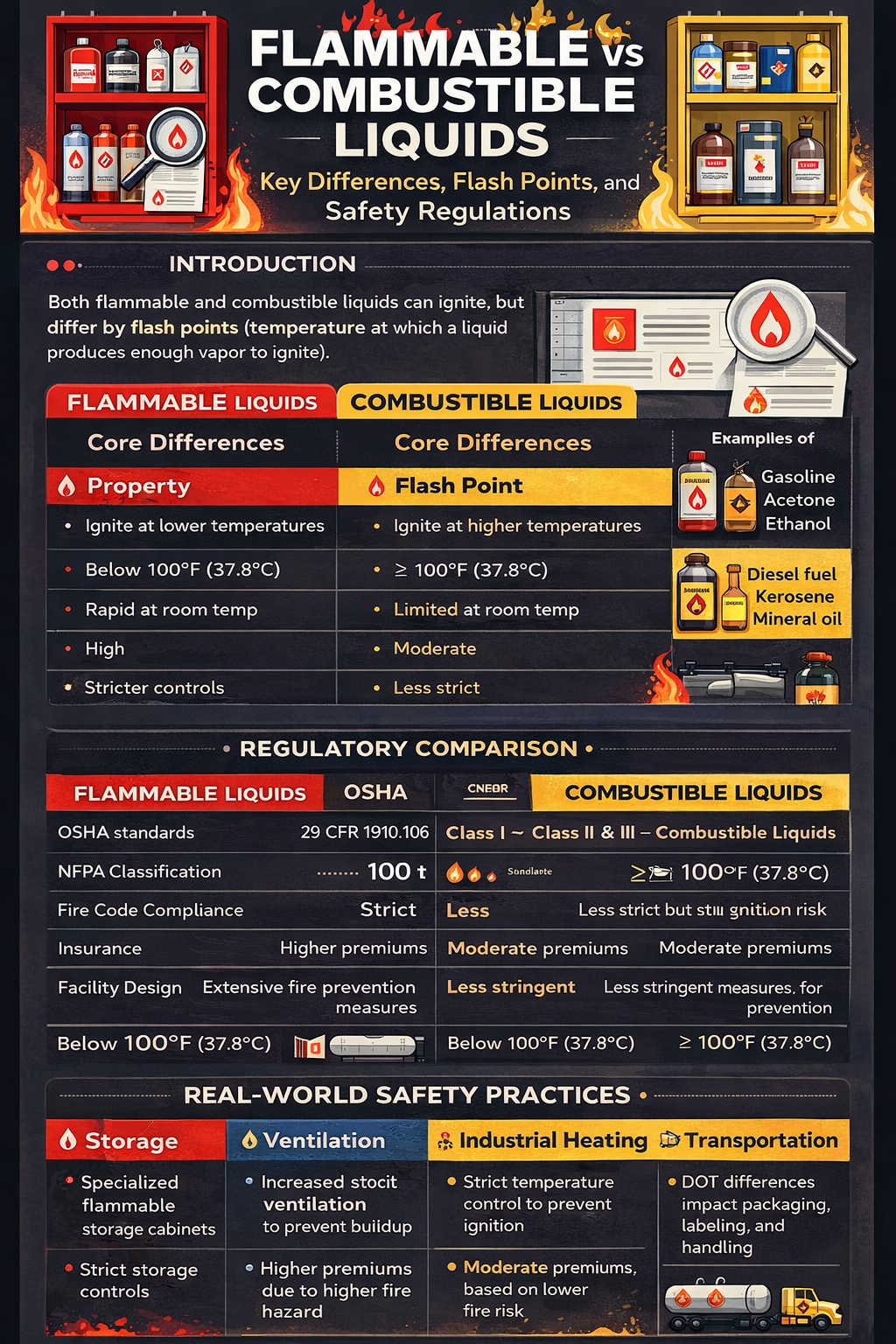
| Core Differences | Flammable Liquids | Combustible Liquids |
|---|---|---|
| Property | These liquids ignite quickly at low temperatures | These liquids ignite at higher temperatures |
| Flash Point | Below 100°F (37.8°C) | ≥ 100°F (37.8°C) |
| Vapor Formation | Rapid at room temperature | Limited at room temperature |
| Ignition Risk | High | Moderate |
| Storage Requirements | Stricter storage controls | Comparatively less strict |
Regulatory Differences Between the Flammable Liquids and Combustible Liquids
| Regulatory Aspect | Flammable Liquids | Combustible Liquids |
|---|---|---|
| OSHA Standards | 29 CFR 1910.106 | 29 CFR 1910.106 |
| Storage Cabinet Requirements | Strict requirements for storing flammable liquids | Slightly less strict storage requirements |
| Quantity Limits Inside Buildings | Limited quantity of flammable liquids allowed | Higher quantities may be stored |
| NFPA Classification | Class I – Flammable Liquids | Class II & III – Combustible Liquids |
| Flash Point | Below 100°F (37.8°C) | ≥ 100°F (37.8°C) |
| Fire Code Compliance | Strict compliance due to high ignition risk | Less strict, but still requires safety measures |
| Insurance | Higher premiums due to higher fire hazard | Moderate premiums, based on lower fire risk |
| Facility Design | Requires more extensive fire prevention measures | Less stringent measures for fire prevention |
Real-World Safety Applications
When it comes to flammable and combustible liquids, proper storage and handling methods are essential. The accuracy of storage and handling methods matters a lot in preventing accidents and ensuring safety.
- Storage
Flammable liquids require specialized flammable storage cabinets. These types of storage cabinets must come with temperature control and segregation from potential ignition sources. These cabinets are made to lower the risk of fire and ensure safe containment.
- Ventilation
Flammable liquids require higher levels of ventilation. Higher levels of ventilation can prevent the buildup of flammable vapors. Sufficient airflow is necessary to lower the risk of ignition.
- Industrial Heating
Combustible liquids cause a high risk when heated above their flash point. In industrial sectors, strict temperature control is essential. As a result, accidental ignition (when these liquids are exposed to heat) can be prevented.
- Transportation
The Department of Transportation (DOT) categorized the flammable and combustible liquids in different ways. This differentiation affects the packaging, labeling, and handling requirements during transport. The categorization determines safe transportation practices.
- SDS Section 9 (Physical & Chemical Properties)
Hazard communication is essential. Safety Data Sheets (SDS) contain critical information in section 9. Physical and chemical properties of these liquids (such as flash points and vapor pressure), help to manage hazards effectively.
Conclusion
The above discussion illustrates the fundamental distinction between flammable and combustible liquids based on their flash point. Liquids that catch fire easily. These catch fires easily at normal temperatures, but combustible liquids need to be heated to become dangerous. Both kinds of liquids are very dangerous when it comes to fire, so they need to be stored safely and with clear signs of danger. To stop fires, you need to know how to categorize things. It makes sure that the
FAQ
- Identification Details:
It shares data such as product identifiers, and manufacturer or supplier details along with their address.
- Hazards Identification:
This document also shared details on hazard classification, signal words, and hazard and precautionary statements.
- Composition or Ingredients: An SDS shares details on chemical ingredients, including hazardous components and some other relevant information.
- First Aid Measures: Users can also find some useful first-aid measures that allow them to handle emergencies.
- Fire-Fighting Measures: Employees of a facility have suitable extinguishing techniques, and understand all the hazards from combustion products.
- Accidental Release Measures: It shares helpful emergency procedures, containment methods, and cleanup procedures for the employees.
- Handling and Storage: Users can also find precautions for safe handling and storage, including the incompatibilities of the chemicals, the ideal storage conditions, and packaging materials.
- Exposure Controls or Personal Protection: An employee can also find details on appropriate engineering controls, personal protective equipment (PPE), and exposure limits.
- Physical and Chemical Properties: Knowing the physical state, appearance, odor, pH, melting point, boiling point, flashpoint, vapor pressure, etc. is possible from this document.
- Stability and Reactivity: Chemical stability, and the possibility of hazardous reactions are also crucial for users to know to stay safe.
- Toxicological Information: It shares all the possible routes of exposure, acute or chronic effects, symptoms of exposure, and toxicity data.
- Ecological Information: The users can also find ideas about the product’s capacity to damage the environment.
- Disposal Considerations: It shares some appropriate disposal methods for hazardous products also along with disposal considerations, and waste treatment methods.
- Transport Information: All the transport precautions are vital and users can find information in detail.
- Regulatory Information: Employees will also know all the safety, health, and environmental regulations by going through this document.
Simplify Your SDS Management
CloudSDS gives your team instant access to 23M+ safety data sheets with AI-powered search, automated updates, and full OSHA/GHS compliance — all from one platform.
CloudSDS’s SDS search is the easiest way to find out the required SDS in seconds. It can conducted by following the below steps easily:
-
Free Account Creation:
Users must sign up first to create a free account to view and download all of the SDSs or to get access to CloudSDS’s Global SDS repository.
-
Easy Search:
Start the search by entering either the product name or other data fields such as manufacturer name, and CAS number. In case you have the complete details of the product, enter all the details and start your search to find the specific product.
-
Advanced SDS Search:
Users can also take advantage of an advanced search that helps narrow down the entire process. Take advantage of an advanced search option to reduce the total number of search results.
Find Any SDS in Seconds
Search 23M+ safety data sheets by product name, manufacturer, or CAS number — free and instant.
A safety data sheet or SDS has the following benefits:
-
Provides Safety Information:
It offers important details regarding the dangers of chemicals. In this way, it aids people in comprehending possible concerns related to their handling, disposal, storage, and use. Additionally, it offers some particular safety advice.
-
Regulatory Compliance:
This document is necessary as proof to stay compliant with all legal requirements. After all, it contains not just hazard information but also safety tips.
-
Employee Training:
It is also required to train employees on how to handle hazardous chemicals. Besides, its tips on emergency control allow workers to save themselves and their colleagues from chemical exposures.
-
Emergency Preparations:
SDSs contain instructions for responding to chemical spills, leaks, fires, and exposure incidents. It also shares tips on taking prompt and effective emergency response actions.
Simplify Your SDS Management
CloudSDS gives your team instant access to 23M+ safety data sheets with AI-powered search, automated updates, and full OSHA/GHS compliance — all from one platform.
The chemical inventory list includes the details of all the chemicals that any manufacturing facility uses. It’s mainly a comprehensive catalog with details of all the chemicals stored or used on-site, along with relevant safety information.
The following details should be included in a complete chemical inventory list:
- Chemical Name: The chemical’s common name, scientific name, synonyms, and trade names should be mentioned in the list.
- Quantity: It must have information on the amount of each chemical currently in stock or stored at the facility.
- Location: The specific storage location should also be shared in this list for the users or workers.
- SDSs: All the relevant safety data sheets should be included here with hazard information and handling precautions.
- Expiration Date: The expiration date of the chemicals must be mentioned if applicable.
- Usage Information: Details about how the chemicals should be used in the workplace must be included here.
- Regulatory Compliance: This should also include information about the legal requirements for the handling, labeling, storage, and disposal of hazardous chemicals.
- Emergency Contact Details: Contact details for emergency response personnel or departments should also be included to tackle chemical spills, leaks, or accidents.
Simplify Your SDS Management
CloudSDS gives your team instant access to 23M+ safety data sheets with AI-powered search, automated updates, and full OSHA/GHS compliance — all from one platform.
Facilities need to rely on a proper technique to handle the chemical inventory. Check out the following details to know more about the process.
-
Identification and Documentation:
The process begins by identifying all hazardous chemicals present in the workplace. Therefore, you need to maintain a comprehensive inventory list. The list must include the names of the chemicals, and quantities, and also should share the locations where they are stored. Keeping the relevant safety data also makes the process more accurate.
- Labeling and Segregation:
To properly manage all your chemical inventory ensure that all chemical containers are properly labeled. These container labels should also display clear and accurate information about the contents. The labeling is only complete when it includes all the hazard information along with the right pictograms.
- Storage and Handling:
You must understand the importance of storing chemicals in designated areas. The place has to be well-ventilated, secure, and equipped with appropriate safety measures. It’s also important to follow manufacturer instructions and regulatory guidelines for the sake of proper handling and storage practices.
- Regular Inspections and Audits:
It’s vital to conduct proper and thorough regular inspections of chemical storage areas. Why? It will help identify potential hazards, leaks, or safety issues. Therefore, facilities must perform audits of the chemical inventory daily to ensure effective chemical safety management.
- Taking Help of Software:
To simplify the process take the help of chemical inventory management software. This software helps track chemical usage details along with reports and analysis. Moreover, auto tracks the inventory which reduces time and improves overall efficiency.
- Regular Updates:
Regular review and updates are also necessary. Therefore, organizations must maintain the inventory list to reflect changes in the inventory levels. Thus, updating new chemical acquisitions, or updates to safety regulations is possible which helps manage the inventory.
Simplify Your SDS Management
CloudSDS gives your team instant access to 23M+ safety data sheets with AI-powered search, automated updates, and full OSHA/GHS compliance — all from one platform.
A Hazardous Chemical Inventory is a comprehensive list or database that provides detailed information about the hazardous chemicals present in a facility. From this inventory, users can find data on the names and quantities of chemicals. Additionally, it shares the chemical’s locations within the facility, associated hazards, storage requirements, and some relevant safety precautions.
According to OSHA, facilities need to maintain an inventory of this type to ensure effective chemical safety management and public safety. It also helps handle emergencies and mitigate risks to the health and safety of workers and the environment.
Simplify Your SDS Management
CloudSDS gives your team instant access to 23M+ safety data sheets with AI-powered search, automated updates, and full OSHA/GHS compliance — all from one platform.
One glance at the current market size of the SDS management software reveals how businesses are feeling its requirements. That’s why the market value is expected to reach USD 90-133 billion by 2030 with a CAGR of 24-30%. This suggests that facilities will have a wide range of options to select from when determining which is best for their particular needs. What precisely should they search for? To streamline workflows and improve efficiency, finding the best SDS management software is the key.
Simplify Your SDS Management
CloudSDS gives your team instant access to 23M+ safety data sheets with AI-powered search, automated updates, and full OSHA/GHS compliance — all from one platform.
Simplify Your SDS Management
CloudSDS gives your team instant access to 23M+ safety data sheets with AI-powered search, automated updates, and full OSHA/GHS compliance — all from one platform.
Leave A Comment