
Last Updated on November 2, 2026
SDS Training: Importance, OSHA Requirements, and Best Practices
Introduction
SDS training teaches employees how to find, read, and act on the safety information chemical suppliers provide in safety data sheets. In the United States it falls under OSHA's Hazard Communication Standard (HazCom), 29 CFR 1910.1200(h), alongside instruction on labels, hazard recognition, protective equipment, and emergency response. The aim is practical: workers who can use the information at the moment need it.
Key facts about SDS training
| Fact | Information |
| Governing standard | OSHA Hazard Communication Standard, 29 CFR 1910.1200 |
| Training requirements | Paragraph (h) of the standard |
| Initial training | At initial assignment, and whenever a new chemical hazard the employee hasn’t been trained on enters the work area |
| Fixed refresher interval | HazCom doesn’t prescribe one |
| SDS format | 16 standardized sections |
| HCS 2024 employer deadlines | November 20, 2026, for substances; May 19, 2028, for mixtures |
Definition of SDS training?
SDS training covers the skills a worker needs to use chemical hazard information safely on the job. In practice that means
- Reading and interpreting the sections of an SDS.
- Recognizing chemical hazards, including how chemicals can enter the body.
- Choose and use the right PPE and exposure controls.
- Handling, storing, and disposing of chemicals safely.
- Responding to spills, fires, and accidental exposure.
One clarification matters here. OSHA doesn’t have a separate standard called “SDS training.” The instruction on SDSs is one part of the broader HazCom training duty, which also covers labels, the written program, and workplace-specific procedures. When someone asks whether SDS training is required, the accurate answer is that SDS instruction is a required piece of HazCom training.
Is SDS training required by OSHA?
Yes, in the sense that matters. Employers with hazardous chemicals in the workplace must train employees under 1910.1200(h), and that training has to include how to understand labels and SDSs.
What does 29 CFR 1910.1200(h) require?
Paragraph (h)(1) requires employers to give employees effective information and training on the hazardous chemicals in their work area. Two events trigger it: the employee’s initial assignment and the introduction of a new chemical hazard the employee hasn’t been trained on. Training can be organized by hazard category, such as flammability or carcinogenicity, or by specific chemical, but chemical-specific information must always be available through labels and SDSs.
The word “effective” carries weight. It means workers actually understand and can apply what they were taught. Handing out a binder of SDSs, or telling people where the binder lives, doesn’t meet that bar. Access to SDSs is a separate duty under paragraph (g)(8); training is what makes that access useful.
What must employees be told under 1910.1200(h)(2)?
Paragraph (h)(2) lists what employees must be informed of, and it’s mostly about orientation:
- The requirements of the HazCom standard.
- Any operations in their work area where hazardous chemicals are present.
- The written HazCom program is kept in the work area, and it includes information on how to access it, a list of hazardous chemicals, and the SDSs.
What must train cover under 1910.1200(h)(3)?
Paragraph (h)(3) sets out the substance of the training. It’s easiest to think of it in four groups:
- Detection. Methods and observations that help an employee notice a chemical’s presence or release, such as monitoring, visual appearance, or odor.
- Hazards. Physical and health hazards, including simple asphyxiation, combustible dust, pyrophoric gas, and hazards not otherwise classified.
- Protection. What employees can do to protect themselves, including work practices, emergency procedures, and PPE the employer has implemented.
- Program details. How the written program works, how to read the labels on shipped containers and any workplace labeling system, and how an SDS is organized and used.
How often must SDS training be repeated?
There’s no universal quarterly or annual refresher in HazCom. The legal triggers are the two in (h)(1): initial assignment and new hazards. Anything beyond that is a judgment call, not a rule.
That said, a few situations usually justify more training: an employee moves to a job with different chemicals; a supplier issues a revised SDS with new hazard information, or an incident or audit shows workers aren’t following procedures. Short periodic checks, like a quiz or a spot demonstration, are a reasonable way to find gaps before they become incidents. Many employers choose an annual cycle for this reason, but it’s their policy rather than OSHA’s.
HCS 2024: what must employers update by November 20, 2026?
OSHA revised HazCom in May 2024 to align with Revision 7 of the GHS, with some Revision 8 provisions. In January 2026 the agency pushed every compliance date back by four months. Employers now have until November 20, 2026 for substances and May 19, 2028 for mixtures. By each date, as necessary, employers must:
- Update any alternative workplace labeling under paragraph (f)(6).
- Update the written HazCom program under paragraph (h)(1).
- Provide additional training under (h)(3) on newly identified physical or health hazards.
Until those dates, employers may follow the 2012 version of the standard, the 2024 version, or both. Practically, if a chemical you use has been reclassified and its SDS now lists a hazard employees weren’t trained on, that’s your training trigger. Start by comparing new SDS revisions against your existing training content.
Why is SDS training important?
Protects employee health
Most chemical injuries don’t come from workers ignoring danger. They come from not knowing it was there. Training that explains exposure routes (inhalation, skin and eye contact, and ingestion) and what protection each one calls for lets workers make sensible calls when the job doesn’t match the textbook.
Helps meet OSHA HazCom requirements
Labels, SDSs, the written program, and training are the four working parts of HazCom, and they depend on each other. A well-written SDS does little for a worker who can’t find Section 8. Hazard communication routinely ranks among OSHA’s most frequently cited standards, so inspectors see these gaps often. Training doesn’t guarantee a clean inspection, but it addresses a core requirement and makes the rest of the program function.
Reduces chemical incidents
Many incidents trace back to small, avoidable errors. A bleach-based cleaner stored next to an ammonia-based one. Acids shelved above bases. Flammable solvent decanted near an ignition source. Each of these is flagged on the SDS, in Sections 7 and 10 especially, and each is easy to prevent once people know to look.
Builds a workplace safety culture
When employees know how to get hazard information, they ask better questions and report problems sooner. Role-specific training adds to this: a forklift operator who understands what’s in the pallets they move is more likely to flag a leaking drum.
Improves emergency response
Three sections carry most of the emergency load. Section 4 (first-aid measures) tells responders what to do after exposure. Section 5 (firefighting measures) covers suitable extinguishing media and fire-specific hazards. Section 6 (accidental release measures) covers spill containment and cleanup precautions. Workers should know where to find these quickly and how they connect to the site’s own emergency procedures, since an SDS is generic, and your evacuation plan is not.
What should SDS training cover?
Understanding the 16 sections of an SDS
Every SDS follows the same 16-section order, which is the point: once an employee learns the layout, any SDS works the same way.
| SDS section | What to cover |
| 1. Identification | Product identity, supplier, emergency contact |
| 2. Hazard identification | Classification, pictograms, signal words, hazard, and precautionary statements |
| 3. Composition/information on ingredients | Ingredients and concentration ranges |
| 4. First-aid measures | Actions after inhalation, contact, or ingestion |
| 5. Firefighting measures | Extinguishing media, fire-related hazards |
| 6. Accidental release measures | Spill response, precautions, containment |
| 7. Handling and storage | Safe handling, storage conditions, incompatibilities |
| 8. Exposure controls/personal protection | Exposure limits, engineering controls, PPE |
| 9. Physical and chemical properties | Flash point, appearance, odor, and similar |
| 10. Stability and reactivity | Conditions and materials to avoid |
| 11. Toxicological information | Health effects and routes of exposure |
| 12. Ecological information | Environmental effects |
| 13. Disposal considerations | Disposal guidance |
| 14. Transport information | Shipping classification |
| 15. Regulatory information | Other applicable regulations |
| 16. Other information | Revision date, preparation details |
Training depth should follow the job. For most workers, Sections 1, 2, and 4 through 8 do the heavy lifting day to day, so spend the most time there and cover the rest as their duties require. A shipping clerk needs Section 14 far more than a lab technician does. Note that OSHA does not enforce the content of Sections 12 through 15 because other agencies regulate that information, though the headings still appear on the sheet (see Appendix D to 1910.1200).
Understanding GHS labels and hazard pictograms
The label is usually the first thing a worker sees, so training should treat it as the front door to the SDS. Cover these elements:
- Pictograms. The red-bordered diamond symbols signal the type of hazard, such as flame, corrosion, or health hazard.
- Signal words. “Danger” for more severe hazards, “Warning” for less severe ones.
- Hazard statements. Standardized phrases describing the nature of hazard.
- Precautionary statements. Recommended measures for prevention, response, storage, and disposal.
The label information matches Section 2 of the SDS, which is a useful teaching point: a worker who can read a label already knows what Section 2 will say. Practice with real containers from the workplace, including secondary containers and any in-house labels, since those are the ones people get wrong.
How do you deliver effective SDS training?
-
Use real SDSs for chemicals in your workplace
Generic examples teach the format. Real SDSs teach the job. Pull the sheets for products employees handle every day and let them find answers in those: What PPE is specified? What do you do if it gets in your eyes? What shouldn’t it store nearby?
-
Walk through the 16 sections, focusing on Sections 2, 4, and 8
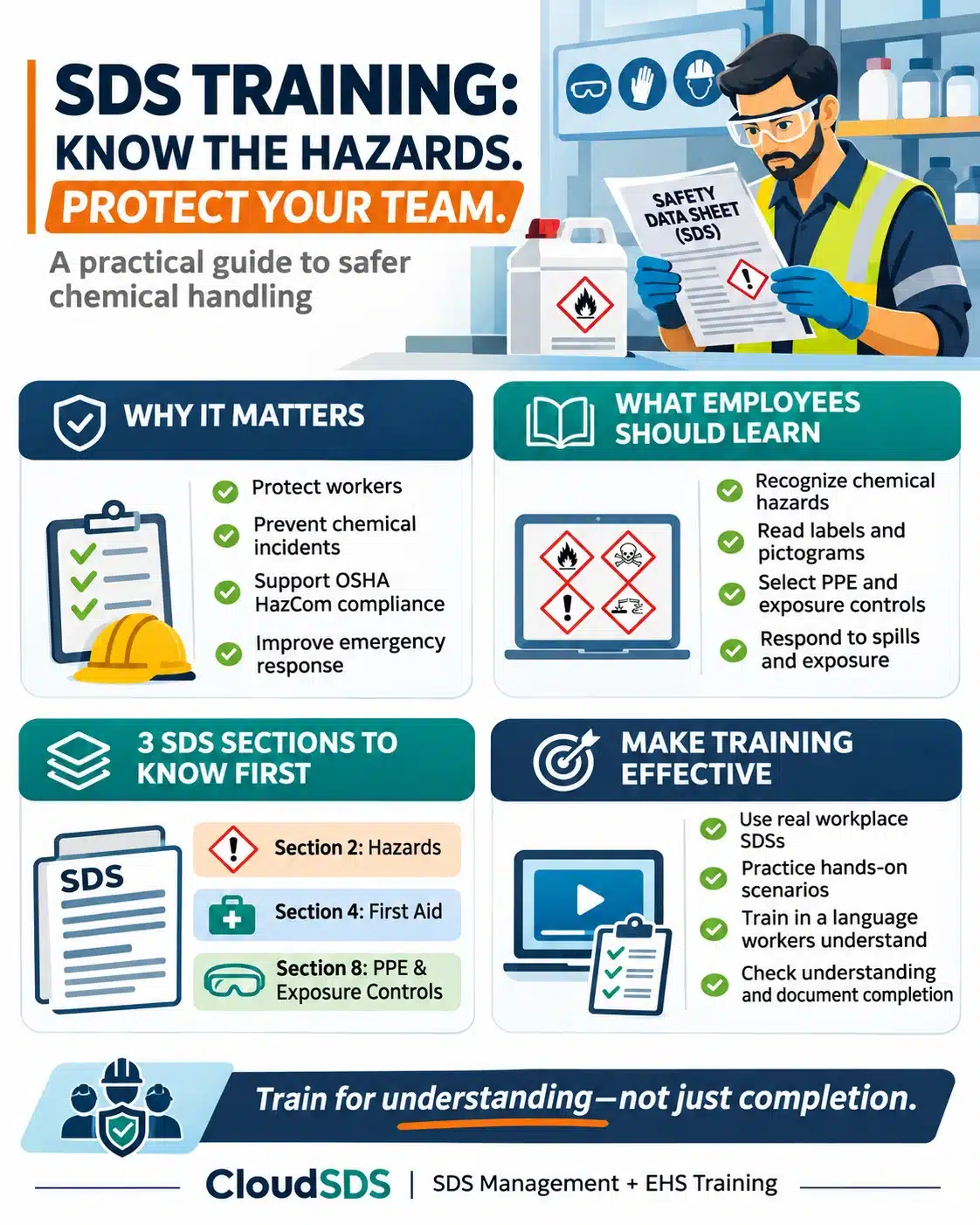
Don’t try to give every section an equal time. Show employees how to jump straight to hazards (Section 2), first aid (Section 4), and PPE and exposure controls (Section 8). Time them if you like. If a worker can locate those three in under a minute, the training is working.
-
Use visual aids: GHS pictograms and sample labels
Bring physical samples when you can. Printed pictogram charts, real container labels, and short videos all help, particularly for new hires who haven’t seen the symbols before. Show the pictograms alongside the hazard they stand for, then ask people to identify labels from products on their own shelves.
-
Run hands-on demonstrations and drills
Practice sticks better than lectures. Useful exercises include:
- Finding the correct SDS for a named product.
- Picking the right gloves and eye protection from an SDS.
- Locating the first aid and spill-response instructions.
- Running through the site’s actual emergency procedure, including where the eyewash and spill kits are.
-
Train workers in a language and vocabulary they understand
Training nobody understands isn’t effective. OSHA’s Training Standards Policy Statement makes this point directly: instruction has to be delivered in a language and at a level workers can follow. That may mean translated materials, interpreters, or plain-language rewrites of technical terms. Check comprehension by asking people to explain a label or SDS in their own words rather than asking whether they understood.
-
Customize training by role
The same chemical raises different questions for different jobs.
- Laboratory personnel: small quantities, many different chemicals, and reactivity and incompatibility concerns.
- Warehouse and storage workers: segregation, labeling, damaged containers, and spill response.
- Maintenance teams: lockout situations, non-routine exposure, and unlabeled piping.
- Manufacturing employees: process exposures, ventilation, and PPE selection.
- Contractors: the site’s chemicals, where SDSs are kept, and emergency procedures.
-
Use SDS management software for access and training
Digital SDS management helps in practical ways. Workers can pull up the current version of a sheet instead of a stale printout, and QR codes on shelves or in a training room make that a few seconds work. Where a platform supports multiple languages, it can also help with comprehension. Pairing SDS management with a learning management system lets you deliver courses and keep completion records in the same place. Our SDS management software and LMS are built for this workflow. Software supports a compliance program; it doesn’t replace the judgment and instruction that goes into one.
-
Check understanding and retrain when needed
Short quizzes, demonstrations, and scenario questions show you what is stuck. If most of a crew misses the same question, that’s a training problem, not a people problem. Retrain when hazards change, when workers change jobs, or when an incident points to a gap. Quarterly or annual refreshers are good practice, and many programs include them, but they are a choice, not something HazCom imposes.
Special training situations
Non-routine tasks
The written program under 1910.1200(e)(1)(ii) must describe how the employer will inform employees of the hazards of non-routine tasks, such as cleaning a tank, and of chemicals in unlabeled pipes. These jobs are where surprises happen, so brief workers on the specific hazards before they start.
Contractors and multi-employer workplaces
When employees of different employers share a site, paragraph (e)(2) requires the host employer’s program to cover how other employers get access to SDSs, how they’re told about precautionary measures during normal operations and foreseeable emergencies, and how they’re informed about the site’s labeling system. In plain terms: tell contractors what’s on site, where the sheets are, and what to do if something goes wrong. Each employer remains responsible for training its own employees.
Laboratory training requirements
Laboratories that fall under OSHA’s Laboratory Standard, 29 CFR 1910.1450, work from a chemical hygiene plan, and that standard has its own information and training requirements. Lab workers must still be able to get SDSs, and containers must keep their labels.
SDS training outside the United States
Other jurisdictions handle worker training differently. In Canada, WHMIS requires worker education and training, with the specifics set through federal, provincial, and territorial occupational health and safety laws. In the European Union, REACH Article 35 gives workers access to safety data sheet information, while Directive 98/24/EC requires employers to provide information and training on chemical agents at work. If you operate across borders, check local requirements for each site.
How should you document SDS training?
HazCom doesn't explicitly require a written training record. That doesn't make records optional in practice. If an inspector asks how you trained employees, or if you need to show that training was effective, a record is the easiest proof you have. Good records usually capture:
- The training date.
- The employee or trainee.
- The chemicals or hazard categories covered.
- The trainer or training provider.
- Assessment or competency results.
- The language used, where relevant.
An LMS can handle most of this automatically by tracking completions, scores, and dates. Before you rely on any reading of the documentation requirement, check OSHA's current interpretations, since they can be more specific than the standard's text.
SDS training checklist
Use this list to check your program against 1910.1200(h)(2) and (h)(3). It's a working aid, not a replacement for the standard itself. A printable one-page version can be offered as a download alongside this article.
- Identify the hazardous chemicals and workplace operations the employee encounters.
- Explain the HazCom standard and the workplace program.
- Told employees where the chemical list and SDSs are.
- Covered hazard detection, physical and health hazards, and protective measures.
- Explain labels, pictograms, and the SDS sections.
- Provided role-specific instruction and practical exercises.
- Checked employee understanding.
- Identified situations that need additional training.
- Kept training records and supporting evidence.
How does CloudSDS support SDS training?
Help employees access relevant SDSs.
Training only helps if workers can reach the information afterward. SDS management gives employees one place to find the current sheet for the chemical in front of them.
Deliver training and track progress with an LMS.
The Learning Management System lets you assign courses, assess knowledge, and track completion, so training and records stay together.
Support training access across different work environments.
Where your setup supports it, QR-code access and multilingual options make it easier to reach workers on the floor, in the lab, or in a warehouse.
To see how it fits your program, explore CloudSDS SDS Management Software and the Learning Management System.
Frequently asked questions
Is SDS training required by OSHA?
Yes, as part of HazCom training. Under 1910.1200(h), employers must train workers on the hazardous chemicals in their work area, including how to read labels and SDSs. OSHA doesn’t have a standalone SDS training standard, but instruction on SDSs is a required element of the broader HazCom training duty.
How often is SDS training required?
OSHA requires training at initial assignment and whenever a new chemical hazard is introduced into the work area. HazCom sets no fixed refresher interval, so annual or quarterly sessions are an employer choice. Many employers retrain when jobs change, hazards are updated, or workers show gaps in understanding.
What must HazCom training include?
Paragraph (h)(2) requires telling employees about the standard, where hazardous chemicals are used in their area, and where the written program, chemical list, and SDSs are. Paragraph (h)(3) adds detection methods, physical and health hazards, protective measures, and details of the program, including labels and SDS format.
Do I need to retrain employees for HCS 2024?
Possibly. By November 20, 2026, for substances and May 19, 2028, for mixtures, employers must provide additional training on newly identified hazards, as necessary. If revised SDSs or labels show hazards your workers haven’t been trained on, you need to cover them. If nothing changed for your chemicals, extra training may not be needed.
Does SDS training need to be documented?
HazCom doesn’t expressly require written training records. Even so, documenting the date, attendees, topics, trainer, and assessment results is strongly recommended, because it shows what was delivered and whether it worked. Check current OSHA interpretations before treating any documentation practice as a legal requirement.
Can SDS training be done online?
Yes, online courses can deliver much of the content, especially general material on labels and SDS layout. But OSHA expects training to be effective, which means workers must also learn the hazards and procedures at their own site. Pair online modules with hands-on practice and a way to ask questions.
Do contractors need SDS training?
Contractors’ own employers are responsible for training them. The host employer, though, must share SDS access, precautions, emergency procedures, and labeling information with other employers on site under 1910.1200(e)(2). In practice, brief contractors on site-specific chemicals and emergency steps before they start work.
Which SDS sections are most important for employees?
Sections 2, 4, and 8 matter most for most workers: hazards, first aid, and PPE and exposure controls. Others matter depending on the job. Storage and maintenance staff need Sections 7 and 10, emergency responders need Sections 5 and 6, and shipping staff need Section 14.

Simplify Your SDS Management
CloudSDS gives your team instant access to 23M+ safety data sheets with AI-powered search, automated updates, and full OSHA/GHS compliance — all from one platform.
Leave A Comment