

Last Updated on March 27, 2026
Dimethoate, a commonly used organophosphate pesticide, presents significant risks to human health in both the short and long term. When it comes to short-term exposure, it can cause immediate cholinergic poisoning in the form of nausea, dizziness, headaches, blurred vision, muscle weakness, and difficulty breathing. This problem is due to its strong inhibition of acetylcholinesterase function.
Long-term exposure, on the other hand, has been linked to serious health problems like neurological damage, reproductive problems, developmental disorders, and even the possibility of cancer. Current research is underway to fully explore the extent of these risks. Therefore, it is essential to have complete knowledge about the short-term toxicity and long-term cumulative effects of dimethoate to fully understand the total risk it poses.
Dimethoate Exposure: Immediate Symptoms and Long-Term Risks Explained
You purchase fruits and vegetables daily, but have you ever wondered about the pesticides that protect these vegetables from insects? Dimethoate is one such pesticide that is used to destroy insects and boost crop production. Dimethoate acts fast on farmlands, but it also seeps into our food and water. This article discusses the dangers of dimethoate in a balanced manner. We will discuss the dangers of dimethoate in the short term, such as poisoning quickly, and its long-term effects, such as how it can harm your brain. You will learn why you must exercise caution when handling this chemical by the end.
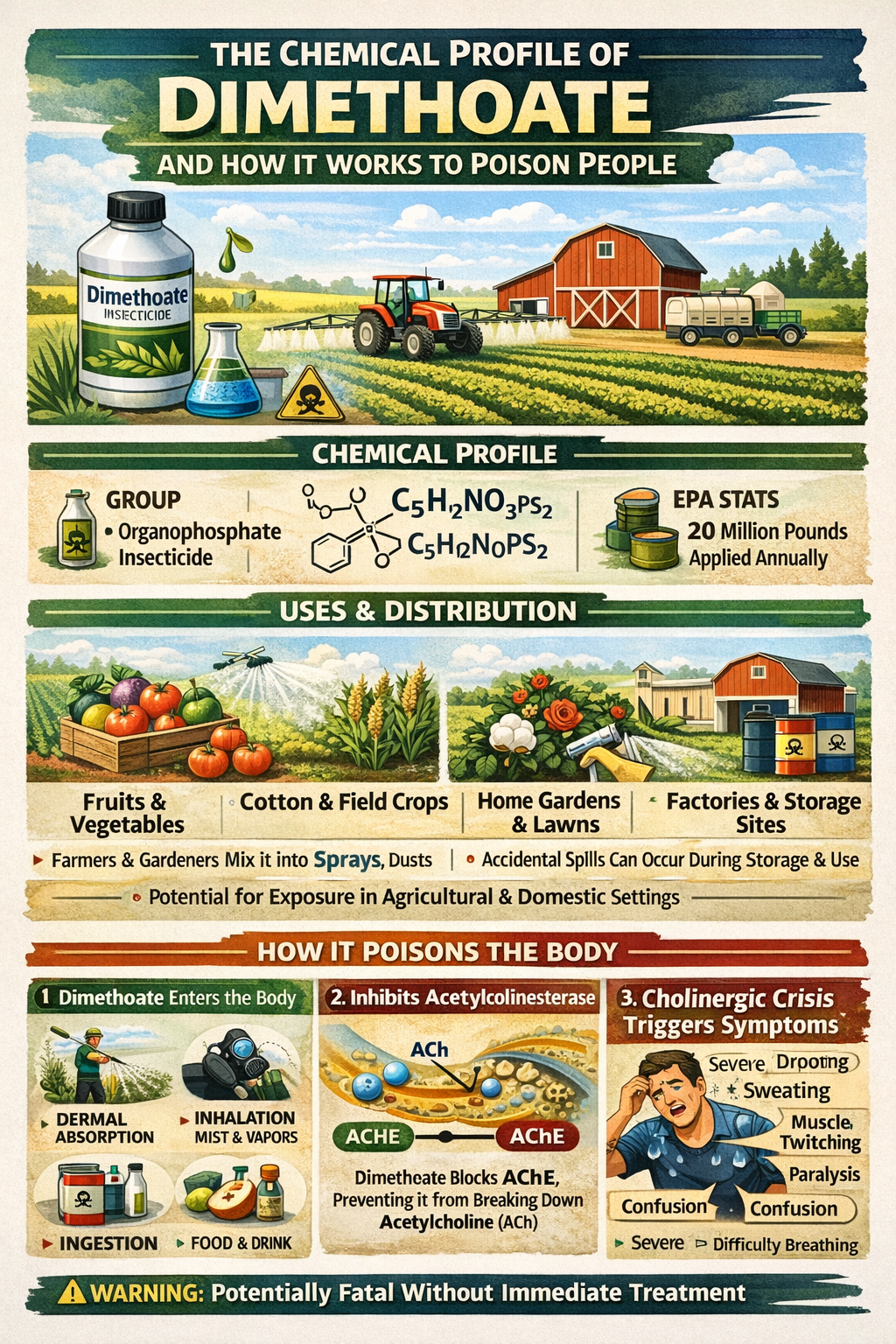
The Chemical Profile of Dimethoate and How It Works to Poison People
1. What is Dimethoate? Chemical Groups and How They Are Used
Dimethoate is a type of insecticide called an organophosphate. Farmers spray it on cotton, apples, and tomatoes to keep aphids and leafhoppers away. It started to be used more in the 1960s and is still used in places like the US and parts of Asia.
Over time, the rules about dimethoate have gotten stricter. Because of health concerns, the European Union prohibited it on food crops in 2003. The EPA sets strict limitations in the US, but some states want even more. These changes reflect how professionals balance the pros and cons.
If the produce was cultivated in places where it's legal, you might detect traces of it on store-bought food. That's why it's important to know where it came from while making choices every day.
2. How Dimethoate Affects the Brain and Nerves
Dimethoate affects the impulses that nerves send out. It stops an enzyme known as acetylcholinesterase, or AChE for short. Acetylcholine is a chemical messenger that this enzyme usually breaks down.
Acetylcholine builds when AChE is blocked. Nerves keep firing, like when the gas pedal on an automobile becomes stuck. Muscles jitter, glands work too hard, and the whole system goes crazy.
This chain reaction happens quickly when there are a lot of them. Even small amounts might add up over time. Think of it as overloading your body's wiring, which can cause actual damage if not stopped.
3. Metabolites and Staying in the Environment
When dimethoate gets into the body or soil, it turns into omethoate. This side product is even more harmful than the original. It stays around longer and is easier for plants and animals to take in.
Dimethoate stays in water or dirt for weeks in the environment. When it rains, it might wash into streams, where fish eat it. It builds up in the food web over time and gets to people through the food and drinks we consume.
This persistence makes it more likely that everyone, not just farmers, will be exposed. Research indicates it can disperse significantly from application sites, contaminating remote water supplies.
Short-Term Dimethoate Exposure: Health Risks
1. Signs of Acute Organophosphate Poisoning
Short-term exposure to dimethoate can cause organophosphate poisoning. Too much saliva, tears flowing down your face, and unexpected needs to go to the bathroom are all early indicators. You might also get stomach cramps, throw up, and have problems breathing. They fit the SLUDGE pattern:
- Salivation
- Lacrimation
- Urination
- Defecation
- GI problems
- Emesis
As it gets worse, muscles get weaker, vision gets blurry, and confusion sets in. In the worst circumstances, convulsions or a coma can happen. After a spill, one farmer in a 2015 research felt these. He got better quickly with care, but delays can make modest symptoms lethal. Finding them early saves lives.
2. Occupational Safety and High-Risk Exposure Scenarios
Dimethoate is most dangerous to farm workers in the short term. They mix sprays or walk across treated fields, breathing in mist or touching wet leaves. People who work in factories and handle it during production also risk getting it on their skin.
Kids or pets might accidentally eat it from bottles that are stored. People who plant at home sometimes pick up old cans that don't have labels. These incidents happen more often in rural areas when storage isn't very secure.
Wear gloves, masks, and full-body suits to lower your risk. Never eat near work areas, and wash your hands straight away. These actions are stressed in training programs to keep people safe at work.
3. How to Respond to an Emergency and Treat an Overdose
If you get dimethoate poisoning, you need to act quickly. Within minutes, call poison control or go to the ER. Take off the wet garments and wash your skin with water for 15 minutes.
Atropine is a drug that doctors use to dry up secretions and make breathing easier. They use pralidoxime, or 2-PAM, to reactivate the enzyme that was stopped. This pair performs best in the first several hours.
Oxygen or IV fluids are examples of supportive care that can help. A report from 2020 said that 80% of people who got treatment right away recovered. If you wait too long, those odds go down a lot.
Health Issues That Last for a Long Time When You Are Exposed to Them All the Time
1. Long-Term Effects on the Nervous System and Behavior
Years of low-level dimethoate exposure can damage the brain. People who live on farms are more likely to forget things and have unsteady hands. One research in California followed 500 workers for ten years. Many of them had decreased reaction speeds after that time.
Kids in these communities do worse on tests that measure focus. Animal tests reveal the same thing: rats have nerve damage from regular doses. It's like your brain is slowly wearing out.
In some cases, experts say it is linked to symptoms similar to Parkinson's. Not everyone is hit, but the damage builds up. Regular checkups help find problems early.
2. Possible Endocrine Disruption
Dimethoate may interfere with hormones, functioning as an endocrine disruptor. Lab rats who were given minimal amounts of food showed alterations in their thyroids and less ability to have babies. Studies on people in India discovered that farm wives had similar changes.
It acts like estrogen or stops important signals. This could have an effect on growth or the development of the infant. A 2018 review linked it to women who were exposed to it often having irregular cycles.
The effects are small at first, but they get stronger over time. Additional study is required to validate connections among individuals. Still, it warns people who are close to treated areas to be careful.
3. Evaluating Data on Carcinogenicity and Mutagenicity
Does dimethoate lead to cancer? The IARC says that organophosphates are "not classifiable" for humans, which means there isn't enough proof. Some animal testing suggests malignancies at high doses, but data from the real world is still mixed.
EPA reviews show that workers don't have a strong link to cancer. Most of the time, mutagenicity tests, which look for DNA damage, come out negative. There are some problems with the lab, though.
In general, the evidence points to no clear conclusion. Long-term viewers still say that limitations are the best way to stay safe. There isn't a definite "yes" on cancer, but it's important to stay alert.
Dietary Exposure and Groups at Risk
1. Dietary Residues: Limits Set by the Government and Risks to Consumers
You get dimethoate from eating fruits and vegetables. Agencies determine Maximum Residue Limits (MRLs), which are the most amount of a chemical that can be in a food. For example, apples can have 0.5 parts per million of a chemical. These make sure that the intake is safe.
The Acceptable Daily Intake (ADI) says that you can only be exposed to 0.0002 mg per kg of body weight for the rest of your life. Food testing in the US evaluates thousands of samples every year, and most of them are fine. According to USDA data, washing decreases the amount of residue by half.
Most buyers don't have to worry about risk. But imports from countries with loose rules raise the odds. Pick products that have been washed or peeled to make your load lighter.
2. Children and Developing Fetuses Are at Risk
Kids' brains grow quickly, which makes them easy targets for neurotoxins like dimethoate. Studies show that even little amounts given during pregnancy can cause learning deficits. Moms who lived on farms had infants with smaller heads.
A Brazilian study monitored 300 families, and by age 7, the kids who were exposed were behind in math. Their nerves develop important pathways early on, which are easy to break. High-spray areas also have more teens who say they have headaches.
Use organic picks and home filters to keep them safe. Doctors tell pregnant women to stay away from treated regions. These steps work best to protect kids.
3. Contamination of Water and Safety of Drinking Water
Runoff carries dimethoate into the ground. In the Midwest, tests revealed it in 10% of wells close to farmland. Surface water picks it up, which has an effect on municipal supplies.
In tap water, the EPA says it can't be more than 3 parts per billion. Most filters, like reverse osmosis, block things. People who live in the country depend on wells; therefore, testing them every year is quite helpful.
A facility in Florida closed after surges in 2022. Boiling won't get rid of it, but notifications keep people safe. Keep up with the news about the water in your area.
Rules, Other Options, and Ways to Lessen the Effects
1. Bans and Restrictions in the Global Regulatory Landscape
The EU stopped using dimethoate in 2020 for all purposes because it could harm nerves. Australia only allows it on crops that aren't food. The US lets it happen, but every five years it looks at the standards again, with stricter rules for kids' food.
Canada decreased MRLs in half ten years ago. Worker sickness and damage to the environment are two reasons. Developing countries are falling behind, yet trade agreements are putting more pressure on them.
These bans make things safer. Look at the labels on imports to find out what you can and can't do in your area.
2. How to Reduce Your Exposure (Actionable Tips)
For extra clean, immerse the vegetables in vinegar after washing it under running water for 30 seconds. When you can, buy organic food. It doesn't include synthetic pesticides like dimethoate.
Keep farm implements out of the reach of kids. If you garden, wear gloves and only treat tiny areas. Keep an eye on symptoms like nausea after handling and visit a doctor.
People in communities might ask for buffer zones around schools. These habits quickly lower your daily dose.
3. Integrated Pest Management (IPM) and safer options
IPM uses techniques to get rid of pests without using strong chemicals. First, scout the fields. Then, before using sprays, use ladybugs or traps. In tests, it decreases the amount of dimethoate needed by half.
Some safer alternatives are pyrethrins from flowers and neem oil from trees. Bacillus thuringiensis is a bacterium that kills worms without hurting their nerves. These also help the health of the soil.
IPM saves farmers money in the long run. Governments give money to people who switch. It's good for agriculture and health.
Conclusion: Balancing Risk with Usefulness
Dimethoate is strong against bugs, but it can be dangerous if you use too much of it in short bursts or over a long period of time. When you have acute poisoning, you get SLUDGE symptoms. When you get chronic poisoning, you get cognitive fog and hormone changes. There are significant hazards, especially kids and workers, but laws keep most exposures modest. We need to find a balance between farm demands and safety. Bans in places like the EU show that phasing it out works. Promote IPM and hygienic practices to keep everyone safe.
Be aware: wash your food, support green farms, and talk to your doctor about hazards. Your decisions make your plate safer.
FAQ
- Identification Details:
It shares data such as product identifiers, and manufacturer or supplier details along with their address.
- Hazards Identification:
This document also shared details on hazard classification, signal words, and hazard and precautionary statements.
- Composition or Ingredients: An SDS shares details on chemical ingredients, including hazardous components and some other relevant information.
- First Aid Measures: Users can also find some useful first-aid measures that allow them to handle emergencies.
- Fire-Fighting Measures: Employees of a facility have suitable extinguishing techniques, and understand all the hazards from combustion products.
- Accidental Release Measures: It shares helpful emergency procedures, containment methods, and cleanup procedures for the employees.
- Handling and Storage: Users can also find precautions for safe handling and storage, including the incompatibilities of the chemicals, the ideal storage conditions, and packaging materials.
- Exposure Controls or Personal Protection: An employee can also find details on appropriate engineering controls, personal protective equipment (PPE), and exposure limits.
- Physical and Chemical Properties: Knowing the physical state, appearance, odor, pH, melting point, boiling point, flashpoint, vapor pressure, etc. is possible from this document.
- Stability and Reactivity: Chemical stability, and the possibility of hazardous reactions are also crucial for users to know to stay safe.
- Toxicological Information: It shares all the possible routes of exposure, acute or chronic effects, symptoms of exposure, and toxicity data.
- Ecological Information: The users can also find ideas about the product’s capacity to damage the environment.
- Disposal Considerations: It shares some appropriate disposal methods for hazardous products also along with disposal considerations, and waste treatment methods.
- Transport Information: All the transport precautions are vital and users can find information in detail.
- Regulatory Information: Employees will also know all the safety, health, and environmental regulations by going through this document.
Simplify Your SDS Management
CloudSDS gives your team instant access to 23M+ safety data sheets with AI-powered search, automated updates, and full OSHA/GHS compliance — all from one platform.
CloudSDS’s SDS search is the easiest way to find out the required SDS in seconds. It can conducted by following the below steps easily:
-
Free Account Creation:
Users must sign up first to create a free account to view and download all of the SDSs or to get access to CloudSDS’s Global SDS repository.
-
Easy Search:
Start the search by entering either the product name or other data fields such as manufacturer name, and CAS number. In case you have the complete details of the product, enter all the details and start your search to find the specific product.
-
Advanced SDS Search:
Users can also take advantage of an advanced search that helps narrow down the entire process. Take advantage of an advanced search option to reduce the total number of search results.
Find Any SDS in Seconds
Search 23M+ safety data sheets by product name, manufacturer, or CAS number — free and instant.
A safety data sheet or SDS has the following benefits:
-
Provides Safety Information:
It offers important details regarding the dangers of chemicals. In this way, it aids people in comprehending possible concerns related to their handling, disposal, storage, and use. Additionally, it offers some particular safety advice.
-
Regulatory Compliance:
This document is necessary as proof to stay compliant with all legal requirements. After all, it contains not just hazard information but also safety tips.
-
Employee Training:
It is also required to train employees on how to handle hazardous chemicals. Besides, its tips on emergency control allow workers to save themselves and their colleagues from chemical exposures.
-
Emergency Preparations:
SDSs contain instructions for responding to chemical spills, leaks, fires, and exposure incidents. It also shares tips on taking prompt and effective emergency response actions.
Simplify Your SDS Management
CloudSDS gives your team instant access to 23M+ safety data sheets with AI-powered search, automated updates, and full OSHA/GHS compliance — all from one platform.
The chemical inventory list includes the details of all the chemicals that any manufacturing facility uses. It’s mainly a comprehensive catalog with details of all the chemicals stored or used on-site, along with relevant safety information.
The following details should be included in a complete chemical inventory list:
- Chemical Name: The chemical’s common name, scientific name, synonyms, and trade names should be mentioned in the list.
- Quantity: It must have information on the amount of each chemical currently in stock or stored at the facility.
- Location: The specific storage location should also be shared in this list for the users or workers.
- SDSs: All the relevant safety data sheets should be included here with hazard information and handling precautions.
- Expiration Date: The expiration date of the chemicals must be mentioned if applicable.
- Usage Information: Details about how the chemicals should be used in the workplace must be included here.
- Regulatory Compliance: This should also include information about the legal requirements for the handling, labeling, storage, and disposal of hazardous chemicals.
- Emergency Contact Details: Contact details for emergency response personnel or departments should also be included to tackle chemical spills, leaks, or accidents.
Simplify Your SDS Management
CloudSDS gives your team instant access to 23M+ safety data sheets with AI-powered search, automated updates, and full OSHA/GHS compliance — all from one platform.
Facilities need to rely on a proper technique to handle the chemical inventory. Check out the following details to know more about the process.
-
Identification and Documentation:
The process begins by identifying all hazardous chemicals present in the workplace. Therefore, you need to maintain a comprehensive inventory list. The list must include the names of the chemicals, and quantities, and also should share the locations where they are stored. Keeping the relevant safety data also makes the process more accurate.
- Labeling and Segregation:
To properly manage all your chemical inventory ensure that all chemical containers are properly labeled. These container labels should also display clear and accurate information about the contents. The labeling is only complete when it includes all the hazard information along with the right pictograms.
- Storage and Handling:
You must understand the importance of storing chemicals in designated areas. The place has to be well-ventilated, secure, and equipped with appropriate safety measures. It’s also important to follow manufacturer instructions and regulatory guidelines for the sake of proper handling and storage practices.
- Regular Inspections and Audits:
It’s vital to conduct proper and thorough regular inspections of chemical storage areas. Why? It will help identify potential hazards, leaks, or safety issues. Therefore, facilities must perform audits of the chemical inventory daily to ensure effective chemical safety management.
- Taking Help of Software:
To simplify the process take the help of chemical inventory management software. This software helps track chemical usage details along with reports and analysis. Moreover, auto tracks the inventory which reduces time and improves overall efficiency.
- Regular Updates:
Regular review and updates are also necessary. Therefore, organizations must maintain the inventory list to reflect changes in the inventory levels. Thus, updating new chemical acquisitions, or updates to safety regulations is possible which helps manage the inventory.
Simplify Your SDS Management
CloudSDS gives your team instant access to 23M+ safety data sheets with AI-powered search, automated updates, and full OSHA/GHS compliance — all from one platform.
A Hazardous Chemical Inventory is a comprehensive list or database that provides detailed information about the hazardous chemicals present in a facility. From this inventory, users can find data on the names and quantities of chemicals. Additionally, it shares the chemical’s locations within the facility, associated hazards, storage requirements, and some relevant safety precautions.
According to OSHA, facilities need to maintain an inventory of this type to ensure effective chemical safety management and public safety. It also helps handle emergencies and mitigate risks to the health and safety of workers and the environment.
Simplify Your SDS Management
CloudSDS gives your team instant access to 23M+ safety data sheets with AI-powered search, automated updates, and full OSHA/GHS compliance — all from one platform.
One glance at the current market size of the SDS management software reveals how businesses are feeling its requirements. That’s why the market value is expected to reach USD 90-133 billion by 2030 with a CAGR of 24-30%. This suggests that facilities will have a wide range of options to select from when determining which is best for their particular needs. What precisely should they search for? To streamline workflows and improve efficiency, finding the best SDS management software is the key.
Simplify Your SDS Management
CloudSDS gives your team instant access to 23M+ safety data sheets with AI-powered search, automated updates, and full OSHA/GHS compliance — all from one platform.
Simplify Your SDS Management
CloudSDS gives your team instant access to 23M+ safety data sheets with AI-powered search, automated updates, and full OSHA/GHS compliance — all from one platform.
Leave A Comment