
- What is Dimethoate? Chemical Profile and Routes of Exposure
- Recognizing the Symptoms of Dimethoate Poisoning (Cholinergic Crisis)
- Immediate First-Aid Measures: Stabilizing the Victim
- Medical Treatment Protocols for Severe Poisoning
- Medical Treatment Protocols for Severe Poisoning
- Long-Term Prognosis and Prevention Strategies
- Conclusion: Vigilance Against Organophosphate Toxicity
Last Updated on March 27, 2026
Organophosphate pesticides like dimethoate show up on farms across the country. Farmers spray them on crops to fight off pests. But these chemicals can harm people too. One wrong move, and you face serious health risks. Dimethoate stands out for its strong toxicity. It blocks an enzyme in your body, leading to a buildup of signals that overload nerves.
This buildup causes a cholinergic crisis. That’s when your body acts like it’s in overdrive. Quickly spotting signs can save lives. Delays make things worse fast. We’ll cover what dimethoate is, how it enters the body, and steps to take right away.
What is Dimethoate? Chemical Profile and Routes of Exposure
1. Dimethoate: Chemical Classification and Common Uses
Dimethoate falls into the organophosphate group of insecticides. It kills bugs by messing with their nervous systems. In farming, people use it on fruits, veggies, and cotton fields. You might find it in home gardens too, for roses or lawns.
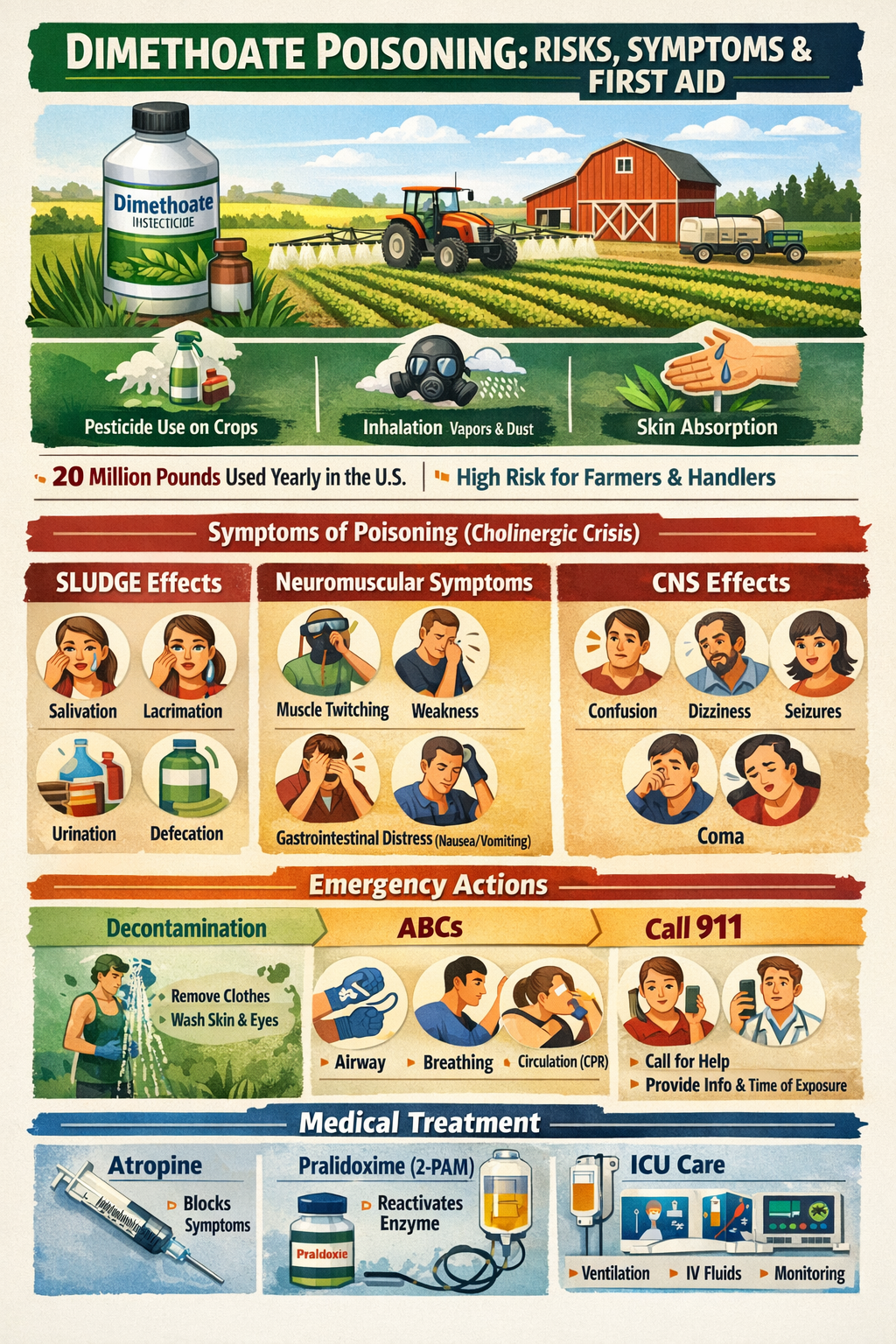
Workers mix it into sprays or dusts. Factories make it for wide use. About 20 million pounds get applied yearly in the U.S., per EPA data. That means exposure risks for handlers and bystanders. Accidents happen during storage or spills. Kids or pets can get into it easily if not locked away.
2. Primary Pathways for Human Absorption
Skin contact tops the list for how dimethoate gets in. It soaks through fast, especially if your skin is wet or cut. Although it is recommended to wear gloves, many people choose not to do so and suffer the consequences.
Breathing comes next. Vapors or mist from spraying fill the air. This route hits lungs quickly and spreads to blood. Swallowing ranks as the most direct. Contaminated food or an accidental gulp from a bottle. It’s rare but deadly. All paths lead to the same nerve chaos. Dermal stays the biggest worry in fields.
3. Latency Period and Initial Subtle Signs
Symptoms don’t hit right away. You might wait minutes to hours after touch. Low doses bring mild hints like a runny nose or sweaty skin. As levels rise, the crisis builds. Think of it like a storm gathering force. Early clues include blurred vision or a tight chest. Farmers often brush these off as heat or fatigue. But ignoring them speeds up the danger. Watch for patterns if you’ve been near sprays.
Recognizing the Symptoms of Dimethoate Poisoning (Cholinergic Crisis)
1. Muscarinic Effects: SLUDGE Syndrome Detailed
Muscarinic signs come from overactive glands and smooth muscles. Salivation ramps up first. Your mouth floods with spit you can’t control. Lacrimation means tears stream down without reason. Eyes burn and water nonstop. Urination follows. You feel a sudden, urgent need to go, even if your bladder is empty.
Defecation hits hard too. Loose stools or cramps twist your gut. Gastrointestinal woes add nausea and vomiting. “Emesis” means puking, often violent. The SLUDGE mix leaves you weak and messy. It’s your body’s alarm for help. These show up in minutes for big exposures. Smaller ones build over time. Don’t wait, just act on the first clue.
2. Nicotinic Effects: Neuromuscular Manifestations
Nicotinic symptoms target your skeletal muscles. Twitching starts small, like eye flutters. Then fasciculations spread to arms and legs. Weakness creeps in next. You can’t grip tools or stand steady. Cramps knot your calves or back.
In bad cases, paralysis sets in. Chest muscles fail, making breaths shallow. That’s when things turn life-threatening. Respiratory arrest can follow. Picture your body locking up mid-task. Farmers report similar symptoms after spills. It mimics a stroke but feels widespread.
3. Central Nervous System (CNS) Symptoms: The Cognitive Impact
CNS effects cloud your mind. Anxiety spikes like a panic attack. Confusion muddles thoughts—you forget where you are. Headaches pound hard. Dizziness spins into the room. Seizures shake your whole frame in severe fits. Coma is at the end stage. Breathing slows to a stop. These brain signs often decide if you pull through. Prognosis is tied to how quickly you receive care. Early CNS trouble means higher risks. Always check for these alongside body signs.
Immediate First-Aid Measures: Stabilizing the Victim
1. Scene Safety and Decontamination: The First Priority
Safety comes before anything. Put on gloves, goggles, and a mask if you can. Approach only if the area is clear of spills. Remove wet clothes right away. Cut them off if stuck. Rinse skin with running water for 20 minutes at least.
For the eyes, flush with water or saline. Hold lids open wide. Do this nonstop till help arrives. Decon stops more poison from soaking in. It buys time for the body to fight. Skip this, and symptoms worsen quickly.
2. Managing Airway, Breathing, and Circulation (ABCs)
- Check the ABCs first. Is the airway open? Tilt the head back gently if there is no neck injury.
- Look for breathing. If weak, give rescue breaths. Two per 10 chest compressions if needed.
- Feel for a pulse. If absent, start CPR. Keep the victim flat and warm.
- Respiratory failure is common here. Watch for blue lips or gasps. These steps keep oxygen flowing till pros take over.
3. Essential Next Steps: Seeking Emergency Medical Services (EMS)
- Call 911 now. Tell them about organophosphate poisoning—mention Dimethoate if known.
- Stay with the person. Note the time of exposure. Grab any bottles or labels for the medics.
- Don’t give food or drink. It could spread the poison more. Transport fast to a hospital with antidotes.
- EMS knows the drill. They carry atropine kits sometimes. Your quick call saves minutes that count.
Medical Treatment Protocols for Severe Poisoning
1. Antidotal Therapy Part 1: Atropine Administration
- Atropine blocks the excess signals at muscarinic spots. It dries up spit and sweat fast. Docs start with 1-2 mg IV for adults.
- They double the dose if signs linger. The goal is a dry mouth and steady heart rate. It reverses bradycardia—the slow pulse from the poison.
- Watch for side effects like dry skin. But in a crisis, it’s a must. Atropine alone buys time, not a full fix.
2. Antidotal Therapy Part 2: Pralidoxime (2-PAM) and Oxime Reactivators
- Pralidoxime revives the blocked enzyme. It grabs the poison before it locks in tight. Give it early—within hours of exposure.
- The standard dose is 1-2 grams IV over 30 minutes. Follow with drips for ongoing fight. “Aging” happens after, making it useless.
- This duo—atropine plus pralidoxime—teams up best. Studies show better outcomes with both. Time is the enemy here.
3. Supportive Care and Monitoring in the Clinical Setting
- Support keeps the body stable. Ventilators help if breathing quits. IV fluids fight dehydration from puking.
- Seizures need benzos like diazepam. Heart monitors track rhythms. Blood tests check enzyme levels.
- Stay in the ICU for days if serious. Watch for rebounds. Full care turns most survivors around.
Medical Treatment Protocols for Severe Poisoning
1. Antidotal Therapy Part 1: Atropine Administration
- Atropine blocks the excess signals at muscarinic spots. It dries up spit and sweat fast. Docs start with 1-2 mg IV for adults.
- They double the dose if signs linger. The goal is a dry mouth and steady heart rate. It reverses bradycardia—the slow pulse from the poison.
- Watch for side effects like dry skin. But in a crisis, it’s a must. Atropine alone buys time, not a full fix.
2. Antidotal Therapy Part 2: Pralidoxime (2-PAM) and Oxime Reactivators
- Pralidoxime revives the blocked enzyme. It grabs the poison before it locks tight. Give it early—within hours of exposure.
- The standard dose is 1-2 grams IV over 30 minutes. Follow with drips for ongoing fights. “Aging” happens after making it useless.
- This duo—atropine plus pralidoxime—teams up best. Studies show better outcomes with both. Time is the enemy here.
3. Supportive Care and Monitoring in the Clinical Setting
- Support keeps the body stable. Ventilators help if breathing quits. IV fluids fight dehydration from puking.
- Seizures need benzos like diazepam. Heart monitors track rhythms. Blood tests check enzyme levels.
- Stay in the ICU for days if serious. Watch for rebounds. Full care turns most survivors around.
Long-Term Prognosis and Prevention Strategies
Understanding Organophosphate-Induced Delayed Neuropathy (OPIDN)
OPIDN can sneak up weeks later. Nerves in limbs get damaged slowly. Weakness starts in the feet and climbs. You might limp or drop things. It’s a deep hit from the poison. Not all cases get it, but risks rise with big doses. Recovery takes months. Physio helps rebuild strength. Docs test nerves to spot it early.
Prevention in Agricultural and Domestic Settings
- Store dimethoate high and locked. Use childproof caps always. Label everything clearly.
- Wear full gear—long sleeves, pants, and boots. Calibrate sprayers to avoid drifts. Wait out reentry times, often 24-48 hours of post-spray.
- In homes, skip it for safer options. Train workers on spills. These habits cut risks sharply.
Conclusion: Vigilance Against Organophosphate Toxicity
Dimethoate poisoning shows through muscarinic, nicotinic, and CNS signs. SLUDGE hits glands, twitching grips muscles, and confusion clouds the brain. Spot them early so they act. First aid demands quick decon and ABC checks. Call EMS with details for antidotes like atropine and pralidoxime. The final step is to provide support for care. Stay alert around these chemicals. Safe habits prevent most cases.
- Identification Details:
It shares data such as product identifiers, and manufacturer or supplier details along with their address.
- Hazards Identification:
This document also shared details on hazard classification, signal words, and hazard and precautionary statements.
- Composition or Ingredients: An SDS shares details on chemical ingredients, including hazardous components and some other relevant information.
- First Aid Measures: Users can also find some useful first-aid measures that allow them to handle emergencies.
- Fire-Fighting Measures: Employees of a facility have suitable extinguishing techniques, and understand all the hazards from combustion products.
- Accidental Release Measures: It shares helpful emergency procedures, containment methods, and cleanup procedures for the employees.
- Handling and Storage: Users can also find precautions for safe handling and storage, including the incompatibilities of the chemicals, the ideal storage conditions, and packaging materials.
- Exposure Controls or Personal Protection: An employee can also find details on appropriate engineering controls, personal protective equipment (PPE), and exposure limits.
- Physical and Chemical Properties: Knowing the physical state, appearance, odor, pH, melting point, boiling point, flashpoint, vapor pressure, etc. is possible from this document.
- Stability and Reactivity: Chemical stability, and the possibility of hazardous reactions are also crucial for users to know to stay safe.
- Toxicological Information: It shares all the possible routes of exposure, acute or chronic effects, symptoms of exposure, and toxicity data.
- Ecological Information: The users can also find ideas about the product’s capacity to damage the environment.
- Disposal Considerations: It shares some appropriate disposal methods for hazardous products also along with disposal considerations, and waste treatment methods.
- Transport Information: All the transport precautions are vital and users can find information in detail.
- Regulatory Information: Employees will also know all the safety, health, and environmental regulations by going through this document.
Simplify Your SDS Management
CloudSDS gives your team instant access to 23M+ safety data sheets with AI-powered search, automated updates, and full OSHA/GHS compliance — all from one platform.
CloudSDS’s SDS search is the easiest way to find out the required SDS in seconds. It can conducted by following the below steps easily:
-
Free Account Creation:
Users must sign up first to create a free account to view and download all of the SDSs or to get access to CloudSDS’s Global SDS repository.
-
Easy Search:
Start the search by entering either the product name or other data fields such as manufacturer name, and CAS number. In case you have the complete details of the product, enter all the details and start your search to find the specific product.
-
Advanced SDS Search:
Users can also take advantage of an advanced search that helps narrow down the entire process. Take advantage of an advanced search option to reduce the total number of search results.
Find Any SDS in Seconds
Search 23M+ safety data sheets by product name, manufacturer, or CAS number — free and instant.
A safety data sheet or SDS has the following benefits:
-
Provides Safety Information:
It offers important details regarding the dangers of chemicals. In this way, it aids people in comprehending possible concerns related to their handling, disposal, storage, and use. Additionally, it offers some particular safety advice.
-
Regulatory Compliance:
This document is necessary as proof to stay compliant with all legal requirements. After all, it contains not just hazard information but also safety tips.
-
Employee Training:
It is also required to train employees on how to handle hazardous chemicals. Besides, its tips on emergency control allow workers to save themselves and their colleagues from chemical exposures.
-
Emergency Preparations:
SDSs contain instructions for responding to chemical spills, leaks, fires, and exposure incidents. It also shares tips on taking prompt and effective emergency response actions.
Simplify Your SDS Management
CloudSDS gives your team instant access to 23M+ safety data sheets with AI-powered search, automated updates, and full OSHA/GHS compliance — all from one platform.
The chemical inventory list includes the details of all the chemicals that any manufacturing facility uses. It’s mainly a comprehensive catalog with details of all the chemicals stored or used on-site, along with relevant safety information.
The following details should be included in a complete chemical inventory list:
- Chemical Name: The chemical’s common name, scientific name, synonyms, and trade names should be mentioned in the list.
- Quantity: It must have information on the amount of each chemical currently in stock or stored at the facility.
- Location: The specific storage location should also be shared in this list for the users or workers.
- SDSs: All the relevant safety data sheets should be included here with hazard information and handling precautions.
- Expiration Date: The expiration date of the chemicals must be mentioned if applicable.
- Usage Information: Details about how the chemicals should be used in the workplace must be included here.
- Regulatory Compliance: This should also include information about the legal requirements for the handling, labeling, storage, and disposal of hazardous chemicals.
- Emergency Contact Details: Contact details for emergency response personnel or departments should also be included to tackle chemical spills, leaks, or accidents.
Simplify Your SDS Management
CloudSDS gives your team instant access to 23M+ safety data sheets with AI-powered search, automated updates, and full OSHA/GHS compliance — all from one platform.
Facilities need to rely on a proper technique to handle the chemical inventory. Check out the following details to know more about the process.
-
Identification and Documentation:
The process begins by identifying all hazardous chemicals present in the workplace. Therefore, you need to maintain a comprehensive inventory list. The list must include the names of the chemicals, and quantities, and also should share the locations where they are stored. Keeping the relevant safety data also makes the process more accurate.
- Labeling and Segregation:
To properly manage all your chemical inventory ensure that all chemical containers are properly labeled. These container labels should also display clear and accurate information about the contents. The labeling is only complete when it includes all the hazard information along with the right pictograms.
- Storage and Handling:
You must understand the importance of storing chemicals in designated areas. The place has to be well-ventilated, secure, and equipped with appropriate safety measures. It’s also important to follow manufacturer instructions and regulatory guidelines for the sake of proper handling and storage practices.
- Regular Inspections and Audits:
It’s vital to conduct proper and thorough regular inspections of chemical storage areas. Why? It will help identify potential hazards, leaks, or safety issues. Therefore, facilities must perform audits of the chemical inventory daily to ensure effective chemical safety management.
- Taking Help of Software:
To simplify the process take the help of chemical inventory management software. This software helps track chemical usage details along with reports and analysis. Moreover, auto tracks the inventory which reduces time and improves overall efficiency.
- Regular Updates:
Regular review and updates are also necessary. Therefore, organizations must maintain the inventory list to reflect changes in the inventory levels. Thus, updating new chemical acquisitions, or updates to safety regulations is possible which helps manage the inventory.
Simplify Your SDS Management
CloudSDS gives your team instant access to 23M+ safety data sheets with AI-powered search, automated updates, and full OSHA/GHS compliance — all from one platform.
Simplify Your SDS Management
CloudSDS gives your team instant access to 23M+ safety data sheets with AI-powered search, automated updates, and full OSHA/GHS compliance — all from one platform.
Leave A Comment