
Last Updated on March 31, 2026
Laboratories handle dangerous chemicals every day. One wrong move with a hazardous substance can lead to injuries, fines, or worse. Safety Data Sheets, or SDS sheets, stand as the key tool to prevent these risks. They give clear info on hazards, safe handling, and emergency steps. In 2026, rules have tightened, making full compliance a must for every lab worker's safety.
New updates to the Globally Harmonized System, or GHS, push labs to refine their SDS management. OSHA inspections now zero in on quick access to these documents during drills or real events. This guide lays out a clear path. You'll learn the rules, how to build solid SDS files, and steps to stay ready for checks. Follow it to protect your team and avoid costly slip-ups.
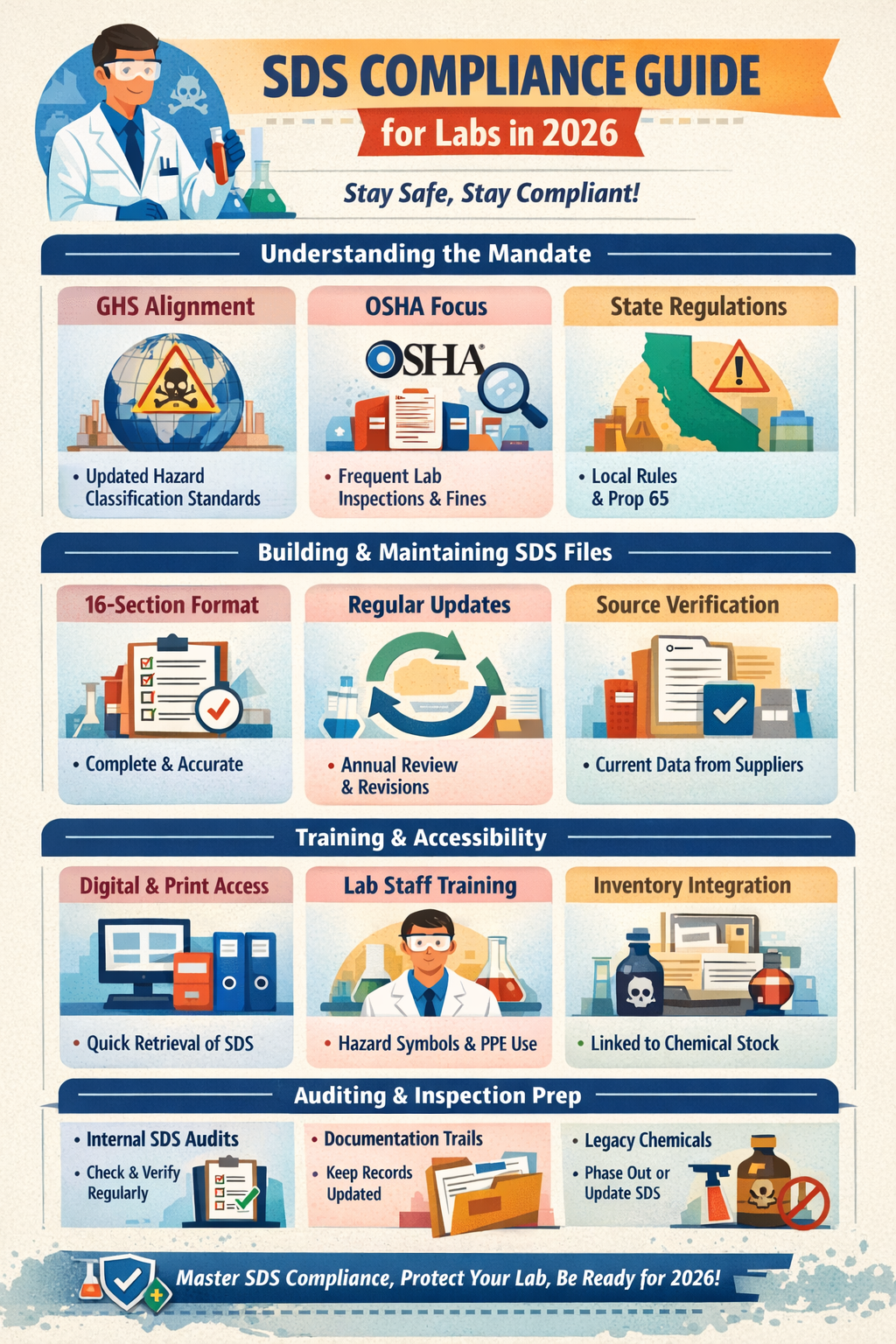
Understanding the Mandate: GHS, OSHA, and SDS Requirements in 2026
Labs must follow strict rules on chemical safety. These come from global and U.S. standards. SDS sheets tie it all together.
Section 1: The Core of Hazard Communication: GHS Alignment and Updates
GHS sets a worldwide standard for chemical labels and data sheets. It uses a 16-section format for SDS sheets. This helps everyone speak the same language about risks.
Section 1 covers product details and supplier info. Section 2 lists hazards with pictograms and words like "danger." By 2026, minor tweaks focus on better clarity for skin sensitizers and carcinogens. Labs need to update their SDS sheets to match these changes. Check for new signal words that flag explosive risks more sharply.
This format cuts confusion in mixed teams. A clear SDS sheet can save time in a spill cleanup.
-
OSHA's Role and Enforcement Focus for Laboratory Settings
OSHA oversees U.S. labs through its Hazard Communication Standard, or HazCom, as outlined in 29 CFR 1910.1200. It demands that SDS sheets stay current and easy to grab.
In 2026, OSHA ramps up checks on lab SDS access. They look for docs that match actual chemicals on hand. Recent reports show fines hit $14,000 per violation when SDS sheets lack key exposure limits. Labs face more surprise visits now. Keep SDS sheets in plain sight near storage areas. This meets OSHA's push for real-time safety.
-
State and Local Variations Beyond Federal Mandates
Federal rules set the base, but states add their own layers. California's Prop 65 lists extra chemicals that need warnings on SDS sheets. New York requires detailed inventory reports tied to these documents. Some cities demand SDS sheets in multiple languages for diverse workers. Always blend these with OSHA standards. Miss one, and you risk double penalties. Check federal and state updates every three months. Use a simple spreadsheet to track changes in your chemical list. This ensures your lab remains at the forefront.
Section 2: Creating and maintaining the 16-Section SDS Lifecycle
SDS sheets require ongoing attention and maintenance. You build them, verify them, and update them often. This cycle keeps your lab safe.
-
Sourcing Credible and Current SDS Information
Get SDS sheets straight from suppliers at first. But don't stop there—verify them inside your lab. Old MSDS formats lack GHS details and can lead to wrong choices. Think of a lab where an outdated sheet missed a new allergy risk. A tech picked up the wrong gloves and ended up in the ER. That cost time and trust. In 2026, suppliers must send GHS-compliant SDS sheets. Request them with every order. If there is a delay, please reach out to the manufacturer promptly. This avoids legal headaches down the line.
-
Critical Review: Section Verification for Laboratory Use
Not all SDS sheets fit every lab setup. Review key parts for your needs. Section 2 spells out hazards like flammability or toxicity. Section 8 details PPE, such as respirators for vapors. But if you heat a chemical, add notes on extra gear. Section 14 covers shipping rules, vital for moving samples. Compare these sections with your processes. Does the SDS sheet warn about mixing risks? Add internal tags if needed. This makes the doc truly useful. Regular checks for spot gaps. They turn generic info into lab-specific gold.
-
Managing SDS Updates and Revision Tracking
Suppliers revise SDS sheets when new data comes out. You must swap in the fresh version fast. While there is no established "three-year rule," it is advisable to review all SDS sheets annually. Track changes with a log: note the date and version for each. Digital tools make this easy. Scan old ones into archives. If a supplier skips notice, your audit catches it. Stay on top to dodge fines. Fresh SDS sheets mean better protection every day.
Section 3: Accessibility and Training: The Human Element of SDS Compliance
SDS sheets do no benefit if no one can locate or read them. Make access simple and teach your team well. This builds a safety-first culture.
-
Digital vs. Hard Copy: Establishing Primary Access Points
Go digital for speed—cloud apps let you search SDS sheets by chemical name. But keep printed binders as a backup. Power outages hit labs hard during emergencies. Electronic systems cut lookup time to seconds. Studies show poor setups waste up to five minutes in crises. That's too long when seconds count. Pick a mix that fits your lab size. Test it in drills. Reliable access saves lives.
-
Tailoring SDS Training to Laboratory Personnel
Simply having access is not sufficient. Train staff to interpret pictograms, such as the flame symbol for fire risks. Cover signal words: "Warning" means caution; "danger" screams "stop." Research techs need deep dives into Section 8 PPE. Cleaners learn the basics of waste handling. Hold sessions twice a year. The National Safety Council suggests hands-on practice. Role-play a spill scenario using the SDS sheet. This sticks better than lectures. Your team will spot hazards quick.
-
Integration with Chemical Inventory Management (CIM) Systems
Link SDS sheets to your inventory list. Each bottle label should match its doc. Scan barcodes to pull up the right file. This setup flag expired. In stock. No more guessing on shelf life. In 2026, OSHA praises labs with tight CIM ties. Update the system when new chemicals arrive. It keeps everything in sync. Smooth operations follow.
Section 4: Auditing, Documentation, and Preparing for 2026 Inspections
Audits keep you sharp. Prepare now for smooth sailing during checks. Document every step.
Conducting Routine Internal SDS Compliance Audits
Run; check yourself first. Ask: Does every chemical have an SDS sheet? Do labels align? Time how fast you locate one—aim under 30 seconds. Check if all 16 sections are complete.
- List all stored chemicals.
- Verify that SDS matches the label.
- Test access in dark or noisy spots.
Do it every six months. Bring in a fresh eye, like a consultant. It uncovers blind spots.
Documentation Trails: Proving Due Diligence
Save more than SDS sheets. Keep training logs with signatures. Note when you got updates from suppliers. File exposure reports linked to chemicals. This proves you act on information. OSHA wants a paper trail. Digitize it all for easy pulls. A solid record shields you in reviews. It shows real care.
Handling GHS Transitions and Legacy Chemical Management
Old chemicals might lack GHS SDS sheets. Hunt for updated ones from makers. If none exists, phase them out safely. Contact experts for disposal guides. Don't store without proper docs. This clears the risks. For keepers, create bridge notes in GHS format. Follow EPA guidelines for a safe end. Clean stock means fewer worries.
Conclusion: Future-Proofing Laboratory Safety Through SDS Mastery
Mastering SDS sheets turns safety into habit. It's not a one-off chore—treat it as daily work. Accurate docs link straight to fewer accidents and strong defenses. This guide arms you with rules, steps, and tips for 2026 compliance. From GHS basics to audit checklists, you've got the tools. Start today. Set up digital tracking and fresh training. Your lab will thrive, safe and sound, through the year and beyond.
- Identification Details:
It shares data such as product identifiers, and manufacturer or supplier details along with their address.
- Hazards Identification:
This document also shared details on hazard classification, signal words, and hazard and precautionary statements.
- Composition or Ingredients: An SDS shares details on chemical ingredients, including hazardous components and some other relevant information.
- First Aid Measures: Users can also find some useful first-aid measures that allow them to handle emergencies.
- Fire-Fighting Measures: Employees of a facility have suitable extinguishing techniques, and understand all the hazards from combustion products.
- Accidental Release Measures: It shares helpful emergency procedures, containment methods, and cleanup procedures for the employees.
- Handling and Storage: Users can also find precautions for safe handling and storage, including the incompatibilities of the chemicals, the ideal storage conditions, and packaging materials.
- Exposure Controls or Personal Protection: An employee can also find details on appropriate engineering controls, personal protective equipment (PPE), and exposure limits.
- Physical and Chemical Properties: Knowing the physical state, appearance, odor, pH, melting point, boiling point, flashpoint, vapor pressure, etc. is possible from this document.
- Stability and Reactivity: Chemical stability, and the possibility of hazardous reactions are also crucial for users to know to stay safe.
- Toxicological Information: It shares all the possible routes of exposure, acute or chronic effects, symptoms of exposure, and toxicity data.
- Ecological Information: The users can also find ideas about the product’s capacity to damage the environment.
- Disposal Considerations: It shares some appropriate disposal methods for hazardous products also along with disposal considerations, and waste treatment methods.
- Transport Information: All the transport precautions are vital and users can find information in detail.
- Regulatory Information: Employees will also know all the safety, health, and environmental regulations by going through this document.
Simplify Your SDS Management
CloudSDS gives your team instant access to 23M+ safety data sheets with AI-powered search, automated updates, and full OSHA/GHS compliance — all from one platform.
CloudSDS’s SDS search is the easiest way to find out the required SDS in seconds. It can conducted by following the below steps easily:
-
Free Account Creation:
Users must sign up first to create a free account to view and download all of the SDSs or to get access to CloudSDS’s Global SDS repository.
-
Easy Search:
Start the search by entering either the product name or other data fields such as manufacturer name, and CAS number. In case you have the complete details of the product, enter all the details and start your search to find the specific product.
-
Advanced SDS Search:
Users can also take advantage of an advanced search that helps narrow down the entire process. Take advantage of an advanced search option to reduce the total number of search results.
Find Any SDS in Seconds
Search 23M+ safety data sheets by product name, manufacturer, or CAS number — free and instant.
A safety data sheet or SDS has the following benefits:
-
Provides Safety Information:
It offers important details regarding the dangers of chemicals. In this way, it aids people in comprehending possible concerns related to their handling, disposal, storage, and use. Additionally, it offers some particular safety advice.
-
Regulatory Compliance:
This document is necessary as proof to stay compliant with all legal requirements. After all, it contains not just hazard information but also safety tips.
-
Employee Training:
It is also required to train employees on how to handle hazardous chemicals. Besides, its tips on emergency control allow workers to save themselves and their colleagues from chemical exposures.
-
Emergency Preparations:
SDSs contain instructions for responding to chemical spills, leaks, fires, and exposure incidents. It also shares tips on taking prompt and effective emergency response actions.
Simplify Your SDS Management
CloudSDS gives your team instant access to 23M+ safety data sheets with AI-powered search, automated updates, and full OSHA/GHS compliance — all from one platform.
The chemical inventory list includes the details of all the chemicals that any manufacturing facility uses. It’s mainly a comprehensive catalog with details of all the chemicals stored or used on-site, along with relevant safety information.
The following details should be included in a complete chemical inventory list:
- Chemical Name: The chemical’s common name, scientific name, synonyms, and trade names should be mentioned in the list.
- Quantity: It must have information on the amount of each chemical currently in stock or stored at the facility.
- Location: The specific storage location should also be shared in this list for the users or workers.
- SDSs: All the relevant safety data sheets should be included here with hazard information and handling precautions.
- Expiration Date: The expiration date of the chemicals must be mentioned if applicable.
- Usage Information: Details about how the chemicals should be used in the workplace must be included here.
- Regulatory Compliance: This should also include information about the legal requirements for the handling, labeling, storage, and disposal of hazardous chemicals.
- Emergency Contact Details: Contact details for emergency response personnel or departments should also be included to tackle chemical spills, leaks, or accidents.
Simplify Your SDS Management
CloudSDS gives your team instant access to 23M+ safety data sheets with AI-powered search, automated updates, and full OSHA/GHS compliance — all from one platform.
Facilities need to rely on a proper technique to handle the chemical inventory. Check out the following details to know more about the process.
-
Identification and Documentation:
The process begins by identifying all hazardous chemicals present in the workplace. Therefore, you need to maintain a comprehensive inventory list. The list must include the names of the chemicals, and quantities, and also should share the locations where they are stored. Keeping the relevant safety data also makes the process more accurate.
- Labeling and Segregation:
To properly manage all your chemical inventory ensure that all chemical containers are properly labeled. These container labels should also display clear and accurate information about the contents. The labeling is only complete when it includes all the hazard information along with the right pictograms.
- Storage and Handling:
You must understand the importance of storing chemicals in designated areas. The place has to be well-ventilated, secure, and equipped with appropriate safety measures. It’s also important to follow manufacturer instructions and regulatory guidelines for the sake of proper handling and storage practices.
- Regular Inspections and Audits:
It’s vital to conduct proper and thorough regular inspections of chemical storage areas. Why? It will help identify potential hazards, leaks, or safety issues. Therefore, facilities must perform audits of the chemical inventory daily to ensure effective chemical safety management.
- Taking Help of Software:
To simplify the process take the help of chemical inventory management software. This software helps track chemical usage details along with reports and analysis. Moreover, auto tracks the inventory which reduces time and improves overall efficiency.
- Regular Updates:
Regular review and updates are also necessary. Therefore, organizations must maintain the inventory list to reflect changes in the inventory levels. Thus, updating new chemical acquisitions, or updates to safety regulations is possible which helps manage the inventory.
Simplify Your SDS Management
CloudSDS gives your team instant access to 23M+ safety data sheets with AI-powered search, automated updates, and full OSHA/GHS compliance — all from one platform.
A Hazardous Chemical Inventory is a comprehensive list or database that provides detailed information about the hazardous chemicals present in a facility. From this inventory, users can find data on the names and quantities of chemicals. Additionally, it shares the chemical’s locations within the facility, associated hazards, storage requirements, and some relevant safety precautions.
According to OSHA, facilities need to maintain an inventory of this type to ensure effective chemical safety management and public safety. It also helps handle emergencies and mitigate risks to the health and safety of workers and the environment.
Simplify Your SDS Management
CloudSDS gives your team instant access to 23M+ safety data sheets with AI-powered search, automated updates, and full OSHA/GHS compliance — all from one platform.
One glance at the current market size of the SDS management software reveals how businesses are feeling its requirements. That’s why the market value is expected to reach USD 90-133 billion by 2030 with a CAGR of 24-30%. This suggests that facilities will have a wide range of options to select from when determining which is best for their particular needs. What precisely should they search for? To streamline workflows and improve efficiency, finding the best SDS management software is the key.
Simplify Your SDS Management
CloudSDS gives your team instant access to 23M+ safety data sheets with AI-powered search, automated updates, and full OSHA/GHS compliance — all from one platform.
Simplify Your SDS Management
CloudSDS gives your team instant access to 23M+ safety data sheets with AI-powered search, automated updates, and full OSHA/GHS compliance — all from one platform.
Leave A Comment